From 'The Government Will Provide' to 'Respond to Ageing Together': 40 Years of China's Pension Slogans
A timeline graphic tracing four decades of retirement slogans — from 'Have one child, the government will provide for your old age' to today's 'actively respond to population ageing' — became one of the week's most shared posts, because each change of wording marks a policy reversal Chinese families lived through personally.
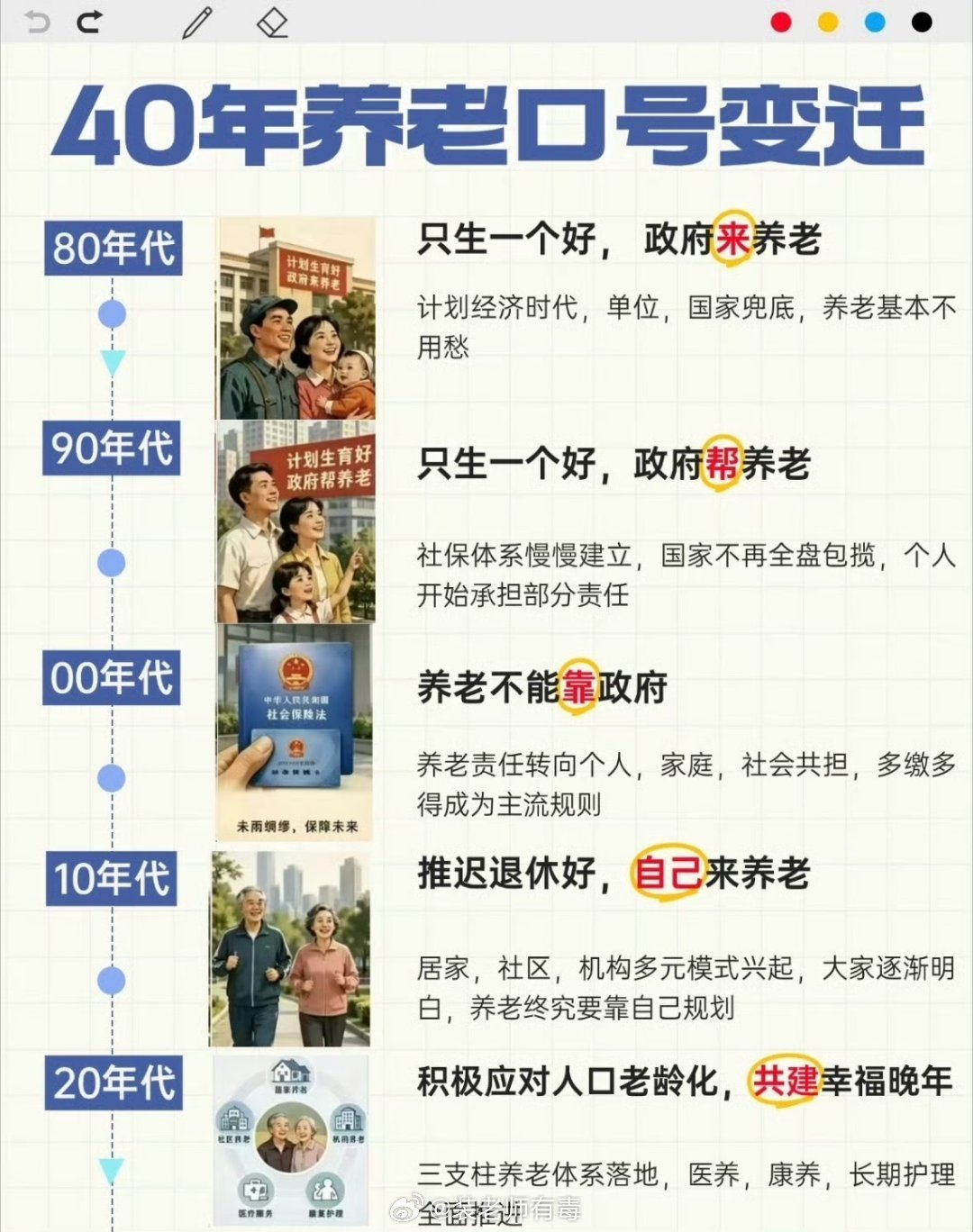
The post is nothing but a picture: five decades of official slogans about old age, arranged as a vertical timeline, liked more than 9,000 times since it went up. But the reason "40 years of pension slogan changes" trended on Monday is that every line on it records a promise adjusted — and the people doing the adjusting are, in many cases, the people who will have to live with the result.
It starts in the 1980s, at the height of the one-child policy: "Have only one child, and the government will provide for your old age" (只生一个好,政府来养老). The message then was a bargain — one child per family, and the state stands behind the outcome. By the 2000s the bargain had been re-papered with institutions; the timeline's section for that decade centers on the Social Insurance Law, the statute that replaced an implicit promise with pooled funds and individual contributions. The 2010s shifted the wording from provision to participation, and by the 2020s the state's line has become "actively respond to population ageing, and jointly build a happy later life" (积极应对人口老龄化,共建幸福晚年). The verb has migrated: a government that once promised to provide now urges everyone to respond, jointly.
The commentary underneath was not nostalgic. The most-liked reply ran: "It shows we've grown strong — stronger and stronger, strong beyond measure. Be grateful~" — sarcasm doing the work of a compact history of how the shifting promise feels on the ground. China is midway through its first increase in the statutory retirement age in decades, a phased reform that will move men's retirement toward 63 and women's toward 55 and 58 over fifteen years, and the site has followed how much social insurance it actually takes to retire on 10,000 yuan a month. The graphic's viral moment lands in the middle of that argument.
The debate in the comments quickly got specific. At the bottom of the pyramid, rural residents' basic pension is barely more than 100 yuan a month at the national minimum, which is why one circulating proposal — raise rural pensions by age bracket: 1,000 yuan a month for the over-80s, 800 for the over-70s, 500 for the over-60s — drew its own shares under the timeline. The government, for its part, is simultaneously trying to make old age a growth industry, launching a 'filial piety' shopping season for the silver economy this month.
The word doing the heaviest lifting in the newest slogan is "jointly." After forty years of reworded promises, the argument underneath the trending graphic is precisely who that includes: the state, the family, or the individual now being asked to fund all three.