A 13-Year-Old's Korea Debut Collides With Her Parents' 3.45-Million-Yuan Wage Debt
A 13-year-old girl's debut in South Korea's idol industry should have been a good-news story. Within days, Weibo dug up court records showing her parents' education companies owe employees 3.45 million yuan in unpaid wages — and the fight over whether a child can be separated from her parents' debts is now one of the day's biggest topics.

The debut of a 13-year-old Chinese girl in South Korea's idol industry was announced as pure good news. Within days, Weibo users had dug into the family's business records — and found that companies run by Sheng Aijing's parents owe workers 3.45 million yuan in unpaid wages.
The paper trail, as assembled by commenters and confirmed in Chinese media reports: her mother's Beijing education company, Sofith Education, began falling behind on salaries in 2024. Labor arbitration produced an installment repayment plan that the company honored for three months before defaulting again. The father, who runs several education companies of his own, has separate court-enforcement records. Combined, the enforcement judgments against the couple come to roughly 3.45 million yuan.
Beijing Time, a state-linked news outlet, framed the arithmetic bluntly in a commentary video titled "Paving a Daughter's Path to Stardom With Workers' Sweat Money": an apology is worth less than paying the arrears. The video has been liked more than 44,000 times. The mother has apologized, saying her daughter has nothing to do with the debt dispute; a dance teacher close to the family has also spoken up, urging people to separate the adults' conduct from the child.
Then came the counter-current, from an unexpected quarter: the girl's own dance studio.
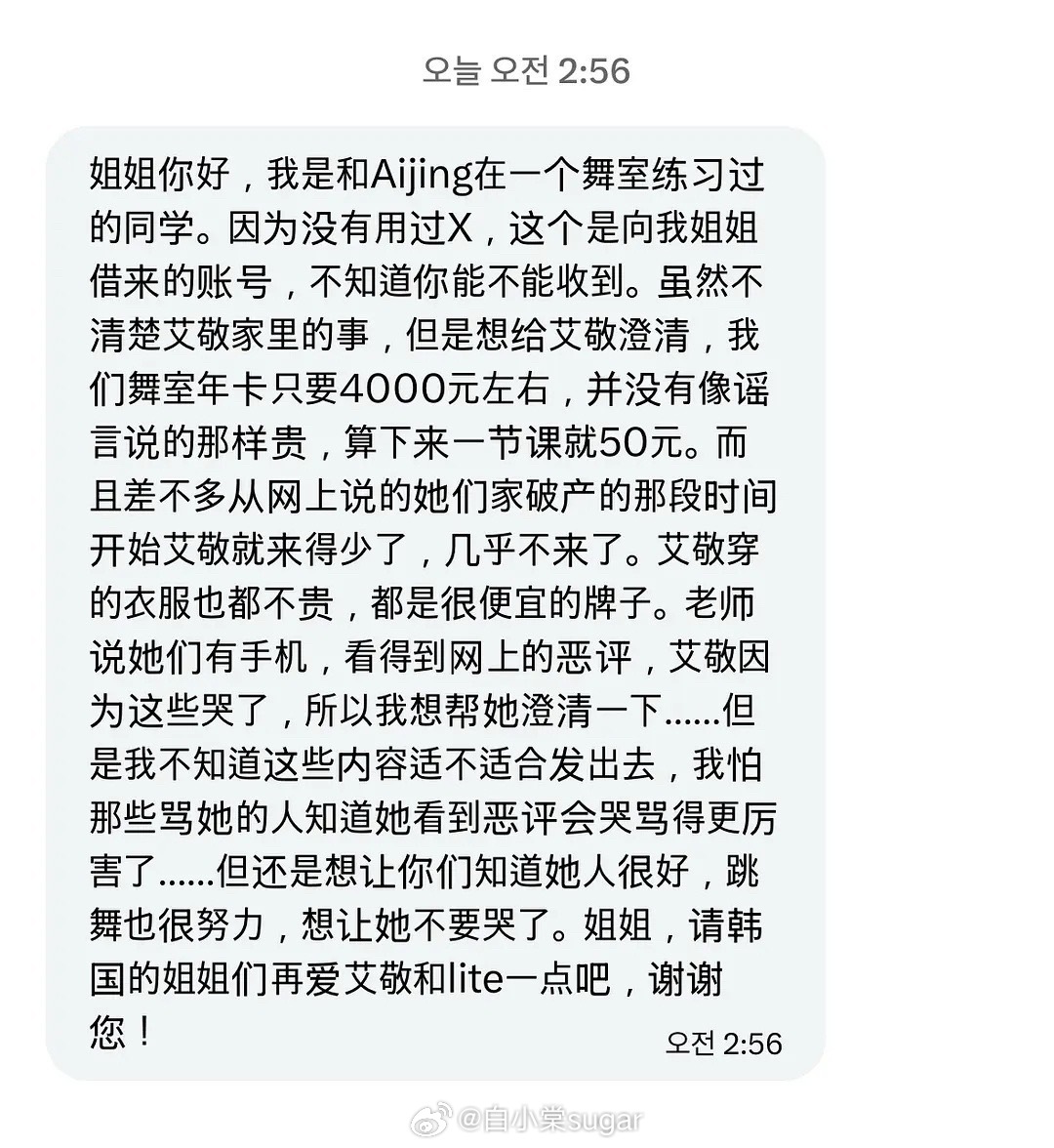
A classmate of Sheng Aijing's messaged a fan account at 2:56 a.m. Korean time to correct the most viral claim about the family — that the girl takes 5,000-yuan private dance lessons while her parents' employees go unpaid. "Our studio's annual card is only about 4,000 yuan, which works out to about 50 yuan a class," she wrote. Since the bankruptcy rumors began, the girl has almost stopped coming to the studio, wears cheap high-street brands, and "she can see the nasty comments online — she cries because of them." The classmate's own worry was specific: that if people learned she had seen the comments and cried, "they would only scold her harder. But I still want you to know she is a good person and works very hard at dancing." The message has been liked more than 27,000 times.
The dueling hashtags — #盛艾敬哭了# ("Sheng Aijing is crying") and #盛艾敬一节舞蹈课50元# ("a dance class for Sheng Aijing costs 50 yuan") — capture the collision. One camp invokes a legal maxim, 祸不及子女: misfortune should not extend to the children, and debts belong to the parents who incurred them. The other camp, echoing the Beijing Time commentary, argues that money talks in both directions: if the family had the funds to send a 13-year-old to Korea to debut, it had funds to pay its workers — "if you want your child to rise clean, first pay back clean." Some are unmoved by the studio defense: even a 50-yuan class, one reply argues, is money that could have gone to the workers first.
Child performers occupy an uneasy place in China's entertainment economy, where a debut's most perishable asset is a "clean" public image — one reason the schooling of the country's most-watched child influencer became a story of its own. A debutante's parents' conduct is now effectively part of her brand, and court-enforcement records are public and permanent in a way a fan-club apology is not.
As of Sunday, no new repayment plan had been published. The debut announcement remains online; the comments beneath it are split between fans sending support and people asking a simpler question first — about the 3.45 million yuan.