China's Economy Grew 4.6% Through the First Three Quarters, but the Recovery Is Splitting
State media distilled the year's economic report into six auspicious characters; a Caixin essay the same day argued the recovery is K-shaped, driven by factories and exports while consumption lags.
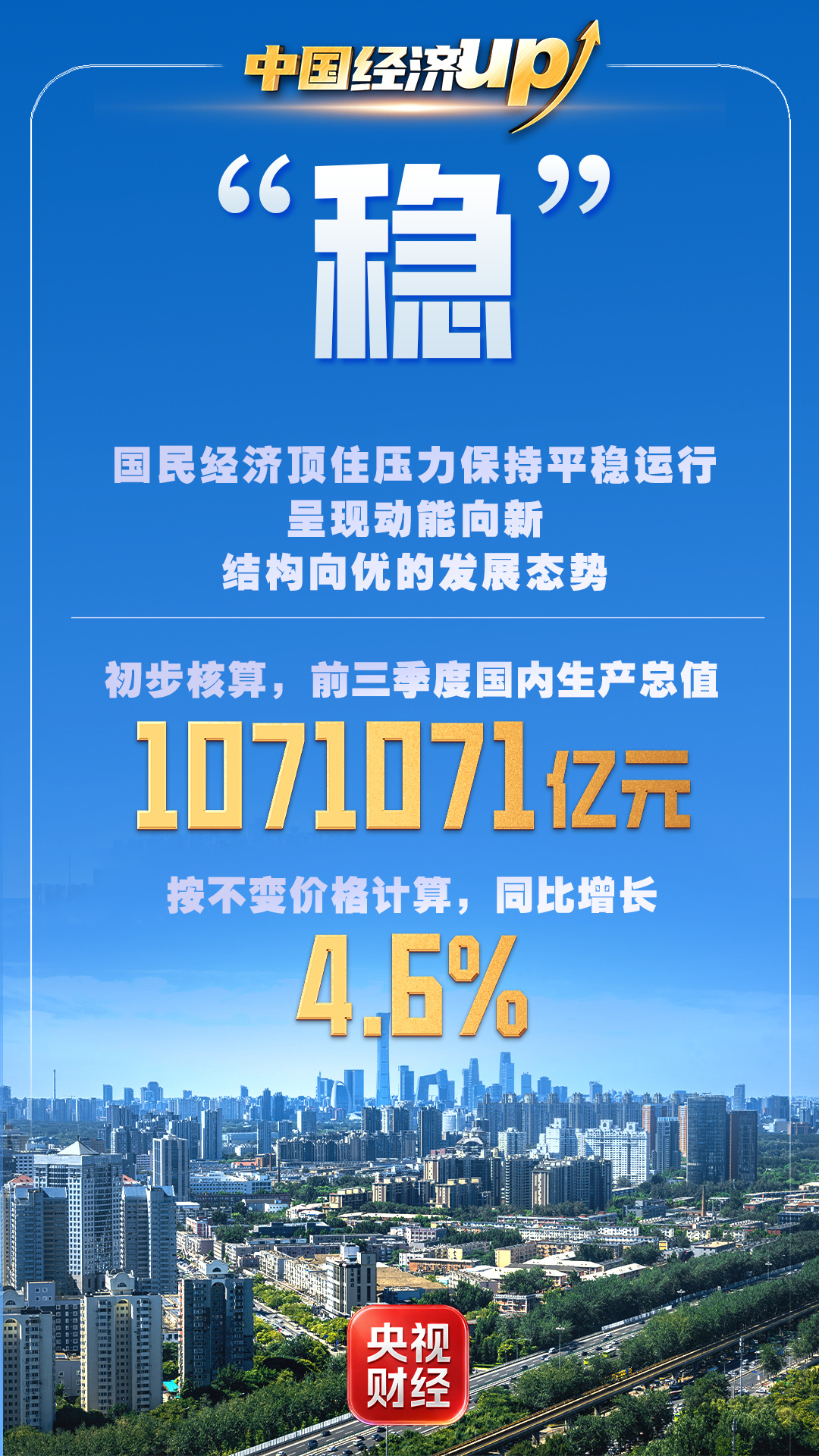
China's statistics bureau released the first three quarters' national accounts this week, and state media reached for shorthand: CCTV Finance offered six characters — 稳, 丰, 新, 好, 快, 优, roughly "stable, abundant, new, good, fast, excellent" — as the key to understanding the report. The topline supports the cheer: GDP for the first three quarters reached 107.1 trillion yuan, up 4.6 percent year on year, with the economy holding its pace despite continued pressure.
The details CCTV Finance chose to highlight say something about where the strength sits. Online retail of goods and services passed 15 trillion yuan, growing 4.4 percent. Total goods trade in and out of the country rose 18.8 percent — an extraordinary figure for a year when tariff walls have been rising elsewhere. Equipment manufacturing and high-tech manufacturing carried the industrial side, and the autumn grain harvest is expected to be abundant for another year. Global media took notice too; CCTV compiled the foreign coverage under the heading that "new-quality productive forces" had become the key growth driver, and Global Times noted that new growth engines now contribute more than 40 percent of the total, with imports growing markedly faster than exports.
The same day, though, Caixin published an essay with a different metaphor: 回升中的分化 — "recovery amid divergence." The economy, it argued, is K-shaped. The rebound so far is driven mainly by external demand and the production side — the factories, the ships, the export lines — while corporate investment and household consumption show only marginal improvement and remain weak overall. Growth has not yet transmitted down into business profits, hiring, and household confidence, and the fourth quarter will depend on existing policies actually being implemented and new ones arriving on time, with the priority on expanding effective demand and stabilizing expectations.
On Baidu's trending board, the companion item was a state-media explainer promising to explain the economy's "resilience and vitality" through nine data points — the same report, framed for optimism. On Weibo, ordinary readers did their own reading. "The engine has shifted from real estate to high-end manufacturing and technology," one user observed, adding that "the transition period itself is where the opportunity is." That is the optimistic version of the K: if you are plugged into the new engine, the numbers describe your life. The cautionary version is the other stroke of the K, where pay growth and spending confidence have yet to catch up.
The trade number ties into what we saw at the Canton Fair earlier this month, where exporters were showing precisely the upgraded goods behind the 18.8 percent figure.
The open question the report leaves is the one Caixin poses: whether production-side strength will finally reach pay packets and dinner tables in the fourth quarter, or whether China ends 2026 with a strong industrial economy and a hesitant household one.