Ten Years of China's Sky Eye: 1,300 Pulsars and a Plan to Multiply Its Vision by 200
China's FAST telescope marked ten years since completion with a milestone tally: more than 1,300 pulsars discovered, more than every other telescope combined over the same period, and an array upgrade promising 200-fold sharper resolution.
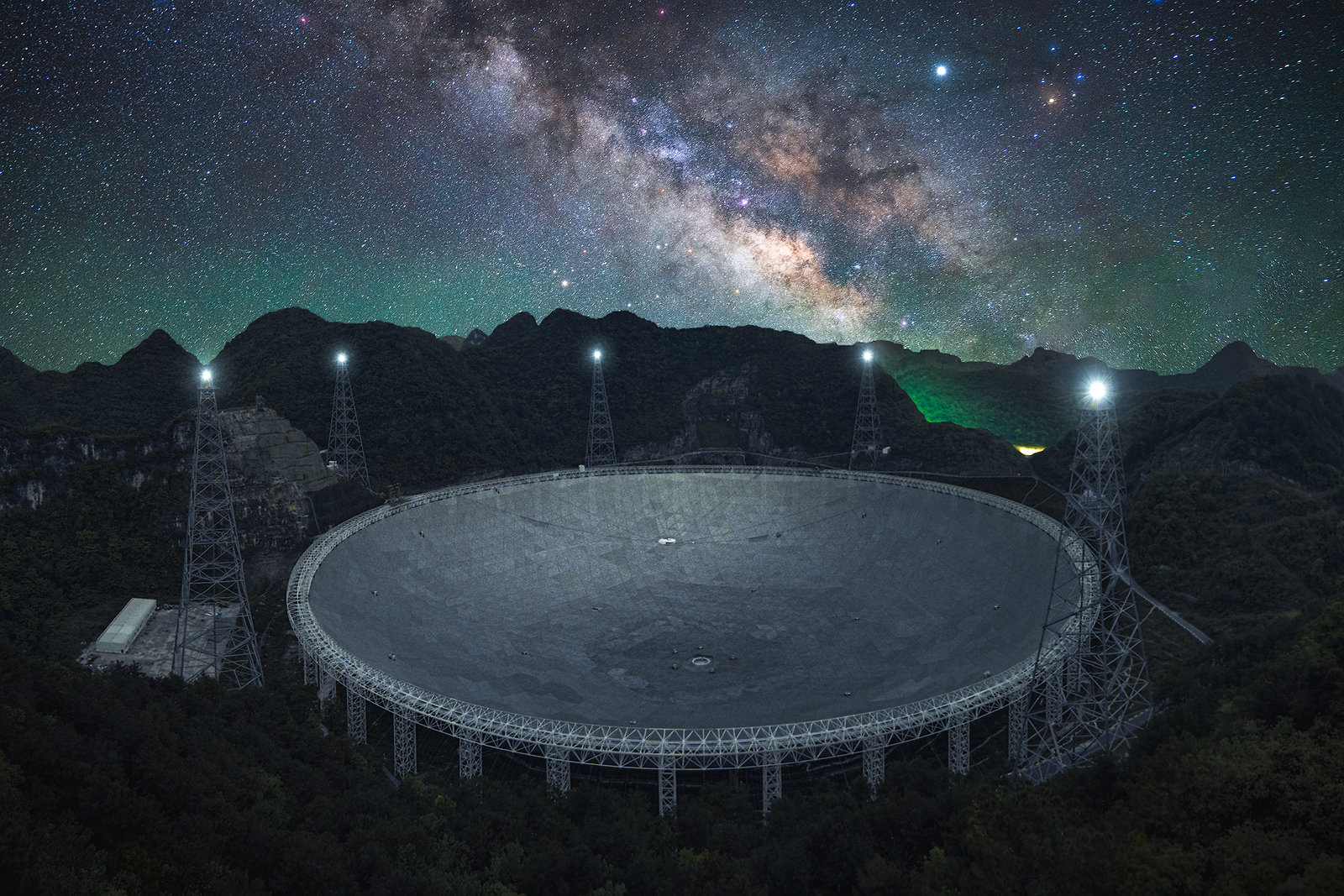
The world's largest single-dish radio telescope turned ten this week, and China marked the anniversary with a report card. FAST — the Five-hundred-metre Aperture Spherical Telescope, carved into a karst sinkhole in Guizhou province and nicknamed "China's Sky Eye" — has discovered more than 1,300 pulsars since it began operating, according to the anniversary coverage on CCTV and Baidu's trending board. That is more than all other telescopes worldwide combined over the same decade, a statistic that has become the standard shorthand for the dish's productivity.
Pulsars — the rapidly rotating corpses of massive stars, sweeping radio beams across the galaxy like lighthouses — are the currency of this kind of astronomy. They serve as precision clocks for testing general relativity, as navigation beacons for concepts of deep-space positioning, and, when found in tightly orbiting pairs, as natural laboratories for gravitational waves that no Earth-bound detector can match. FAST's sensitivity, roughly twice that of the retired Arecibo dish it quietly replaced as the field's reference instrument, is why its discovery ledger outpaces the rest of the world's combined; it has also logged fast radio bursts, the millisecond enigmas that remain one of astronomy's open questions.
The anniversary came with a maintenance milestone and a plan. CCTV reported that the dish has completed a full-scale overhaul — the first since its commissioning — and has resumed observations. The more consequential news is what comes next: engineers are moving FAST from a single eye toward an array, a composite "compound eye" built around the original dish that, according to Huanqiu's report, would lift resolution two hundredfold. A single dish, however enormous, sees coarsely; linking multiple dishes turns separate eyes into one virtual instrument the diameter of the spacing between them. For pulsar timing and mapping the Milky Way's magnetic anatomy, that is the difference between a portrait and a census.
The project's chief engineer, Jiang Peng, has framed the ten-year mark in characteristically austere terms — the overhaul, he said, could only succeed, not fail, since the telescope's science clock does not pause for repairs. The dish's operational culture is famously total: the surrounding five kilometres are an electromagnetic silence zone, staffed largely by villagers relocated during construction, and researchers rotate through in shifts because the radio-quiet nights cannot be spent twice.
For an international reader, the significance is less any single pulsar than the redistribution of fundamental astronomy. For most of radio astronomy's history, the field's reference instruments were American or European; the anniversaries that mattered were Arecibo's and Jodrell Bank's. FAST's decade — arriving amid China's broader build-out of scientific megafacilities, from the under-construction array to a new generation of neutrino and dark-matter detectors — marks the point where the world's most sensitive instrument for a whole class of cosmic questions sits permanently in Guizhou. The next decade's results, array-assisted, will say whether "most sensitive" becomes "most productive" on the same scale.