China's Slow Trains Now Have Women-Only Sleeper Compartments
A Zhejiang railway operator has rolled out women-only sleeper compartments on all five of its green-skin routes — six berths, a privacy curtain and an amenity box, bookable after boarding at no extra cost. The design is opt-in by accident, and it is starting an old argument again.
On the overnight trains of one small Chinese railway operator, some sleeper compartments now sell to women only. Zhejiang Jinwen Railway, which runs five conventional "green-skin" lines out of Wenzhou, has quietly rolled out women-only sleeper compartments across its fleet — bookable after boarding, at no extra charge, with a privacy curtain and an amenity box by way of ceremony.
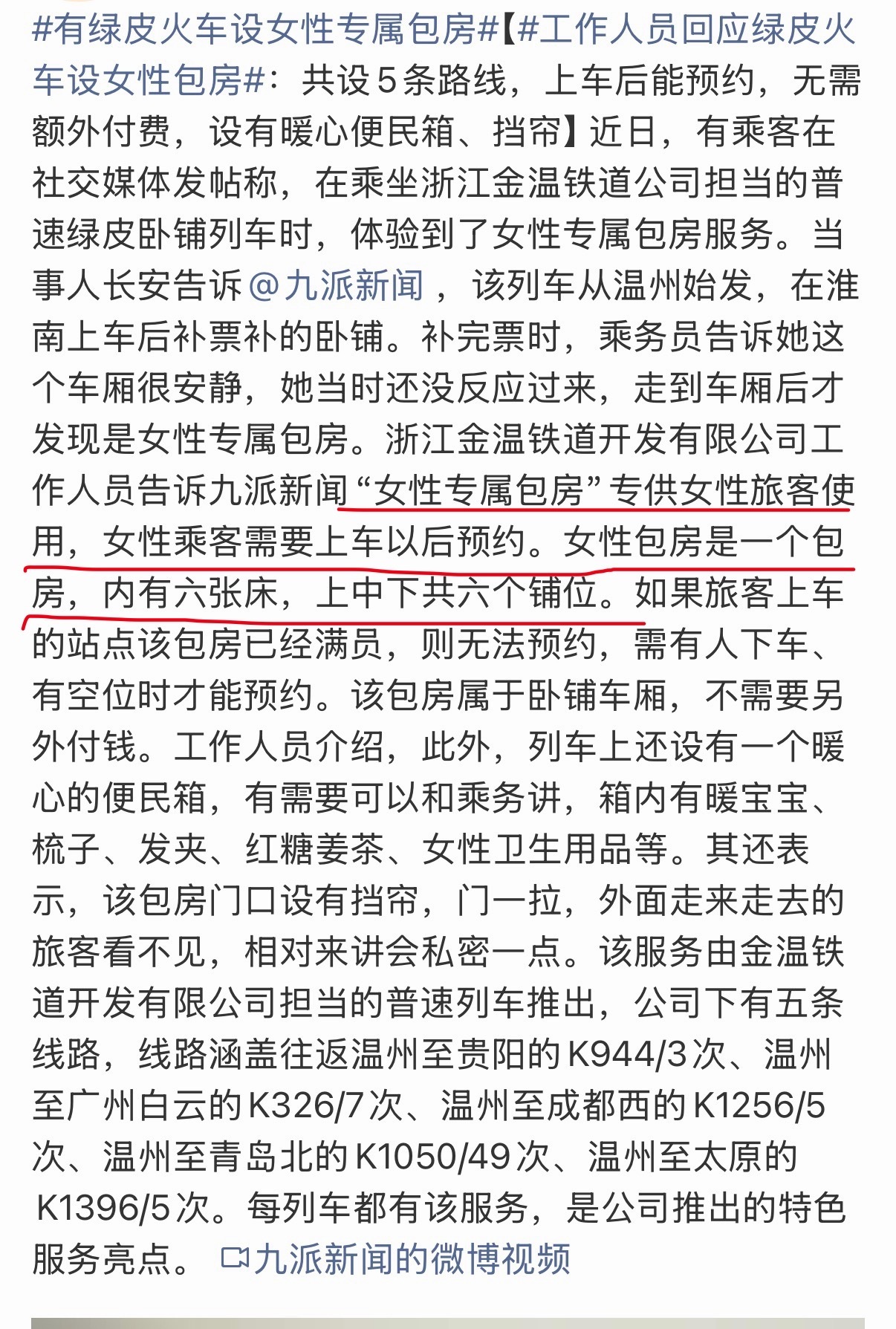
The mechanics are stranger than the idea. A women-only compartment holds six berths, three rows of upper, middle and lower. Passengers cannot reserve one in advance: you book after you board, and only if berths are still vacant, a design that keeps the space opt-in rather than officially segregated. If it fills, the next woman needing it waits for someone to alight. Staff told Jiupai News that each compartment has a curtain across its entrance — pull it and passing travellers see nothing — plus a "convenience box" holding heat patches, combs, hair clips, brown-sugar ginger tea and sanitary products. The service covers all five of the company's routes, including the K944 to Guiyang, the K326 to Guangzhou and the K1256 to Chengdu, overnight hauls of up to a day and a half.
The passenger whose social-media post started the coverage had boarded at Huainan and was buying her sleeper ticket on the train when the conductor told her, cryptically, that the carriage at the end was "very quiet". "I didn't realise until I walked to the carriage and saw it was women-only," she told Jiupai.
Green-skin trains are the cheap, slow workhorses of Chinese rail — hard seats, open sleeper compartments without doors, and journeys long enough that six strangers share a small room for a night or two. That intimacy is exactly why the compartment has caught on. Under screenshots of the coverage, one user recalled raising single-sex berths with a fellow passenger earlier this year and being told it was unrealistic; another rejoiced that the chance of smelling someone's cigarette had dropped by "99%".
There is a counter-argument, and it surfaced too: some women see reserved spaces as a retreat from public space rather than a fix for it. "But because this is a green-skin train," one commenter wrote, "I do think it's worth a pilot — it's a need born of real conditions, not an abstraction."
Zhejiang Jinwen presents the service as a highlight, not a policy. The state railway's own experiments with women-only facilities have never gone national, and no operator of this size has rolled the idea out across its whole network before. For now the experiment runs only as fast as its trains: bookable on boarding, curtained, and gone if nobody asks for it.