He Jiaolong, the Red-Cloaked Rider of Xinjiang's Tourism Boom, Dies; Her Mother Asks for No Statue
He Jiaolong, the Xinjiang official whose red-cloaked snowfield gallop made her the face of local-government tourism promotion, has died months after a January riding accident. A People's Daily memorial revealed her burial in a plain grave — and her mother's refusal to let anyone build a statue.
The memorial article ran in People's Daily on September 4 under the title "Daughter of the Tianshan," and one sentence from it topped Baidu's search board within a day. He Jiaolong, it reported, had been buried beside her father's grave — "clean she came, clean she went; the little earthen mound is very plain." When people proposed erecting a statue, her elderly mother refused: "Don't build a statue for her. Don't add a burden to the county."
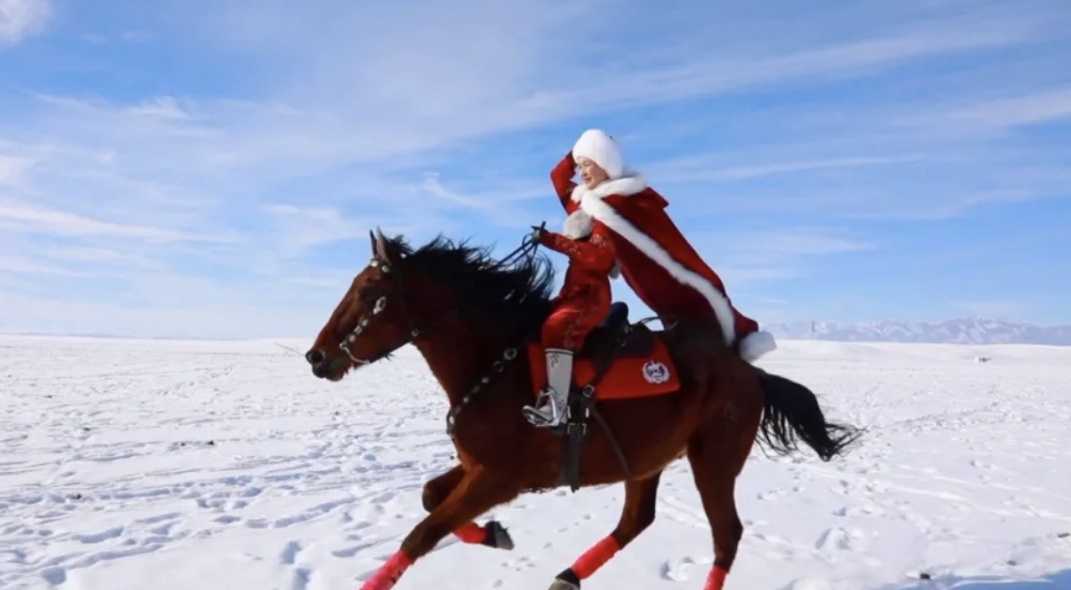
For many readers the name needed no reintroduction. He Jiaolong became one of the most recognizable faces of Chinese local-government promotion when a video of her galloping through snowfields in a red riding cloak — 鲜衣怒马, "bright silks and a spirited horse," as the idiom her admirers reached for has it — swept the internet. At the time she was a county tourism official in western Xinjiang; the clip was an advertisement for the region's winter scenery, and it worked, drawing millions of views and turning her into the public face of a phenomenon: officials who promote their localities not through press releases but by performing them on camera.
By the time of her death she had moved up to run agricultural branding for the Xinjiang region itself — head of the autonomous region's farm-product promotion center — and the persona carried over. In January she was thrown from a horse while working. For days rumors circulated that she had died; regional officials and reporters denied them, while noting that her condition was volatile. Colleagues told a Nanfang Daily reporter that her WeChat feed was still promoting agriculture-and-tourism projects from her hospital bed. One commenter spoke for many: "Really hoping this was just a false alarm."
It was not. The People's Daily piece — written by the author of her biography — confirms what the January denials held back, and it is the reason her name returned to the boards this week, this time in memorial.
The mother's refusal is the sentence the internet kept. It is a rejection with a long cultural pedigree: the modest grave, the insistence on not costing the public anything, the ideal of the official who arrives clean and leaves clean (洁来洁去). It also lands in a country that has spent recent years arguing about statuary — who gets monumentalized, and what a bronze figure says that a person's work should have said for itself. Against that argument, "don't add a burden to the county" read not as false modesty but as the final entry in the persona she had built: promotion, never self-promotion.
He Jiaolong's career sits at a particular moment in how China governs its image — the decade in which a county's marketing budget could matter less than whether its deputy head could ride a horse convincingly on camera, and in which officials built followings that outlasted their postings. Her last posting was, characteristically, a desk job selling farm goods. The image she leaves is the one from the video: a red cloak against the snow, and behind it, a plain grave beside her father's.