Pandas, Students, and a Trade Truce: What Xi's Washington Visit Actually Delivered
Beyond the ceremony optics, Xi Jinping's state visit to Washington produced concrete deliverables: a trade truce extended to January 10, a pledge to bring 100,000 American students to China within five years, and pandas bound for Atlanta.
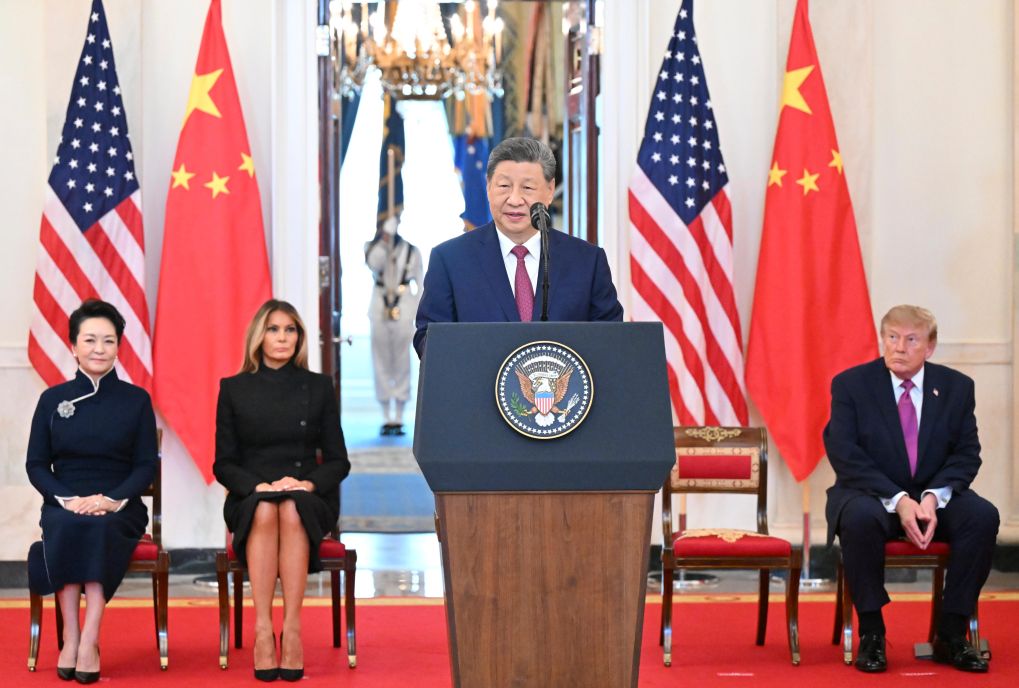
When Xi Jinping's plane landed in Washington on September 23, the choreography was itself the message: Donald Trump became the first sitting US president to greet a Chinese counterpart at the airport, and the welcome ceremony the next morning was staged with a scale that Chinese state media catalogued item by item. But the substance of the three-day state visit — the second leaders' summit in under half a year, after Trump travelled to China in May — came in a string of concrete announcements that Chinese social media parsed with more interest than the speeches themselves.
The one that melted reserve fastest was a panda. At the welcome ceremony Xi announced that within days, giant pandas Ping Ping and Fu Shuang would arrive at Zoo Atlanta. Trump, watching from the podium, was caught on camera smiling "like a child," as one RT Today Russia post put it. The moment carried half a century of baggage: in 1972, after Nixon's visit, pandas Ling-Ling and Hsing-Hsing were flown to Washington, greeted by 8,000 Americans in the rain, and drew more than a million visitors in their first month. Beijing has since turned "panda diplomacy" into a barometer of bilateral weather — sending pandas signals approval, recalling them signals frost. A new pair for Atlanta reads, in that language, as a deliberate thaw.
The economic headline was quieter but weightier. US Treasury Secretary Scott Bessent said the two sides had agreed to extend their "trade truce" — due to expire on November 10 — by two months, to January 10, 2027, while negotiators work toward a larger agreement. At the Foreign Ministry's briefing the next day, spokesman Guo Jiakun neither confirmed nor denied the extension, pointing reporters to the commerce authorities; the question, posed by Reuters, now sits among the most-followed threads on Zhihu, where users are debating what a rolling truce means for exporters on both sides (Zhihu asked the question directly).
The visit's most-talked-about domestic pitch, though, was aimed at young Americans. At the welcome ceremony Xi announced that within five years China would invite 100,000 American students to China for exchange and study — doubling a 2023 pledge of 50,000 made in San Francisco. "China-US relations hope lies in the people and the future in youth," he said, according to ThePaper's report. The program's earlier round became one of the most visible threads of people-to-people diplomacy, with American teenagers touring Hangzhou and Beijing, and Chinese media treat the scaling-up as proof the channel survived the political weather.
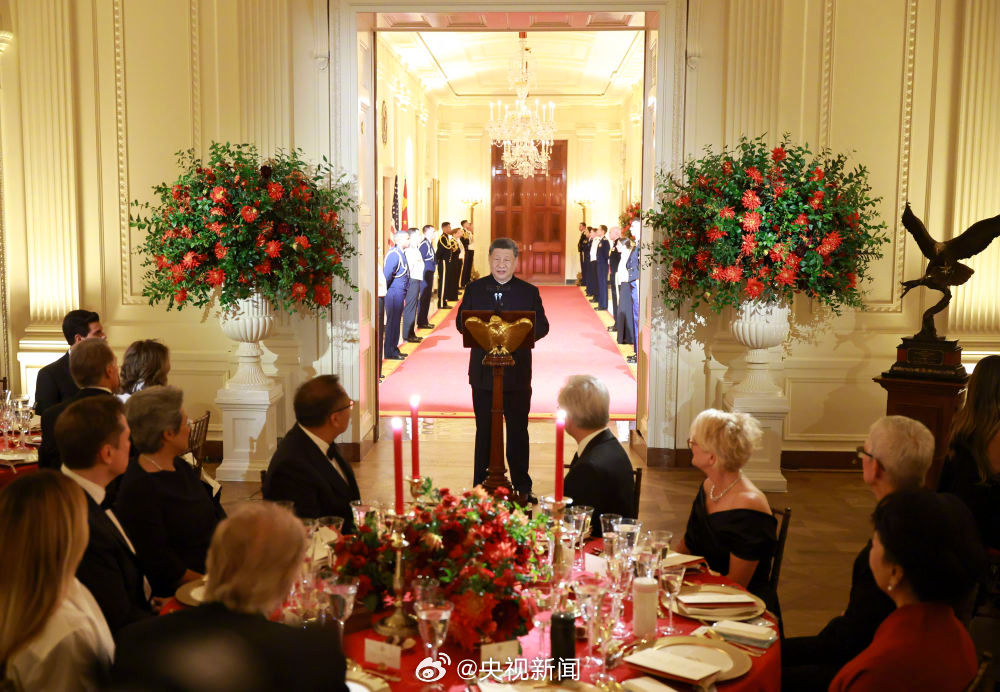
At the state banquet on the evening of September 24, Xi's toast wove together what he presented as a through-line of Sino-American friendship: the wartime alliance against Japan, "ping-pong diplomacy" that opened relations in the 1970s, and the story of Ronald Saike — the retired American teacher who in 1999 raised $5,000 for Yu Yuzhen, a farmer fighting desertification in the Mu Us desert, and whose name Xi singled out in the banquet hall. "I am overwhelmed by the unexpected honor," Saike told reporters afterwards, saying he had never sought attention. The anecdote was a pointed one for an audience of both nations' elites: the friendship, Xi implied, outlives any single political moment.
What the summit did not produce is just as notable: no joint communiqué on Taiwan, no announcement of a "grand bargain," and — as several Chinese analysts noted — no pretence that structural disputes have been resolved. The Taiwanese Affairs Office's response to the visit was a reminder that Beijing treats the meeting as stabilisation, not settlement. For now, both governments have bought eight more months of predictability, a queue of teenagers with visas, and, eventually, two very large ambassadors in black and white.
According to Xinhua, the two sides also agreed to keep high-level engagement steady, and Chinese coverage emphasised that "the leaders met twice in half a year" as evidence of a working rhythm. Whether the January truce deadline produces the "bigger deal" Bessent hinted at is the question both capitals have now scheduled for themselves.