Xibei Sues Luo Yonghao as the Blogger Who Forecast Its Collapse Switches Sides
China's most-watched food feud has gone to court: Xibei has sued Luo Yonghao over his viral reviews, while Li Ji, the influential blogger who declared the chain months from collapse, turned his fire on Luo within a day of a phone call from Xibei's founder.
The food feud that has gripped China's internet for a fortnight has reached the stage where the arguments get made in front of a judge. Xibei, the country's most visible casual-dining chain, has filed a lawsuit against Luo Yonghao, the influencer whose blunt reviews of its food ignited a nationwide fight over pre-made dishes, according to a business brief from the tech outlet 36Kr that lists the suit among the day's headlines with the note that a hearing is imminent (the brief). The chain had already been declared months from collapse by one of Weibo's biggest bloggers — a claim we covered when it landed — and People's Daily has already warned about the 'traffic power' economy that feeds on such rows. The new twist is what happened next.
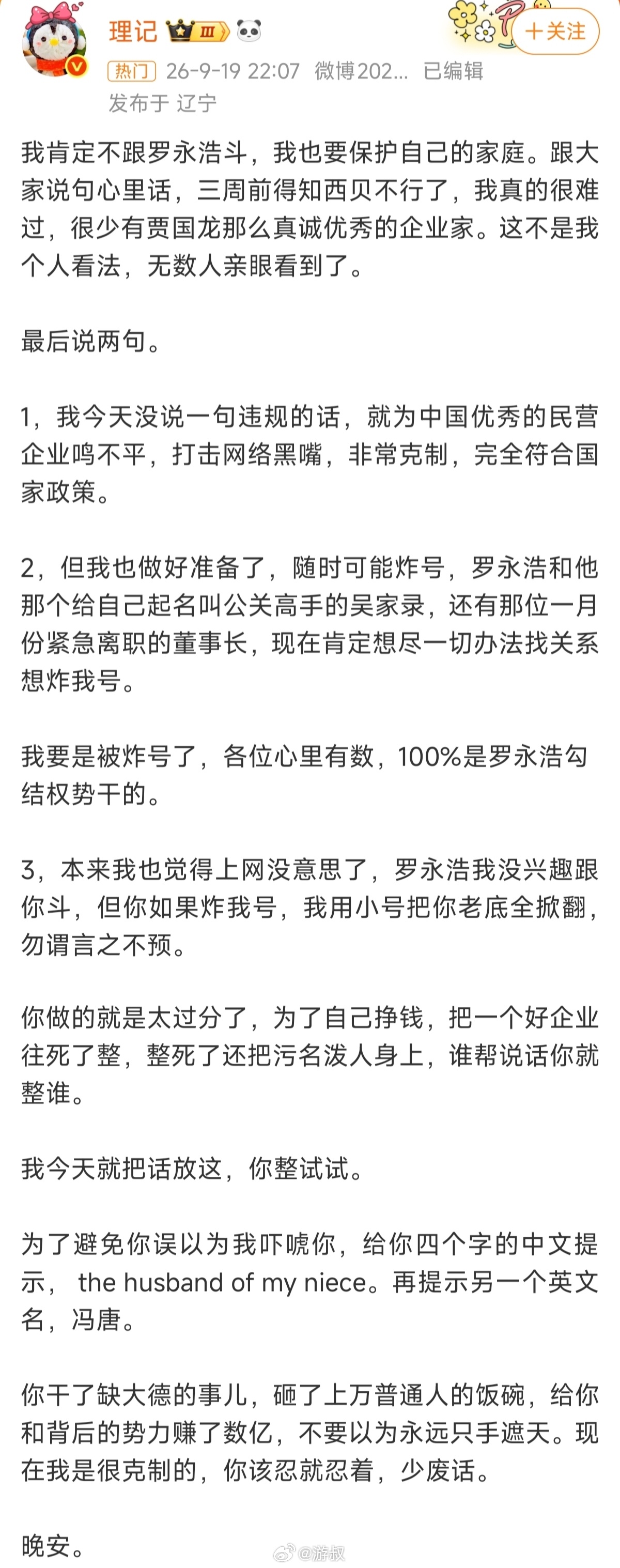
The blogger behind the collapse claim is a former investigative journalist who writes as 理记 (Li Ji), with some 5.4 million followers. On 19 September he laid out the doom arithmetic: the chain could last "at most two or three months," founder Jia Guolong would take the debts on personally and surrender his shares, leaving a hundred-odd profitable stores for staff to run, with more than two hundred closures and over ten thousand jobs gone. Xibei's customer service answered that all stores nationwide were operating normally.
Then, by Li Ji's own telling, Jia Guolong telephoned him. Within a day the man who had diagnosed the company's death was writing eulogies for its founder and aiming his fire at Luo Yonghao instead: Luo had "ruined a thirty-year career" for his own profit, monetised the drama through his livestream and podcast, and — in a line Li Ji let stand in Chinese — "killing a man would be less cruel than what you're doing" (杀人不至于诛心), before calling on Luo's agency to "leave Jia Guolong a way out" (the saga as one poster traced it). Li Ji further claimed, single-handedly, that a writer close to Luo was in fact his public-relations operative, and that he had preserved evidence against the day he might be deplatformed. These are his assertions; the underlying suit and phone call have been reported, the rest has not.
The hashtag 西贝 公关 — "Xibei PR" — sat fifth on Weibo's trending board over the weekend with a heat score above one million, as the platform watched a founder recruit his own accuser (the trending entry).
Public opinion, meanwhile, has started to move against its original hero. A forum thread on the row drew hundreds of comments asking whether an influencer can fairly be blamed for a chain's collapse at all; a PhD-badged blogger argued Luo "did nothing wrong" — a customer who thought the food overpriced said so, and it was Xibei's decision to open its kitchens to inspection, not Luo's review, that made the trouble (the defence). But corporate records gave the sceptics something to hold: more than 100 million yuan of Luo's equity sits frozen, most of it a stake in his old phone company Smartisan dating to 2023, and he is the defendant in more than four-fifths of the court cases that name him (the filings).
His latest move fed the doubt. On Saturday night he complained that three of six takeaway boxes from an unnamed Hong Kong-style café in Shenzhen smelled off — and, uncharacteristically, declined to name the restaurant, the tactic that made the Xibei campaign famous (the report). With a lawsuit pending, the man who built a season of content on naming a chain he disliked has begun to see the value of a name withheld.