How It Feels to Grow Old, One Day at a Time, in China's 'Moderate Aging' Era
A post relayed from a grandmother about how aging is felt day by day has become the human annotation to China's newest statistic: 323 million people over 60, and an argument about what 'moderate aging' spares or spends.

The statistic arrived first: by the end of 2025, China had 323 million people aged 60 or over, 23 percent of the population — the threshold the government calls "moderate aging". What traveled further was a post about what those numbers feel like from the inside. "The old don't discover they're old," one much-shared reflection put it. "They feel themselves older than yesterday, one day at a time" (老人是一天一天的感知到自己比昨天更老).
The post, by a Weibo user relaying her grandmother's observation, has been liked more than 6,000 times. Its taxonomy is concrete: at seventy-something, aging still supports a short trip, stairs, school pickups, growing vegetables, keeping chickens. At eighty-something it becomes, in her phrasing, literally one day less than the last — this month a bus ride out to see flowers, next month only the park at the gate, and then not even that. The battery metaphor she reached for is one Chinese readers knew instantly: the body's 电池健康 — "battery health" — drains fast.
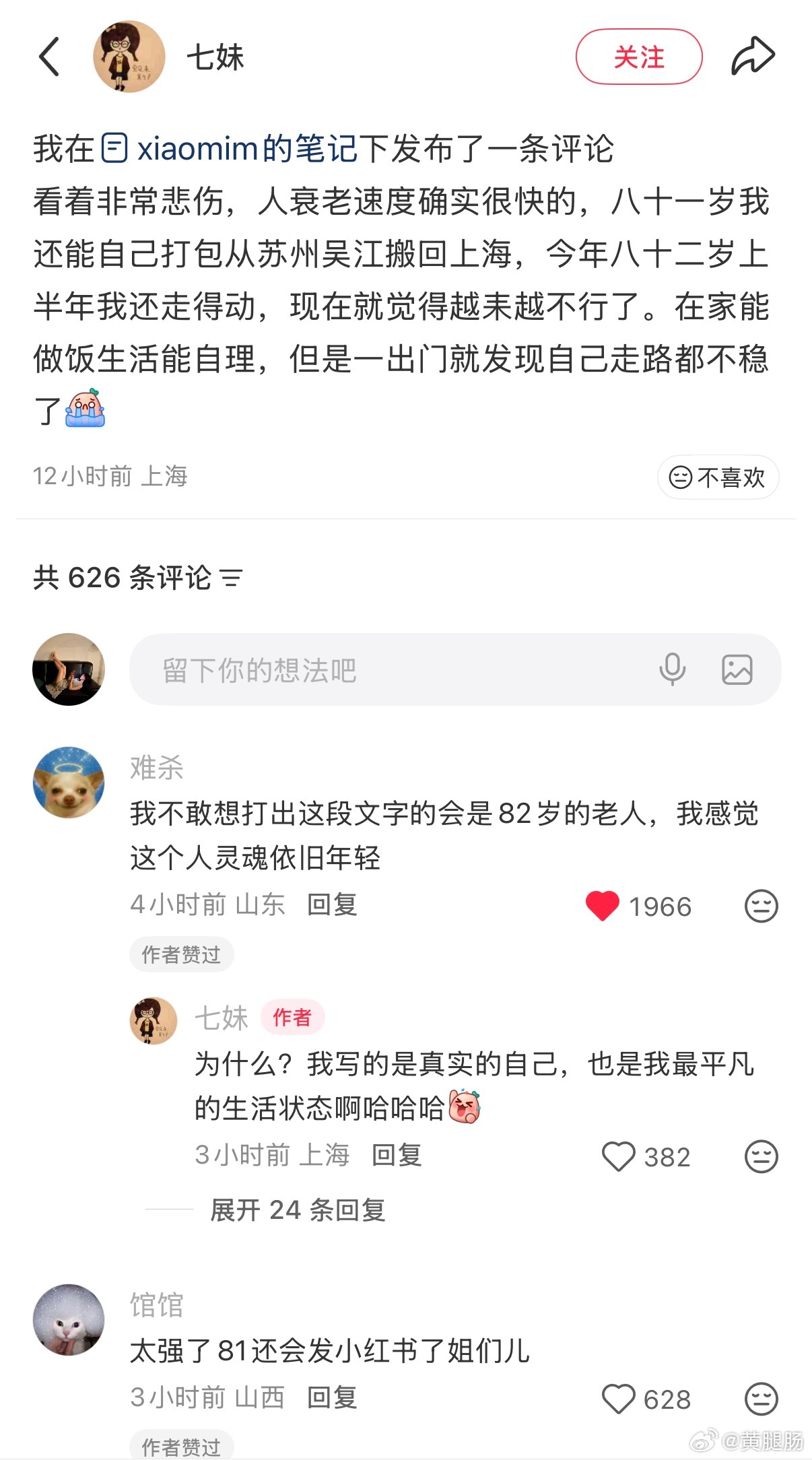
Attached to her post was a screenshot that did much of the work: a comment by an 82-year-old Xiaohongshu user named Qi Mei, who wrote that at 81 she could still pack up and move house from Wujiang, near Suzhou, back to Shanghai; that at home she still cooks and looks after herself; but that once she goes out, she finds she can't even walk steadily. Replying to strangers who praised her for posting at her age, she said only that she writes about her real, ordinary life.
The discussion is not only sentimental, because the label on the statistic is contested. Commenters pointed out that 65-plus Chinese now exceed 220 million, roughly 16 percent of the population — past the 14 percent mark that international usage calls an "aged society" — so "moderate" undersells where China already is. The dependency math circulates with the data: about 4.3 working-age people for every retiree, a ratio one post called the real weight behind the phrase, as pension, medical and care costs land on the present. It sits against the demographic slide the site has followed before, a population one bad year from slipping below 1.4 billion.
Where the argument lands is resources. The same threads that mourn the pace of decline also inventory the opportunities — the silver economy, age-friendly retrofits, care work as an industry — and the Baidu trend board carries the question in its driest form, under the heading where eldercare is actually "stuck". What the viral post adds to the ledger is the texture the planning documents lack: aging in China is being experienced not as a threshold crossed but as a slope, noticed in stairwells and appetites, by people who still go online to describe it.