OpenAI Claims Its Model Proved a Century of Conjectures, Extending a Chinese Mathematician's Work
OpenAI says its model proved the local-smoothing conjecture in every dimension — completing a chain that runs through Chinese mathematician Hong Wang's Kakeya breakthrough — refuted a 30-year-old complexity assumption, and published machine-checkable proofs for anyone to verify.
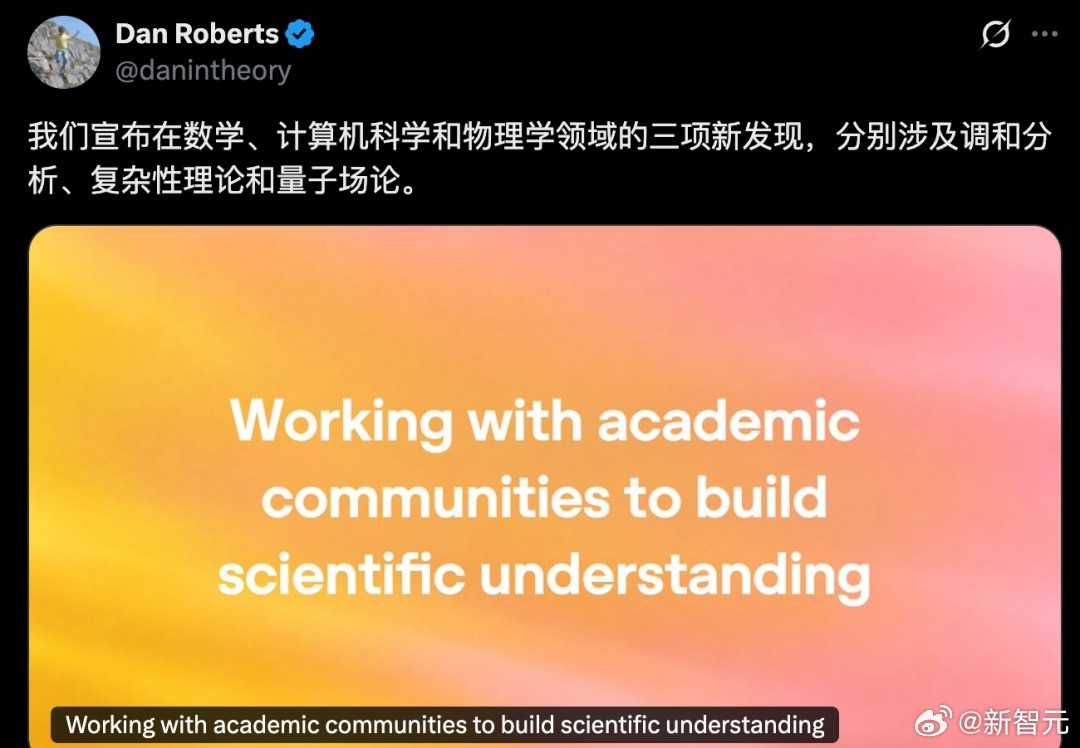
OpenAI announced on October 26 that its frontier model had produced three results the company is calling milestones: a proof of the local-smoothing conjecture in every spatial dimension; a refutation of the Exponential Time Hypothesis, the 1999 assumption on which hundreds of complexity-theory papers rest; and a rigorous existence proof for four-dimensional quantum chromodynamics and pure Yang–Mills theory. Unlike most corporate announcements, this one came with the homework attached — the papers, and formal proofs in the Lean 4 proof assistant, were released for anyone to check.
The mathematics travels furthest. Local smoothing is the first of what harmonic analysts call the field's four great conjectures; prove it at every dimension, and the result cascades down the chain to settle the Bochner–Riesz conjecture, Stein's restriction conjecture and the Kakeya conjecture, a problem about needle-like sets that has stood for a century.
For Chinese readers the story has a local hero at the bottom of that chain. Hong Wang proved the three-dimensional Kakeya conjecture with Joshua Zahl in 2025 — work that later earned her a Fields Medal — after proving the two-dimensional local-smoothing conjecture with Larry Guth in 2019. OpenAI's model, in effect, took the ladder the rest of the way up. Chinese coverage found the phrase for it: 36Kr's headline read "Wang's conjecture, cleared by AI overnight" (王的猜想,被AI一夜通关) — the pun being that the conjecture nicknamed for 王虹 is also, simply, Wang's.
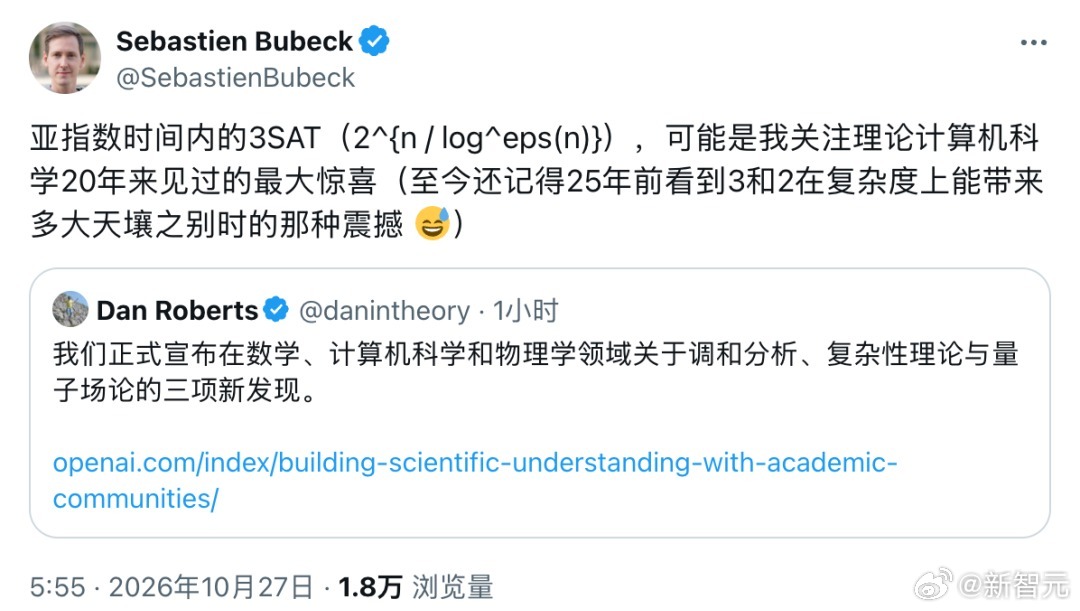
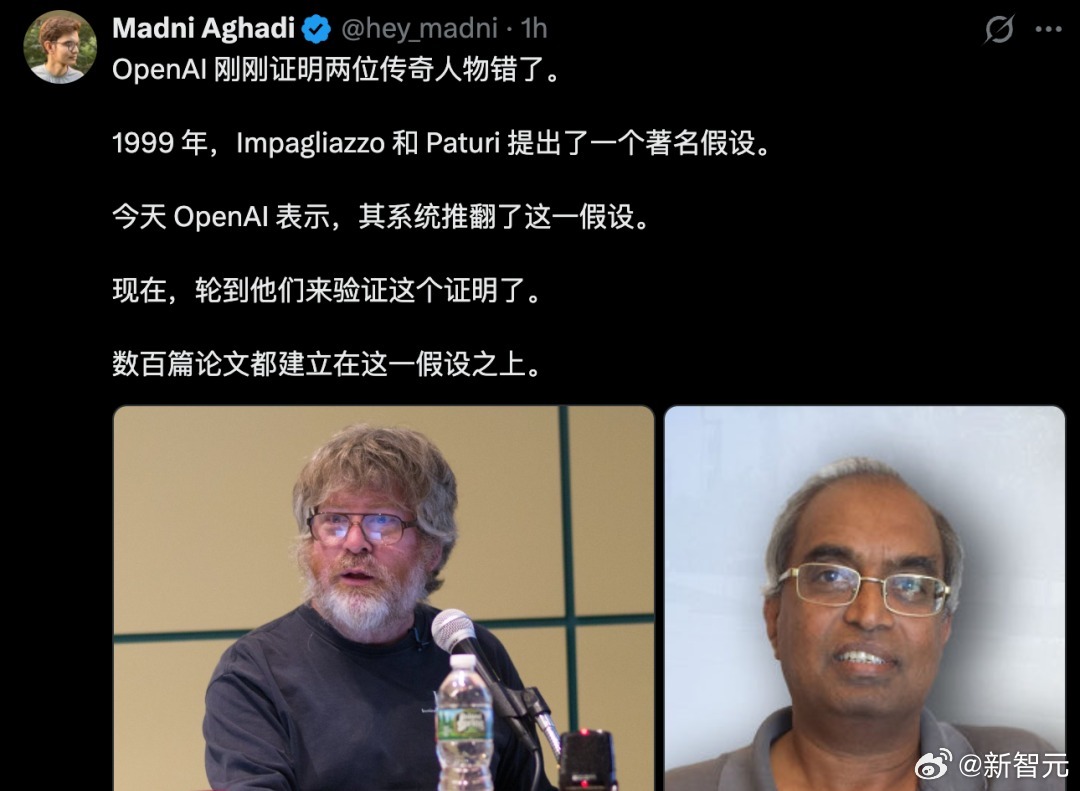
The computer-science result may be the more disruptive one. The Exponential Time Hypothesis, proposed by Russell Impagliazzo and Ramamohan Paturi, is the bedrock beneath hundreds of papers about what is efficiently computable. OpenAI's model produced a subexponential-time algorithm for 3SAT, the hypothesis's central claim — and Sebastien Bubeck, a researcher at the company, called it "possibly the biggest surprise I've seen in 20 years of following theoretical computer science". According to the tech outlet Xinzhiyuan, the grading was done by the people who originally posed the question — a Nobel laureate among them — with the machine checking the derivation line by line in a single day.
Su Weijie, an OpenAI researcher and Wharton professor, marked the moment by posting slides from a talk he gave three years ago asking which jobs AI could replace — programmers among them. Greg Brockman, the company's president, put the claim plainly in the announcement: "AI has begun to deepen our understanding of the universe."
On Zhihu, where the announcement drew dozens of threads within hours, reaction ran in two registers: awe at the pipeline, and scrutiny. The safeguard, commenters noted, is mechanical — if the Lean certificates compile, the theorems hold as stated; the open question is whether the certificates encode what the papers claim. Either way, Chinese coverage converged on the phrase OpenAI itself used for what comes next: AI discovers first, humans verify and understand. The verification has begun.