Six Years After Hiding Its Chips, Huawei Is Naming Them on Billboards
A tech blogger's side-by-side of two Huawei billboards — one wrapped in plastic in 2020, one openly advertising Kirin chips in 2026 — has become the week's defining image of the sanctions era.
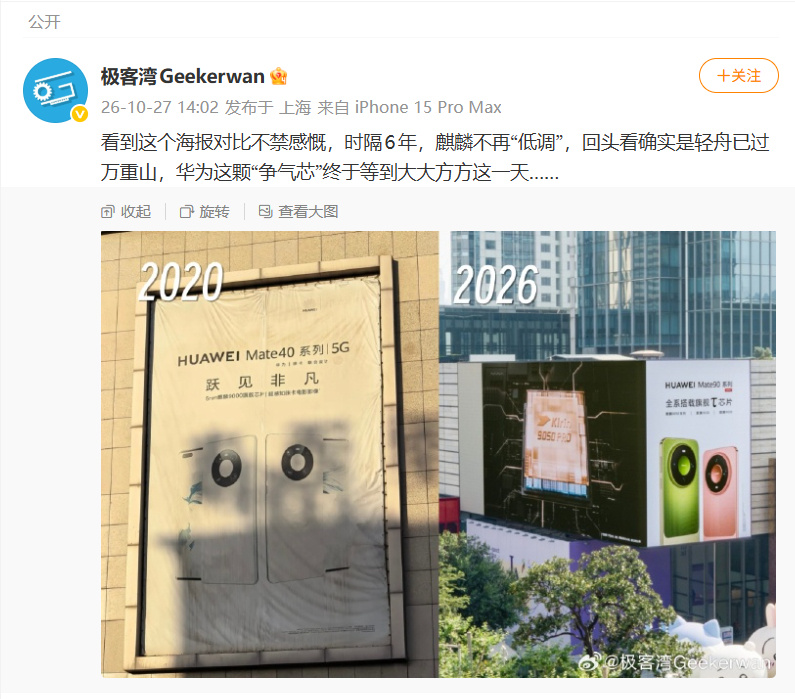
The comparison that circulated through Chinese tech circles this week is just two billboards. The first, from 2020, shows a Huawei Mate 40 advertisement wrapped in plastic sheeting, its slogan a vague "Leap to the Extraordinary," with no mention anywhere of the chip inside. The second, from 2026, is a billboard for the Mate 80 series, and it says the quiet part out loud: the whole line runs Kirin chips — the processors Huawei designs itself. The tech reviewer Geekerwan posted the two images side by side with a sigh in seven characters: 轻舟已过万重山, the Tang-dynasty line about a light boat that has already passed ten thousand mountains — the hardest stretch of the river is behind you.
Six years is exactly how long the silence lasted. After US sanctions cut Huawei off from advanced chips in 2020, the company stopped naming its silicon at all: launches omitted specifications, posters avoided the word Kirin, and anything that could invite scrutiny of its supply chain went unsaid. When the Mate 60 arrived in 2023 with a domestically produced Kirin 5G chip, Huawei launched it without ceremony and let teardown labs confirm what it would not. One commentary recalled the 2023 launch as a surprise attack that caught Apple mid-preparation — the chip, 5G and satellite messaging all there, but announced by silence.
What changed this year is that the secrecy posture is gone. Outdoor screens now spell out the chip's name; the Mate 80 launch was streamed globally with the silicon discussed on stage in detail. One Weibo commentator read the shift as being about a single character — 敢, "to dare": for years the chip was approached sideways, launches hedged, posters without model numbers, say as little as you could get away with. Now the outdoor screens are everywhere. The engineering changed too, he noted: with transistor shrinking blocked, Huawei found room in stacking and scheduling — building upward when it could no longer build smaller.
The fuller reckoning is arriving in public as well. Bilibili's most-watched tech video of the moment is a mega-benchmark pitting the Kirin 9050 Pro against Apple's A20 Pro, Qualcomm's Snapdragon 8 Elite, MediaTek's Dimensity 9600 Pro, Xiaomi's in-house XRING O3 and Google's Tensor G6 — the kind of head-to-head test that would have been unthinkable for a Kirin chip in the sanctions' first years. Huawei's silicon, once something to be confirmed by rumor and teardown, is now simply a contender on a chart.
The billboards settle what the launches used to hedge. Whatever the benchmark numbers conclude, the habits of the hiding years — wrapped posters, unnamed silicon, launches that said nothing — have left Huawei's streets. On the 2026 billboard, the chip's name is the headline.