Zhang Yiming Tops China's Rich List With 670 Billion Yuan, and an AI Fortune Enters the Top Ten
The Hurun Rich List published on Tuesday put ByteDance's founder at 670 billion yuan, a record for a Chinese tycoon, and DeepSeek's Liang Wenfeng in the top ten for the first time — a list reshaped almost entirely by AI.
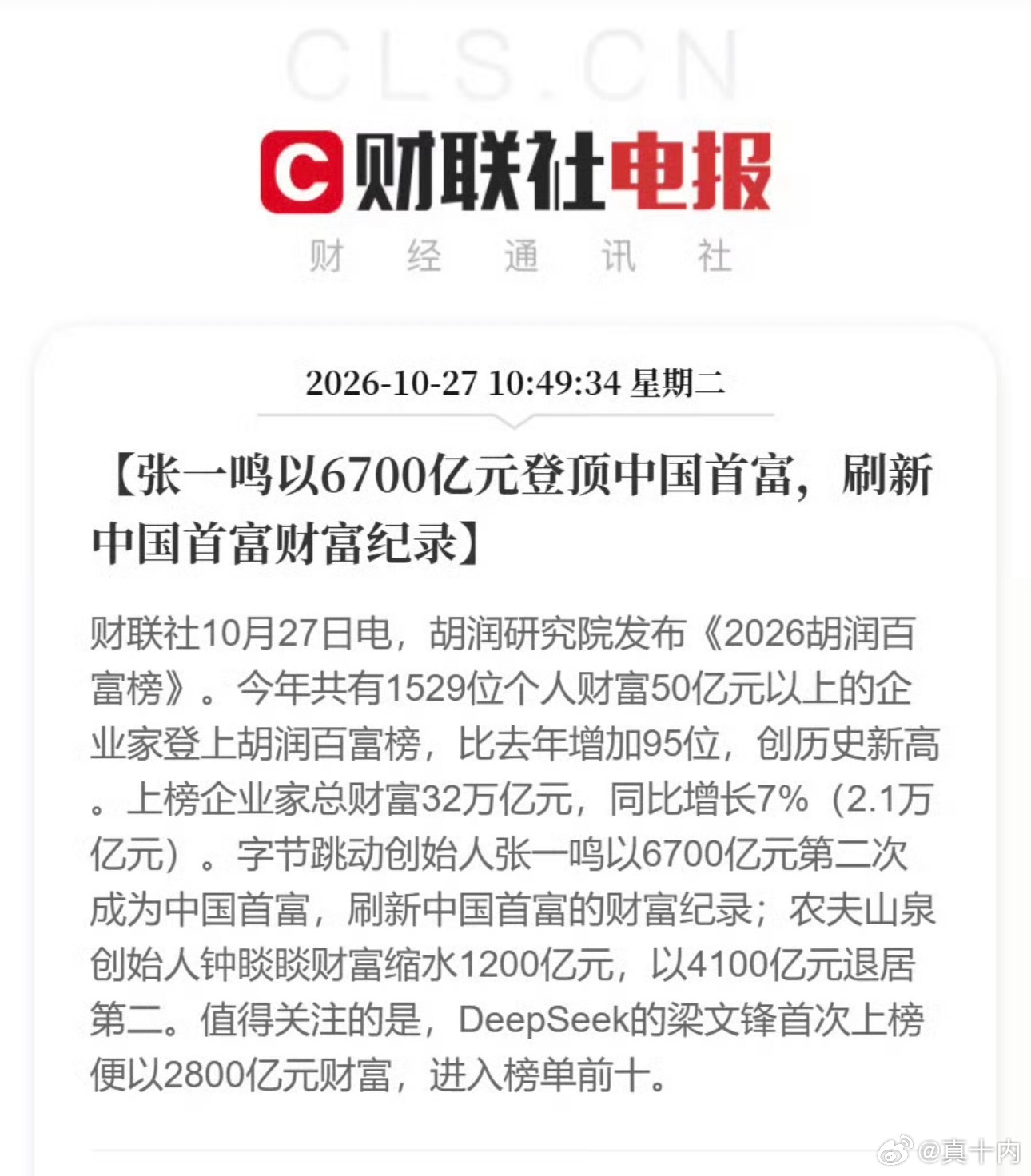
Zhang Yiming, the founder of ByteDance, is China's richest person for a second time — and the 670 billion yuan (about 93 billion dollars) that Hurun's research institute assigned him on Tuesday is the largest fortune the annual list has ever recorded for a Chinese entrepreneur. The number is not a record for its own sake: Hurun's list has become a barometer of where China's money is made, and this year the answer is almost entirely artificial intelligence.
The 2026 Hurun Rich List, published on October 27, counts 1,529 individuals with more than 5 billion yuan each — the most in the ranking's history — with a combined 32 trillion yuan. Zhang's total grew on the back of ByteDance's AI business, which has lifted the company's valuation. Zhong Shanshan, the founder of Nongfu Spring who had been China's richest person for three consecutive years, fell to second with 410 billion yuan after his fortune shrank by 120 billion yuan in a year.
The more telling figure is the one that entered the top ten: Liang Wenfeng, the founder of DeepSeek, appeared on the list for the first time with 280 billion yuan. Liang's position is a snapshot of a strange two years: DeepSeek's open-source models shook the global AI industry in early 2025, and the company's revenue is tiny by Big Tech standards — yet the money now flows into the valuations of the firms that own the compute, and the founders who own the firms.
On Weibo, the list was received as a piece of news about the economy, not a ranking. But the Hurun numbers are a small window into China's shifting distribution of wealth. The wealth list's headline faces — a TikTok owner, a bottled-water tycoon, an AI model builder — have moved from property and consumer staples to software and algorithms. The old money has been displaced by the new money; the list has been shaped by AI.
On Weibo the list drew a mostly resigned response: the most-liked post was a screenshot of the news flash itself, with a laconic comment — "670 billion yuan. Really rich." (670亿。。真有钱啊。。。。。) — that drew far more attention than any of the analytical commentary. The list landed the same day as the Party's Fifth Plenum in Beijing, the meeting that will set the country's economic course for the next five years, and the contrast between the two — a record fortune for a private tech founder and a party plenum whose agenda is state-led self-reliance — is the quiet subplot of China's economy in late 2026.