Alibaba Will Spin Off Its Chip Arm T-Head for a Hong Kong Listing at a $20–30 Billion Valuation
On Monday Alibaba announced it will spin off its wholly-owned chip subsidiary Pingtouge — known internationally as T-Head — for an independent Hong Kong listing, a move analysts are valuing at $20–30 billion and that marks a milestone in China's attempt to build a domestic AI-chip industry.
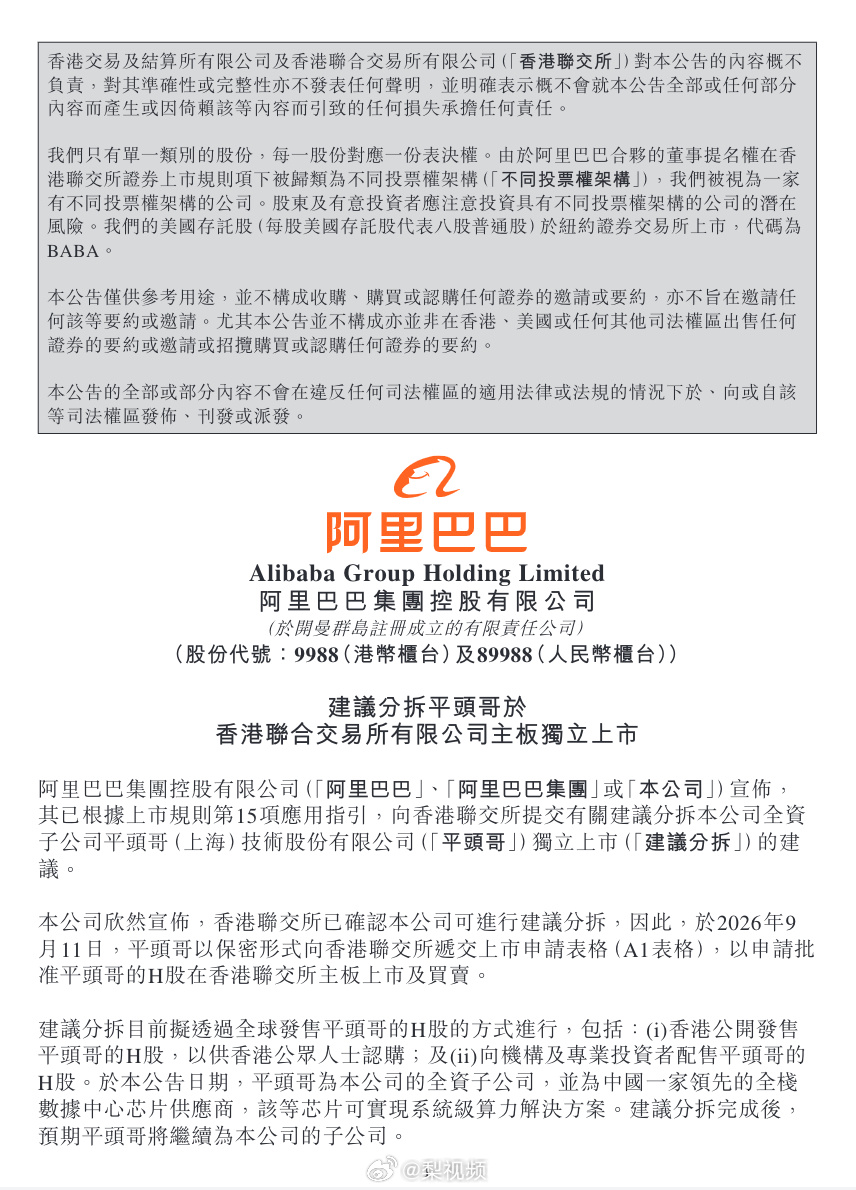
On Monday, Alibaba announced it would spin off its wholly-owned semiconductor subsidiary Pingtouge (Shanghai) Technology Co. for an independent listing on the Hong Kong Stock Exchange's main board. The exchange has confirmed the spin-off, and Pingtouge filed a confidential A1 listing application on September 11, 2026. The transaction will take the form of a global offering of H shares, and analysts quoted by 21st Century Business Herald put the unit's value at $20 to $30 billion. The announcement says that after the split Pingtouge will remain a subsidiary of Alibaba, which is how the group has kept the chip business out of its own books.
The company's Chinese name, Pingtouge (平头哥), is the local nickname for the honey badger, and the animal's reputation for fearlessness is the point. Founded in 2018, T-Head designs CPUs, GPUs, storage and networking chips for Alibaba Cloud, and it has been deliberately low-profile: a Sina Tech report called it "Alibaba's long-hidden nuclear weapon."
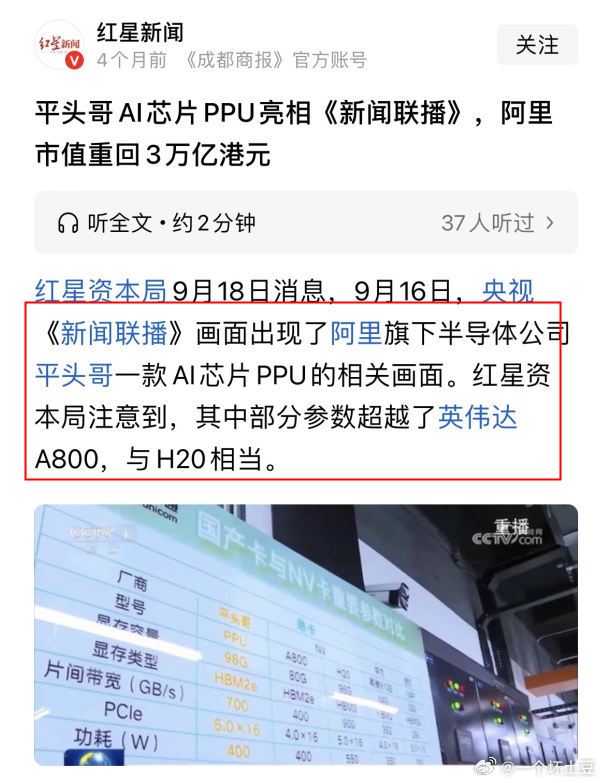
The PPU story is the one that made the company famous. In September 2025, a CCTV Xinwen Lianbo segment about domestic chips briefly showed a PPU GPU with 96 GB of HBM2e memory, 700 GB/s inter-chip interconnect and 400 watts of power — parameters that put it in the same range as Nvidia's H20. The comparison table went viral, and a Red Star News post called it "Alibaba market cap returns to 3 trillion HKD."
The commercial side is already real. The Zhenwu series of AI chips, one Weibo analyst notes, now generates more than 10 billion yuan in annual revenue and serves more than 650 enterprise customers. Alibaba's XuanTie RISC-V processors ship in the billions. The Hong Kong listing is not a rescue: it is a way to bring in capital and give the chip business a market-facing discipline that a subsidiary can hide from.
The market read the news that way. Alibaba's US-listed shares rose about 7 percent on Monday, one Weibo poster noted, "driven by the news that Pingtouge's PPU will launch an independent listing." Nvidia fell about 5.5 percent the same day. Domestic AI chip peers such as Moore Threads have already listed, and the "East Data West Computing" policy, plus Alibaba's 380 billion yuan of AI infrastructure investment over three years, give the business a customer and a testing ground.
What makes the spin-off interesting is what it is not: a way to keep the chip business out of the balance sheet. One Weibo commentator argues that it is the opposite — a "violent clearing of the mixed-valuation logic" that let a conglomerate hide the chip business behind e-commerce and cloud. The split, he says, forces the hardest part of the company to account for its own cash flow, and that is the point of doing it.