Tesla's China Sales Fell From No. 1 to No. 66 in a Single Month
Tesla's Model Y sold 7,807 units in China in October, down from 50,359 in September, dropping it from the top of the domestic sales chart to 66th — a collapse one analyst attributes to production capacity being redirected to exports, and which reflects the state of Chinese EV competition.
Tesla's sales in China collapsed in October, according to retail data from the auto platform Dongchedi: the Model Y sold just 7,807 units in the month, down from 50,359 in September, and fell from the top of the domestic sales chart to 66th place. Tesla's total domestic retail sales in October were 8,817 units, down 66.1 percent year on year — a striking reversal for a model that had been stable in the top three for most of this year.
One of the country's best-known auto commentators, Han Lu, offered a supply-side explanation: Tesla's October production capacity was mostly allocated to exports, he wrote, meaning that the cars that would have been counted in the domestic chart were shipped abroad instead. The Shanghai Gigafactory is Tesla's export hub for the whole Asia-Pacific region, and the allocation of its output between the domestic and export markets moves month to month.
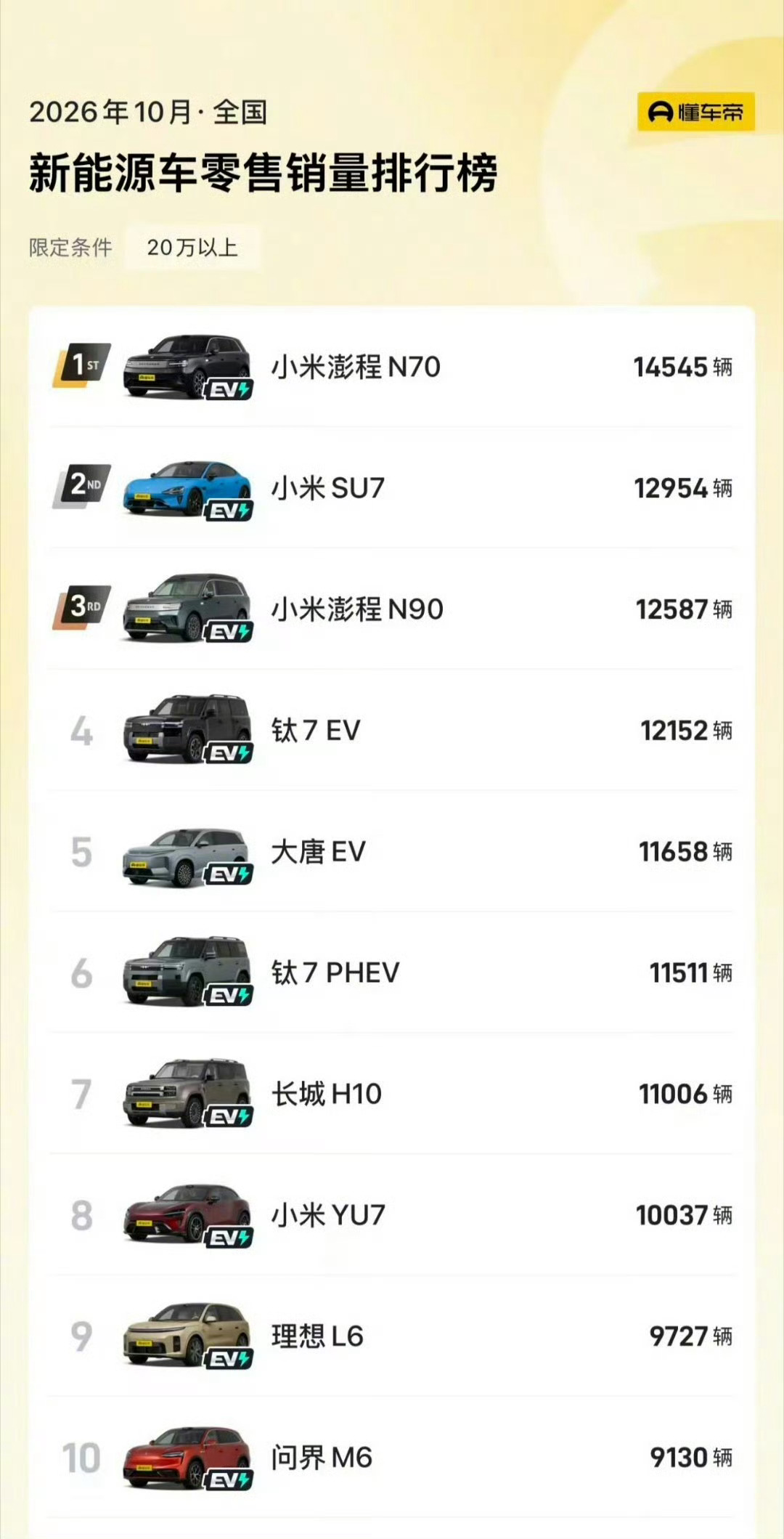
But the supply-side explanation does not erase the demand-side picture. The top of the October chart — the ranking of vehicles above 200,000 yuan — was dominated not by Tesla but by Xiaomi, whose three models took first, second, third and eighth places, with the Pengcheng N70 selling 14,545 units and the SU7 12,954. The rest of the top ten was filled by Chinese brands: Great Wall, Li Auto, Aito. The world's most valuable carmaker has become a niche player in the world's largest EV market, and the chart is a reminder of how quickly that has happened.
The numbers arrived on a day when Tesla's stock was otherwise soaring — the shares rose more than 5 percent in New York as part of a broad tech rally, an irony that Chinese commenters did not miss. One finance writer, who has been publicly sceptical of the company's valuation for months, noted that Tesla's market value has been pulled upward by the AI narrative around autonomous driving and humanoid robots while the underlying sales and earnings picture has been "average" — and that once the stock stops rising, the holders who bought in on the AI story are the ones who turn on it. The October figure suggests the gap between the two stories is widening.
For Chinese readers, the trending topic was less about Tesla than about what replaced it: the spectacle of Xiaomi, a phone maker that sold its first car in 2024, now holding the top three spots in the premium segment that Tesla's Model Y had defined. Chinese EV competition has produced a market where the leader of one month can be the sixty-sixth of the next, and the chart is recalculated every month.
On Baidu's board, where the topic ranked 25th on the day, the story fed a running argument about whether Tesla's China decline is a supply allocation or a verdict. There is no indication yet that the October figure is a one-month anomaly rather than a new baseline.