Beijing Court Rules a Solitary Woman's ¥4 Million Flat Goes to the State, Not Her Nine Relatives
Zhao had no spouse, no children, no siblings. When she died alone in Beijing, nine uncles and aunts fought over her flat. A court ruled it forfeit to the state — a preview, Chinese readers realized, of a question a childless generation will keep meeting.
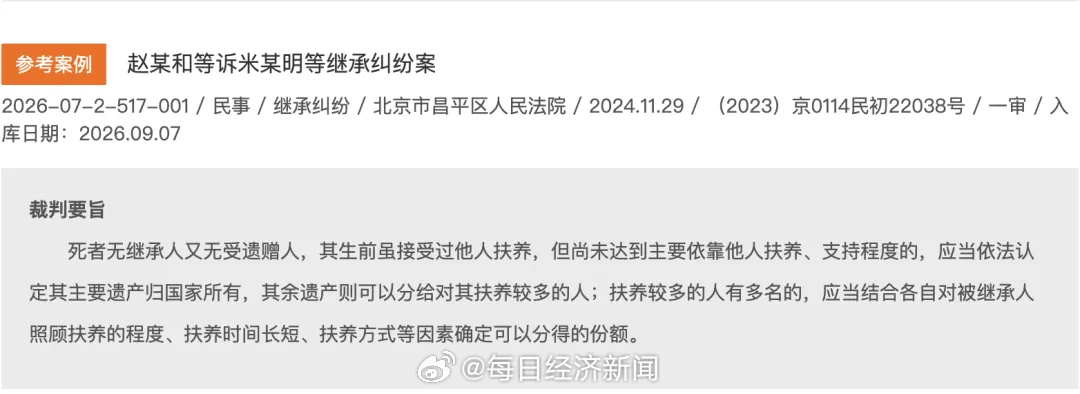
Zhao lived alone in an apartment in Changping District, northern Beijing. She had no spouse, no children, no siblings, and by June 1, 2022, when she died at 41, both her parents were gone too. She left no will. What she did leave was a flat worth more than 4 million yuan, some bank savings, and two life insurance policies — and nine relatives, her uncles, aunts, and their kin on both sides of the family, who went to court claiming it.
This week the outcome became a reference case in the national People's Court Case Database, and trended across Weibo and Zhihu: the Changping District People's Court ruled that the flat — the bulk of the estate — belongs to no one in the family. It goes to the state.
Both sides in the suit, five relatives against four, argued they had fulfilled a duty of care to Zhao. The court found otherwise: what the relatives had provided amounted to ordinary visits and holiday contact, not the substantive support that creates a claim to an inheritance. Under the Civil Code, an estate with no heirs and no bequest is forfeited to the state; a separate provision lets people outside the circle of legal heirs share in an estate if they supported the deceased, and the judges used it only narrowly. The insurance proceeds and a little over 4,000 yuan in savings were divided among the nine according to the degree and duration of care each had actually provided. The flat, the case summary states, is to be handled for public use.
The case landed at a moment when its premise no longer looks exceptional. China has tens of millions of unmarried, childless adults — the one-child generation, now reaching middle age, many living alone in big cities — and as one Weibo summary of the ruling put it, the question the court answered is one a growing number of families will meet: when someone dies alone, what are the obligations of the relatives who remain, and what do they earn?
Commenters on Zhihu divided largely into two camps: those who read the ruling as sound doctrine — inheritance follows care, not blood — and those who found it chilling that a family's ordinary affection counts, in law, for nothing while the state takes the property. The court's answer is deliberately legible: in China's succession law, care is the currency, and visits are not it.
The ruling is also a companion piece to a case we covered earlier this month, in which Beijing courts enforced a 2000 family contract over a ¥4 million flat — another dispute in which courts looked past family ties to what had actually been agreed or done. Together they sketch a consistent doctrine for an ageing, urbanizing country: blood may start the argument, but the outcome turns on paper and care.