As Electric Cars Top Two-Thirds of China's New-Car Market, Li Auto Puts a Lifetime Warranty on the Battery
New data show petrol cars have fallen below a third of China's new-car sales for the first time, and the ten-year cost arithmetic has tipped decisively toward electric. On the same evening, Li Auto promised to replace any car destroyed by a battery fire — reassurance is now the product.
Petrol cars have fallen below one third of China's new-car sales for the first time. September data from the country's auto retail association put overall new-energy-vehicle penetration at 67 percent, a record, against more than 90 percent for combustion engines five years ago — a shift large enough that Elon Musk shared the figures himself, as the Zhihu debate over the numbers records.
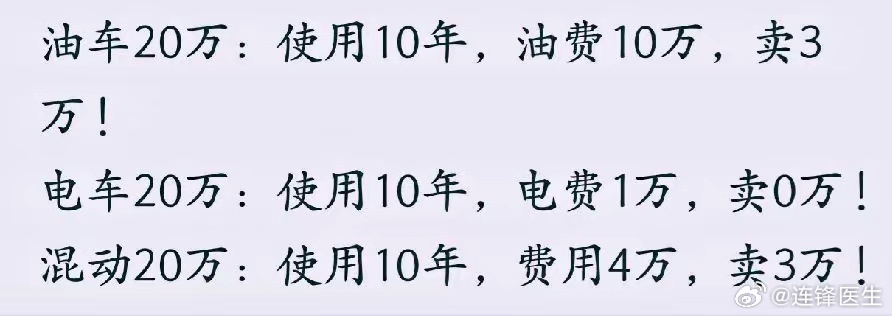
The day's hot search put the same transformation into household arithmetic. A ten-year cost comparison for three 200,000-yuan cars — petrol, electric, hybrid — posted by a doctor's account drew thousands of likes; its sums, 100,000 yuan of fuel against 10,000 of electricity and 30,000 of resale value against none, matched the conclusion most buyers have already reached. A more careful breakdown, from a data blogger, ran the same decade at 10,000 kilometers a year: the petrol car spends some 56,000 yuan on fuel, 18,000 on maintenance and 30,000 to 40,000 on insurance, keeping about 20,000 at resale; the electric car spends 12,000 on charging, 6,000 on maintenance and a heavier 40,000 on insurance, keeping a bit over 10,000. The electric car still wins, the blogger concluded — "and the more you drive, the wider the gap" — even though insurers charge it more.
Into this arrives the evening's industry news. At a "Power Day" event on October 20, Li Auto launched its "Lianshan battery guarantee plan," two lifetime promises built around the battery cells it has designed in-house since 2020 and now fits to models such as the L8. If a battery fire caused by a quality defect writes the car off, the company will replace it with a new car of the same specification. If a collision or an underbody scrape ignites the battery, Li Auto pays the gap between what insurance pays out and what the policy covers. "Li Auto battery, Li Auto guarantee" was the slogan; the launch posters condensed it to no self-ignition, no fire in a collision, for life.
The sequence matters more than either half. A market at 67 percent penetration has largely won the argument it spent a decade on — that electric cars are affordable to run — and the cost chart trending the same day shows buyers now doing that arithmetic themselves, down to resale value. What remains to sell is confidence in the parts that fail: batteries, fires, insurance gaps. A lifetime replacement promise converts engineering confidence into a balance-sheet liability, a bet that the company's cells will not burn — and sets a bar rivals will now be asked to match or explain. Li Auto's engineers, one post noted, are planning superchargers every 100 kilometers along expressways; the reassurance is being built out on the road as well as on paper. The fight is no longer to persuade anyone to go electric. It is to convince them an electric car is safe to keep.