China Imposes 84% Tariff on All US Imports in Escalating Trade War
In a significant escalation of the ongoing trade tensions between the United States and China, the Chinese government announced that it would impose an 84% tariff on all goods imported from the United States. This move is in direct response to the U.S. government's earlier decision to raise tariffs on Chinese products to 84%, which China views as a serious infringement on its legitimate rights and a threat to the multilateral trade system. The decision by China to match the U.S. tariff rate of 84% signifies a hardening of its stance against what it perceives as unilateralism, protectionism, and economic bullying by the United States.
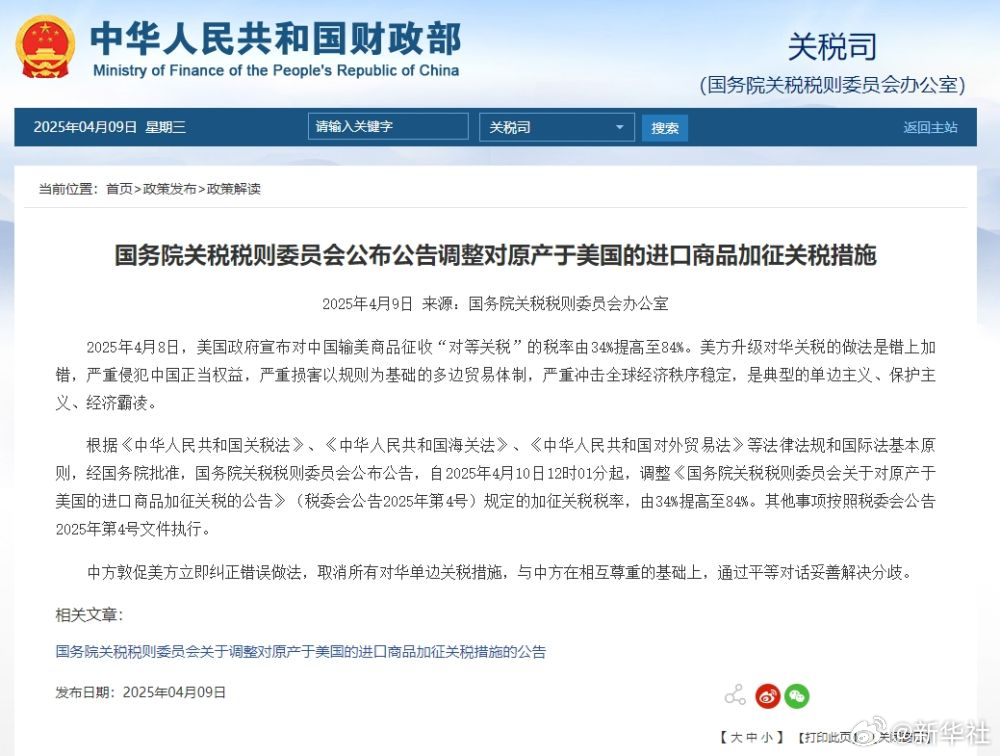
The Chinese government has reiterated its call for the United States to correct its mistakes, revoke all unilateral tariff measures against China, and engage in dialogue based on mutual respect to resolve differences. China also announced that it would take the United States to the World Trade Organization (WTO) over the latest tariff hike, which it believes violates WTO rules and reflects the U.S.'s tendency towards unilateralism and economic hegemony. The situation underscores the deepening rift in trade relations between the U.S. and China, with both countries engaging in a tit-for-tat tariff escalation that could have far-reaching consequences for international trade and the global economy.
According to the General Administration of Customs, the 84% tariff will be imposed on all goods imported from the United States, starting from April 10th. The prices of U.S. goods in China will increase substantially, potentially affecting Chinese consumers' purchasing behavior and U.S. companies' profits. The tariff hike will also lead to a decline in the competitiveness of U.S. goods in the Chinese market, disrupting the balance of bilateral trade between the two nations. Furthermore, the move may prompt Chinese companies to seek alternative sources, reducing their dependence on U.S. goods.
The escalation of trade tensions between the U.S. and China will also have far-reaching consequences for the global economy. The increased uncertainty in trade relations between the two nations may lead to a decline in investor confidence, ultimately affecting global economic growth. Economists believe that the trade war will have a significant impact on the Chinese economy, although it is not expected to be devastating. China has already taken measures to mitigate the effects of the trade war, including diversifying its export markets and increasing domestic consumption.
In response to the U.S. tariff hike, China's State Council Tariff Commission announced that it would impose additional tariffs on U.S. goods, effective April 10th. The commission stated that the U.S. decision to raise tariffs on Chinese products was a serious infringement on China's legitimate rights and a threat to the multilateral trade system. China's retaliatory measures include imposing an 84% tariff on all goods imported from the United States, as well as taking the U.S. to the WTO over the latest tariff hike.
The U.S. government had previously announced an 84% tariff on all Chinese goods imported into the country, which China viewed as a unilateralist and protectionist move that severely infringed upon its legitimate rights. This provocative action was seen as a significant escalation in the ongoing trade tensions between the two nations, with China accusing the U.S. of disregarding international trade norms and breaching World Trade Organization rules.
In a recent development, the Chinese government announced that it would add 12 U.S. entities to its export control list, prohibiting them from exporting certain products to China. The move is seen as a further escalation of the trade tensions between the two nations. Additionally, China's Commerce Ministry announced that it would impose penalties on U.S. companies that fail to comply with Chinese regulations, including those related to export controls.
The trade war between the U.S. and China has sparked concerns globally, with many countries calling for a negotiated solution to the dispute. The EU, for example, has imposed a 25% tariff on U.S. goods in response to the U.S. decision to raise tariffs on European products. The trade tensions have also led to a decline in investor confidence, with many investors seeking safe-haven assets such as gold and bonds.
As the trade war continues to escalate, it remains to be seen how the situation will unfold. One thing is certain, however: the trade tensions between the U.S. and China will have far-reaching consequences for the global economy, and it is imperative that both sides engage in constructive dialogue to find a resolution that benefits all parties involved.