A Welfare Teenager's Hong Kong Concert Trip Tests the Limits of China's Dibao Rules
A vocational student from a welfare household in Jiangxi worked holiday jobs to pay for a concert trip to Hong Kong — and drew a People's Daily verdict that welfare 'is not a fixed benefit' and concerts count as high consumption, setting off a national argument over poverty, dignity and the surveillance of the poor.
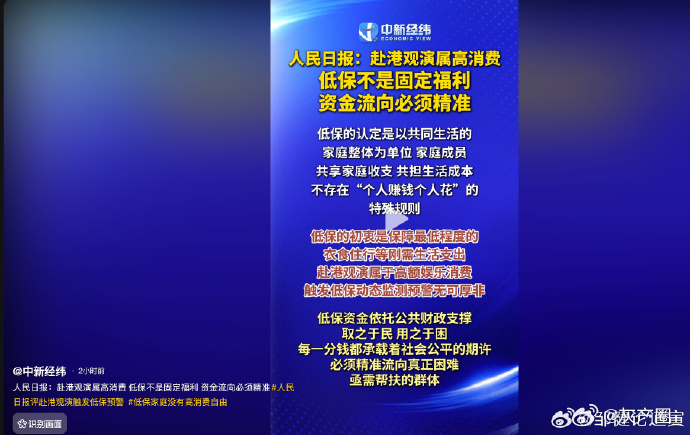
A teenager from a family on welfare in Ganzhou, Jiangxi province wanted to see a concert in Hong Kong. She was still in vocational school, so she did what teenagers there do: worked holiday jobs, saved her wages, and made the trip. This week her outing became a national argument, after People's Daily weighed in with a verdict on whether a family living on China's minimum livelihood guarantee should be going to concerts at all.
The paper's commentary, as carried by business outlet CSJ Eco in a graphic that spread across Weibo, ruled that attending performances in Hong Kong counts as "high consumption" — beyond what 低保, the dibao minimum-living guarantee, exists to cover. Dibao, China's means-tested safety net, tops up household income to a local survival floor, and recipients live under "dynamic monitoring": regular checks of income, property and, as the graphic's red text emphasized, spending patterns that can trigger alerts. Welfare, People's Daily concluded, "is not a fixed benefit for life" — the rolls are meant to shift as circumstances do, and funds must be directed with precision to those with genuine need. A post flagging the verdict was liked more than 13,000 times within two days.
The ruling's defenders kept to its logic. Dibao "covers clothing, food and survival — not entertainment," one widely shared post argued; benefits are calibrated to the local cost of staying alive, and monitoring exists so that limited public money reaches families who cannot cover the basics, not to subsidize tickets. If a household's spending no longer matches hardship, rechecking the file is the system working as designed.
The counterargument went to the girl herself. "She earned the money with her own holiday work — at an age when her peers are free to spend their summers resting, and nobody questions them," one post read, liked more than 1,600 times. "A vocational student who chooses hard work to reach something she loves is exactly the person this society tells us to applaud — until she's poor." In that reading, the case is less about fraud than about the expectation that the poor perform their poverty: that a family on the rolls should be visibly, continuously deserving, down to its daughter's spare change.
What the official commentary did not resolve is the case's uncomfortable detail: the concert money was earned, not diverted from benefits. Precision targeting, as People's Daily frames it, is meant to keep the safety net honest; the question the posts keep returning to is who decides what counts as "necessary" spending when the saver is a teenager on her own wages — and whether an alert on a concert ticket makes the system more precise, or simply poorer in spirit it claims to protect.