A History Ph.D. Quit Teaching and Opened a Bookstore in a Shenzhen Urban Village Because His Books Ran Out of Room
Liu Kai, a 43-year-old history Ph.D. in Shenzhen, moved nearly 10,000 books from his home into a 33-square-metre shop in an urban village, sells them near cost, and keeps the lights on past midnight — for the readers who arrive after work.
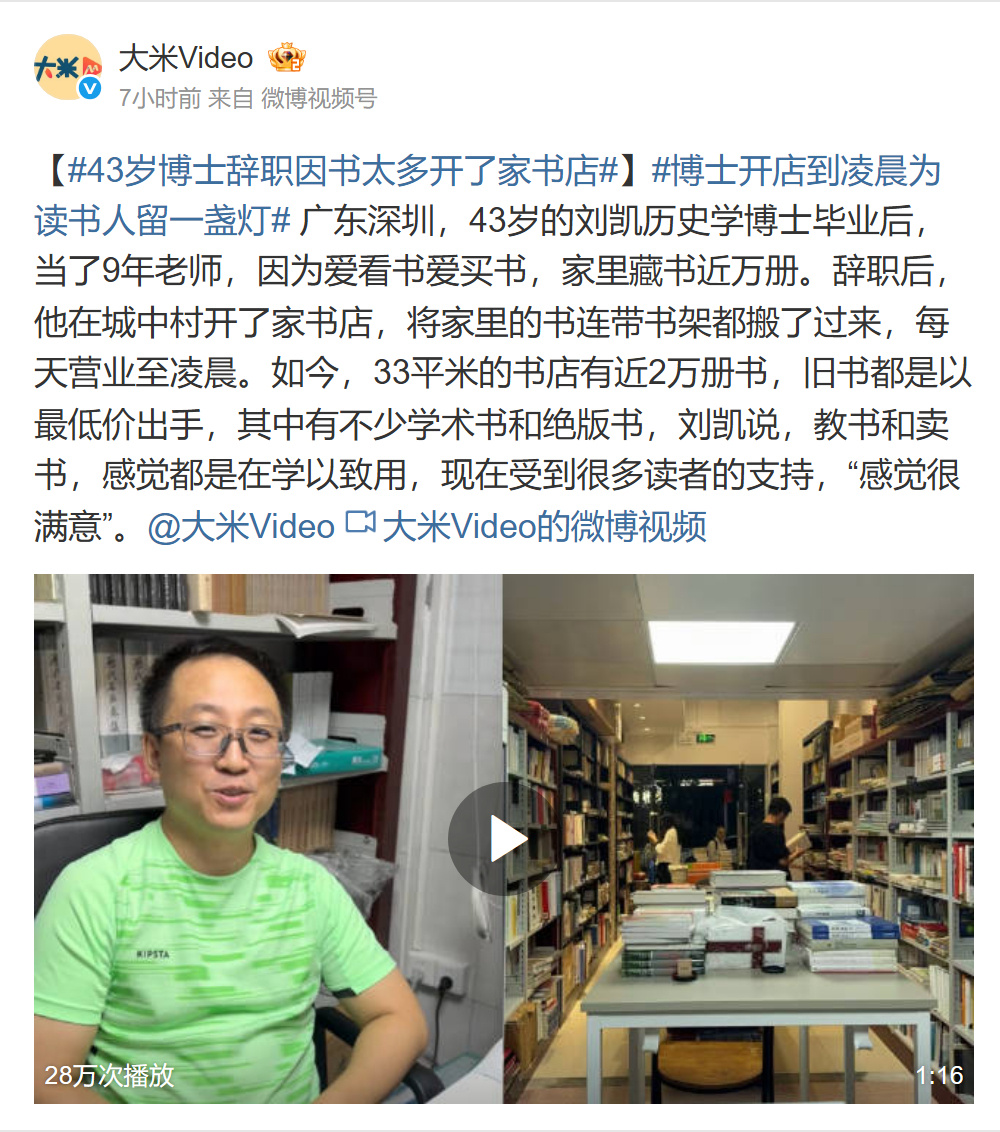
Liu Kai's problem was an ordinary one with an unusual solution. He was a history Ph.D. who had spent nine years teaching in Shenzhen, and his home had filled with nearly 10,000 books — the accumulated weight of a life spent reading and buying. When he left teaching, he moved the books, and the bookshelves they stood on, into a 33-square-metre shop in an urban village, one of the dense, low-rise neighbourhoods of migrant workers and cheap rents that Shenzhen's glass towers grow around. The shop now holds close to 20,000 titles.
Two details from the video profile by the outlet 大米Video have carried the story across Weibo, where it charted under the unimprovable hashtag #43岁博士辞职因书太多开了家书店# — "43-year-old Ph.D. quits job because he has too many books, opens a bookstore." The first is the pricing: the books are secondhand, and Liu sells them at close to the lowest possible price, which for a collection heavy on academic titles and out-of-print editions is less a business model than a redistribution scheme. The second is the hours: the shop stays open until past midnight every night. Late-night commerce is normally the business of convenience stores and food stalls; a bookstore keeping village hours is a statement about who its customers are — people whose day ends late and who want, as one post put it, a light left on for the readers who come home late (为读书人留一盏灯).
The comments have been warmer than Chinese book-world news usually gets, but not uniformly sentimental. One widely read reply noted what the profile itself mentioned in passing: Liu left his job after his job search went poorly, and the shop is a livelihood as well as a library. "Loving books doesn't spare you from running a business," the commenter wrote, wishing the shop both browsers and buyers — a distinction that matters, because in Chinese cities a beautifully stocked independent bookstore is as often a mausoleum as a going concern.
That tension is why the story resonates. Independent bookstores in China have spent a decade closing — squeezed by online discounting, rising rents, and the migration of attention to short video — and the ones that survive tend to survive as cafés with books as décor. A historian selling out-of-print scholarship at minimum prices, in a neighbourhood not built for foot traffic, is an almost deliberately unviable proposition. Liu's own framing in the video is unheroic: teaching and selling books, he said, both feel like putting his learning to use, and he is "very satisfied." It is a modest claim for a shop that has become, for a few days at least, the most discussed bookstore in the country.