Douyin Unbans Faceless Singer Wangzai Xiaoqiao a Year On, 9 Million Followers Gone
Wangzai Xiaoqiao, a singing influencer who never showed her face, lost 9 million followers during a year-long platform ban that followed her masked-concert controversy. Her Douyin account is back this week — with no public record of what earned the ban or what entitled her to the unban.
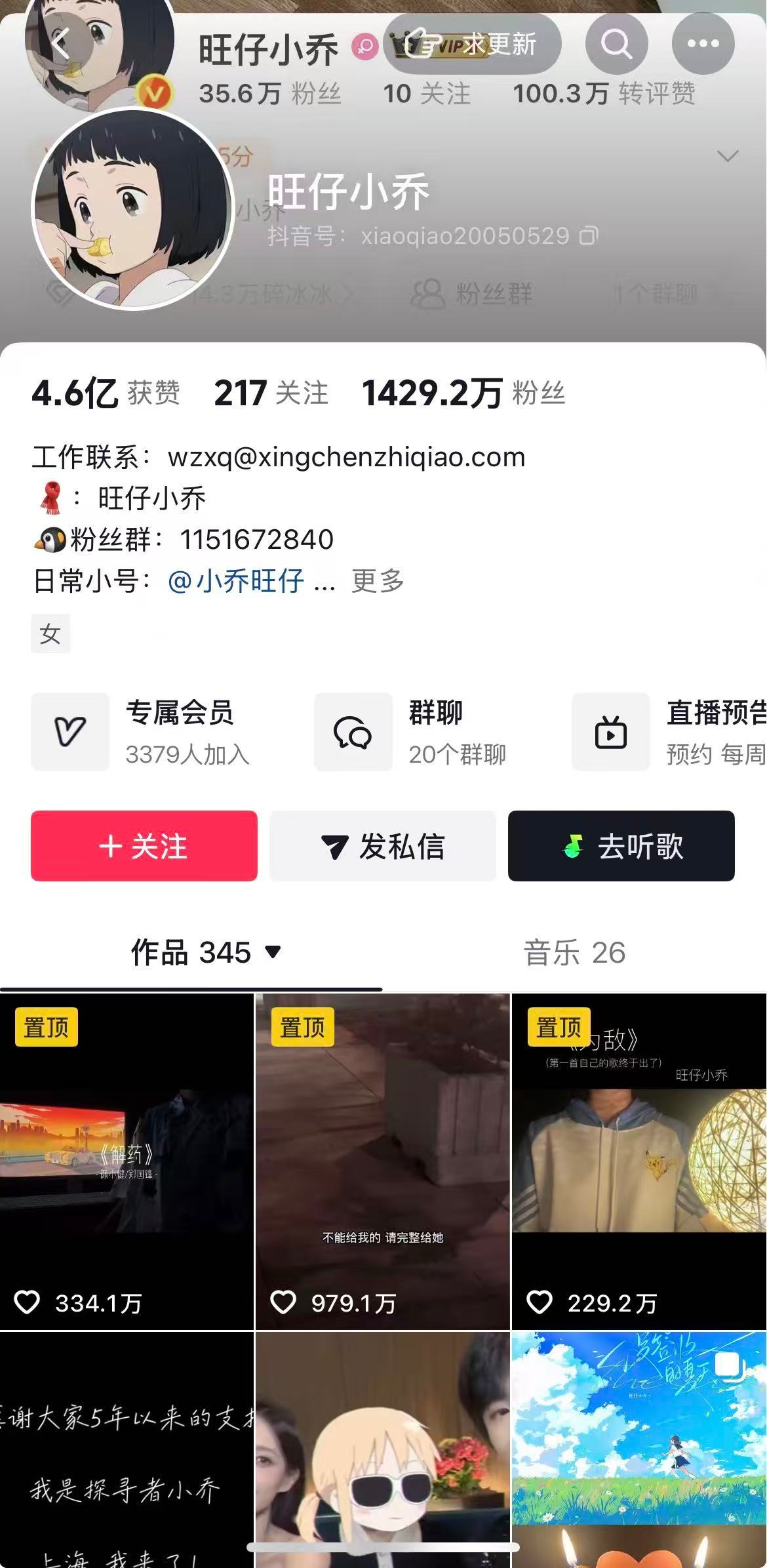
The Douyin account of Wangzai Xiaoqiao (旺仔小乔), one of China's best-known faceless singers, came back to life this week after more than a year of platform restrictions — and the internet promptly went to check the damage. Her follower count, once above 23.4 million, now reads just over 14 million: a loss of more than 9 million, as the news outlet Bailu Video tallied it, in what used to be one of the platform's most reliable comment sections.
Wangzai Xiaoqiao built her career the way a generation of Chinese influencers have: never showing her face. Starting in 2020, she posted cover songs and duets with mainstream stars, letting a cartoon avatar stand in for a face, and the anonymity worked — 23 million followers, and eventually enough fame that "who is she?" became its own topic. Facelessness is not a niche on Chinese platforms; it is an industry, built on anime avatars, voice-only streams and masked appearances, and it trades on a particular kind of parasocial closeness. The audience projects freely onto a singer they cannot see.
The trouble began in July 2025, when she announced a concert built on exactly that anonymity — a "masked" show in which she would perform without ever showing her face, with tickets priced from 268 to 968 yuan. The backlash was immediate. Critics read it as monetizing the mystery one tier too far — paying handsomely for a star who would not appear; arguments over whether she had been straight with fans about who was actually singing — the "original singer" question — compounded it. She tested face reveals in livestreams and posted an apology, but by then the platforms had moved: her accounts were restricted across Douyin and beyond for what would stretch past a year, a deplatforming carried out by companies, with no charge, fine or legal finding attached.
Her return has split the comment section in a way that maps neatly onto a debate Chinese platforms keep having without settling. One camp holds that the punishment already exceeded the crime. "She tested people's attitude to her face, apologized, and has surely mended her ways in this time — why do people keep chasing her?" one user asked, liked more than 1,500 times. The other camp is simply incredulous that a return was possible at all: "This account can still be unbanned? I thought she was gone for good," a typical post reads — while others admit they never learned what she was supposed to have done in the first place.

That is the quieter point underneath the follower arithmetic. Platform restrictions in China are the effective regulator of influencer conduct — faster than any court, unappealable in any formal sense, and reversible without explanation. A year on, Wangzai Xiaoqiao has her account back, 9 million followers fewer, and no public record stating what, precisely, earned the ban or what entitled her to the unban.