FDA Warns GLP-1 Drugs May Cause Permanent Blindness, but China's Platforms Still Sell Them at a Low Threshold
The US drug regulator has warned that the world's most popular weight-loss injections may cause permanent blindness in rare cases. In China, where celebrities have championed these drugs for years, a reporter just showed how easy it remains to buy one online with almost no medical gatekeeping.
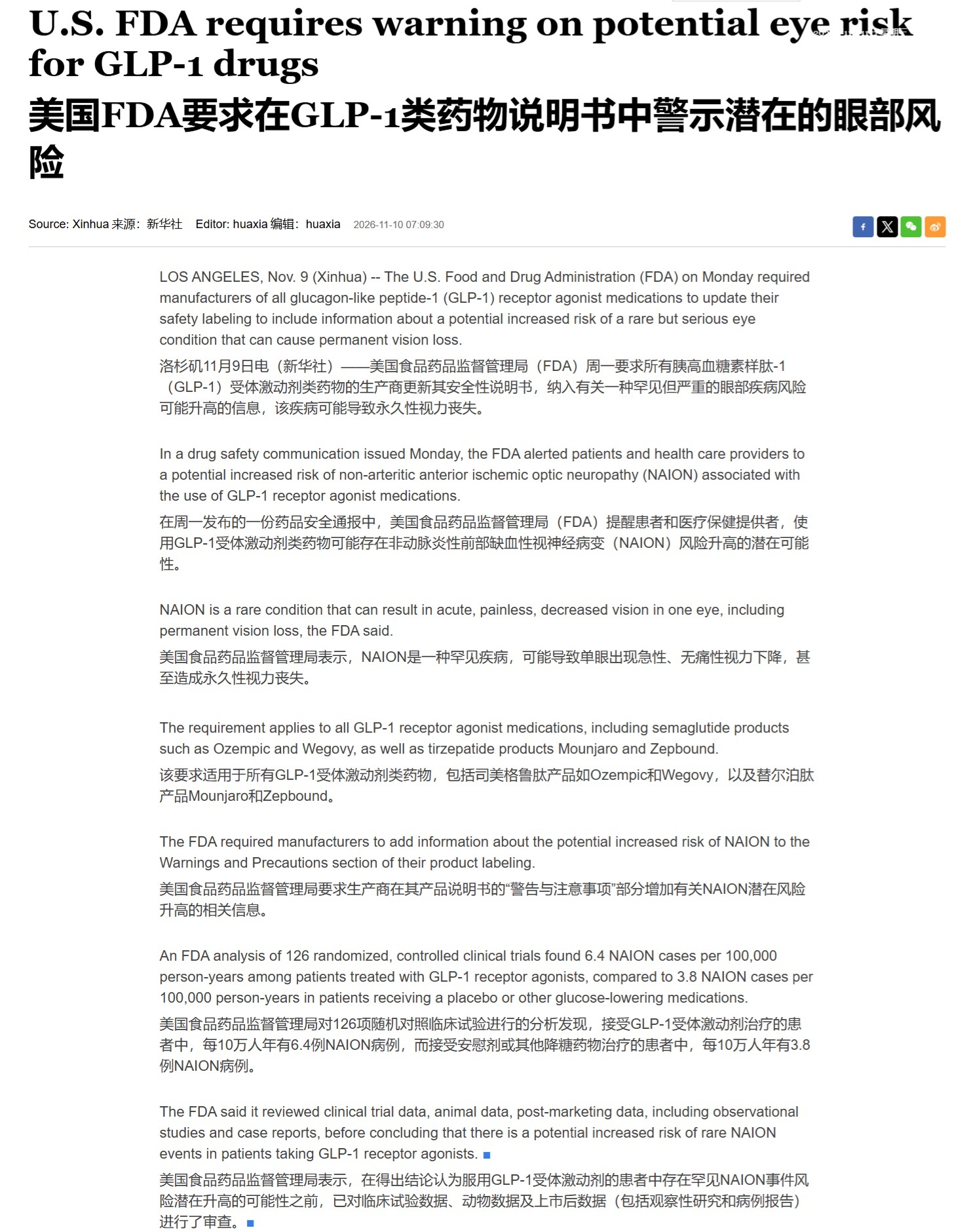
On November 9, the US Food and Drug Administration announced that all GLP-1 receptor agonist drugs — Novo Nordisk's Ozempic and Wegovy, Eli Lilly's Mounjaro and Zepbound among them — must carry a new warning on their labels. The drugs, a class of injectable and oral treatments for diabetes and obesity, have been linked to a rare eye condition called non-arteritic anterior ischemic optic neuropathy, or NAION, which cuts blood supply to the optic nerve and causes sudden, painless vision loss in one eye. There is no known treatment once the damage sets in. Chinese state media carried the announcement within hours; Xinhua's report was reposted widely.
What the warning has not done, so far, is change how these drugs are bought in China. On November 10, a reporter from Orange Persimmon Finance, a local outlet, posing as an ordinary consumer, asked a Chinese online pharmacy's customer service about semaglutide injections. The reply: both injectable and oral versions were in stock, and prices started at 308.8 yuan for a single box — roughly six weeks of treatment. When the reporter ticked "type 2 diabetes" on the platform's online questionnaire, the page immediately moved into a prescription step. The reporter's account was posted on Weibo and drew wide attention.
The FDA's move did not come out of nowhere. The European Medicines Agency had classified NAION as a "very rare" side effect of semaglutide as early as June 2025, and Australia's regulator added a class-wide warning in July 2026. Novo Nordisk has pushed back against the strongest reading of the data, with a company representative saying that existing research has not established that GLP-1 drugs cause NAION. The company's position is technically accurate: the studies show an association, not a proven causal link. But as one Chinese commentator wrote on Weibo, "监管之所以要求加警示,正是因为出现了值得警惕的信号" — regulators require warnings precisely because there is a signal worth watching. "还没证实因果" does not mean the risk is absent, only that the evidence is not yet conclusive.
The Chinese market has a particular stake in this debate. GLP-1 drugs have been marketed as a near-miracle solution for weight loss, with figures like Elon Musk publicly endorsing them, and Chinese online pharmacies have made them accessible at a low threshold. The reporter's experience — a questionnaire, a click, and a prescription — is exactly the kind of frictionless access that a warning label is meant to interrupt. China's own regulator has not yet followed the FDA's move.
The comment that resonated most on Weibo was not about the science at all. It was about who to trust: "该不该用、用多久、定期查什么,听医生的,别听带货的" — whether to use it, for how long, what to check regularly: listen to the doctor, not the one selling it. The FDA warning is the first major regulatory action on the class; whether Chinese platforms will change their sales processes is now an open question.