China's Trade Grew 20 Percent in Ten Months, and the AI Buildout Is the Reason
China's customs data shows the strongest trade growth in years, and the composition is surprising: chips, servers and other AI hardware are doing much of the work. The number also shows how the trade truce with Washington has held even as the trade war's politics continue.
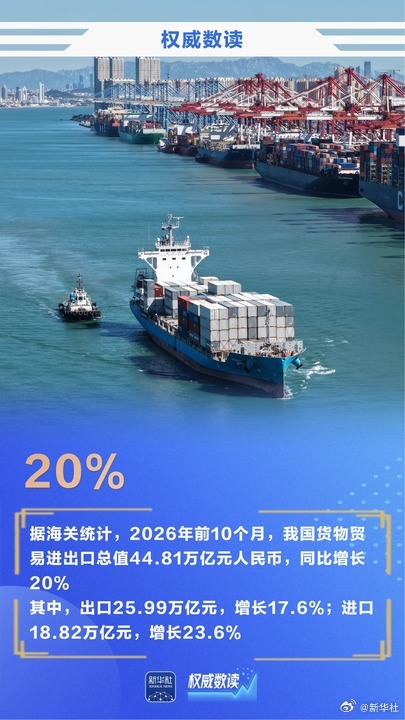
China's customs data released on Monday read like an economy that has stopped worrying about the trade war. In the first ten months of 2026, the country's goods trade grew 20 percent year on year, reaching 44.81 trillion yuan, with Xinhua's data bulletin calling it "strong growth in the face of pressure." The monthly dollar-denominated export figure was even sharper: 35.2 percent, well above the 33.3 percent economists had forecast, according to Caixin's analysis.
The surprise is what is inside the number. Mechanical and electronic products now make up close to 65 percent of China's exports, and within that, exports of integrated circuits and storage components have roughly doubled. The driver is the global AI buildout: as tech companies race to stand up data centers, Chinese factories are supplying the hardware that goes into them. Caixin's commentary notes the demand has also pulled non-AI goods along — Chinese industrial inputs are flowing into newly industrializing countries that are themselves part of the AI supply chain. The "new three" exports — electric vehicles, lithium batteries, and solar cells — added 46.5 percent on top of that.
The trade picture is also heavily Asian. The state broadcaster's business channel calculated that 60.3 yuan of every 100 yuan of China's trade now flows through APEC economies, up from 57.8 a year earlier, and high-tech goods between China and the rest of the bloc grew 50.3 percent. The numbers come a week before the APEC summit in Shenzhen, which China is hosting, and the state media framing is pointed: the trade is not a coincidence of geography, it is the argument for the summit.
Imports grew 23.6 percent, faster than exports — a sign that domestic demand is not simply collapsing. Foreign reserves have also risen past 3.4 trillion dollars, and China's monthly trade surplus has been running above 133 billion dollars, the kind of figures that have made the yuan appreciate and prompted the central bank to reach for older currency-management tools. A Zhihu question asking why the trade data keeps beating expectations while the yuan strengthens has drawn more than a thousand answers, most of them converging on the same answer: the AI boom is not a China story, it is a global one, and China is on the supply side of it.
This is happening against the backdrop of an uneasy truce with Washington.
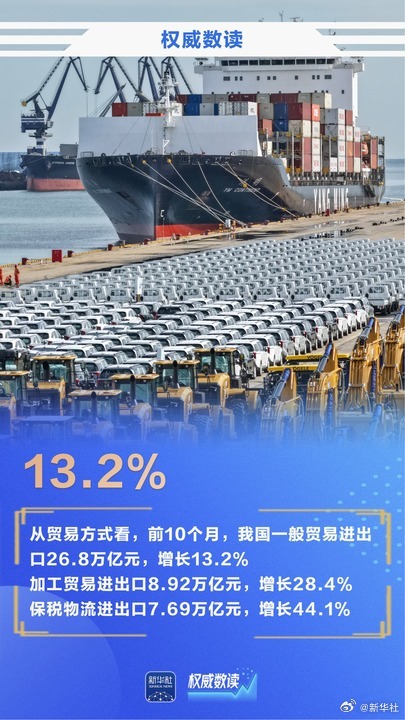
In November, China and the US agreed to extend their trade truce to January, and the tariff exemptions that ran out were renewed on time. Beijing has also suspended the 24 percent tariff increase on US goods for another two months, keeping the 10 percent tariff in place. The site has followed the truce since its last extension. The tension between the two governments has not gone away — the summit in Shenzhen will be the third meeting between the two leaders this year — but the trade data is a reminder that the commercial relationship has its own momentum, one that does not wait on political decisions.