How Fenbi's Blunt Open Letter Turned China's Exam-Prep War into a Spectator Sport
Fenbi, one of China's largest civil-service exam-prep companies, published an open letter admitting it copied a rival's course names, cut prices under competitive duress and profited roughly 510 yuan per student — then the ensuing industry feud played out live, with rival tutors dissecting the text before audiences of tens of thousands.

For China's army of civil-service exam candidates, the evening's main event was not a mock test but a confession. Fenbi, one of the country's largest exam-preparation companies, posted an open letter to Weibo on September 17 under the title "Who Is the Conscience of the Civil-Service Exam Training Industry?" Instead of the usual corporate polish, the letter admitted, point by point, to the tactics students had long suspected: it had named courses after a rival's bestsellers to ride their hype; it had cut prices because competition forced its hand, not out of a change of heart; and it had begrudged the printing and courier costs of paper handouts, substituting free online question-drill courses. The letter even branded one of its own promotional schemes "self-defeating" (弄巧成拙).

More startling than the mea culpas was the arithmetic. The letter walked through the economics of a 1,380-yuan course: roughly 660 yuan in fixed costs per student, 210 yuan for teachers, about 510 yuan in profit per head — implying that a 100-person class clears some 50,000 yuan and a batch of twenty classes sold to 3,000 students brings in nearly three million. Readers were less scandalized by the margins than by the candor. "First time I've seen a company volunteer that it schemes against its own customers," one user wrote, calling Fenbi "the most honest listed company on the internet." The letter drew nearly 19,000 likes within hours, and "Fenbi has gone mad" trended in its own right.
The audience for this accounting is vast. China's national civil-service exam has become one of the country's most contested gateways, drawing millions of applicants a year for a relative handful of posts, a race that has only intensified as private-sector jobs have grown less secure. That anxiety sustains a sprawling prep industry of listed companies, celebrity instructors and price wars — the business Fenbi's letter, deliberately or not, anatomized in public.
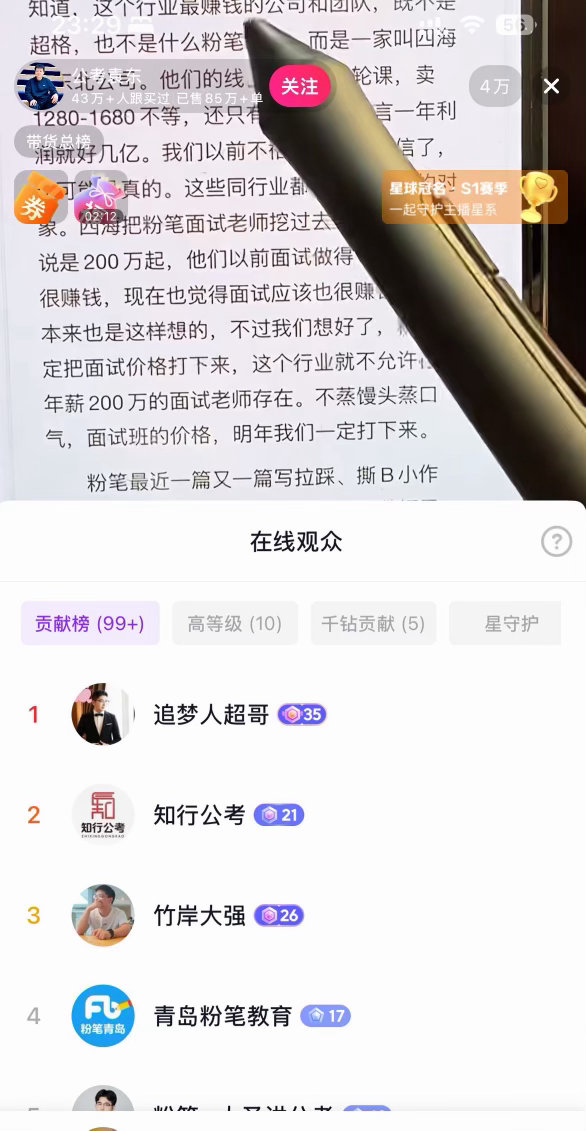
Then the industry turned the confession into a show. That evening Yuan Dong, an independent exam tutor, livestreamed a line-by-line dissection of Fenbi's text, teaching exam technique with the letter as his textbook; about 50,000 people were watching at once. According to a report by Bailu Video, accounts belonging to rivals Chaoge and Sihai — and Fenbi's own regional branches — sat in the audience, while a fan account of yet another tutor topped the stream's gifting chart. Weibo users called it the "civil-service exam Spring Festival Gala" (公考春晚), an event the whole business turned out to watch, and "the exam-prep war" trended alongside it. Among the spicier claims read out on stream: the most profitable firm in the industry is neither market leader Huatu nor Fenbi, but a smaller outfit called Sihai charging 1,280 to 1,680 yuan per course.
The confession did not come from nowhere. Fenbi has had a bruising stretch: its founder, Zhang Xiaolong, drew fire over remarks at a Renmin University of China lecture and resigned all his company positions, several of its best-known essay instructors have departed, and the company has been running losses. Owning the playbook outright — including the admission, under the trending hashtag "Fenbi admits imitating Chaoge," that it cloned a competitor's course lineup — reads as an attempt to get ahead of worse revelations.
Whether candor sells prep courses is untested. Fenbi, for its part, closed the letter by asking students what study products it should build next — an invitation that, by midnight, had drawn its own share of jokes in the comments.