Seven Minutes From the Glacier: How an Ice Avalanche Destroyed China's Nepal Border Crossing
The mudslide that buried China's Gyirong border crossing with Nepal began as a glacial ice avalanche that surged 20 kilometers downhill in about seven minutes, the Ministry of Natural Resources said Thursday. As Nepal's flood death toll passes 350 with more than 900 missing, Wing Loong drones are circling the valley as flying phone towers.
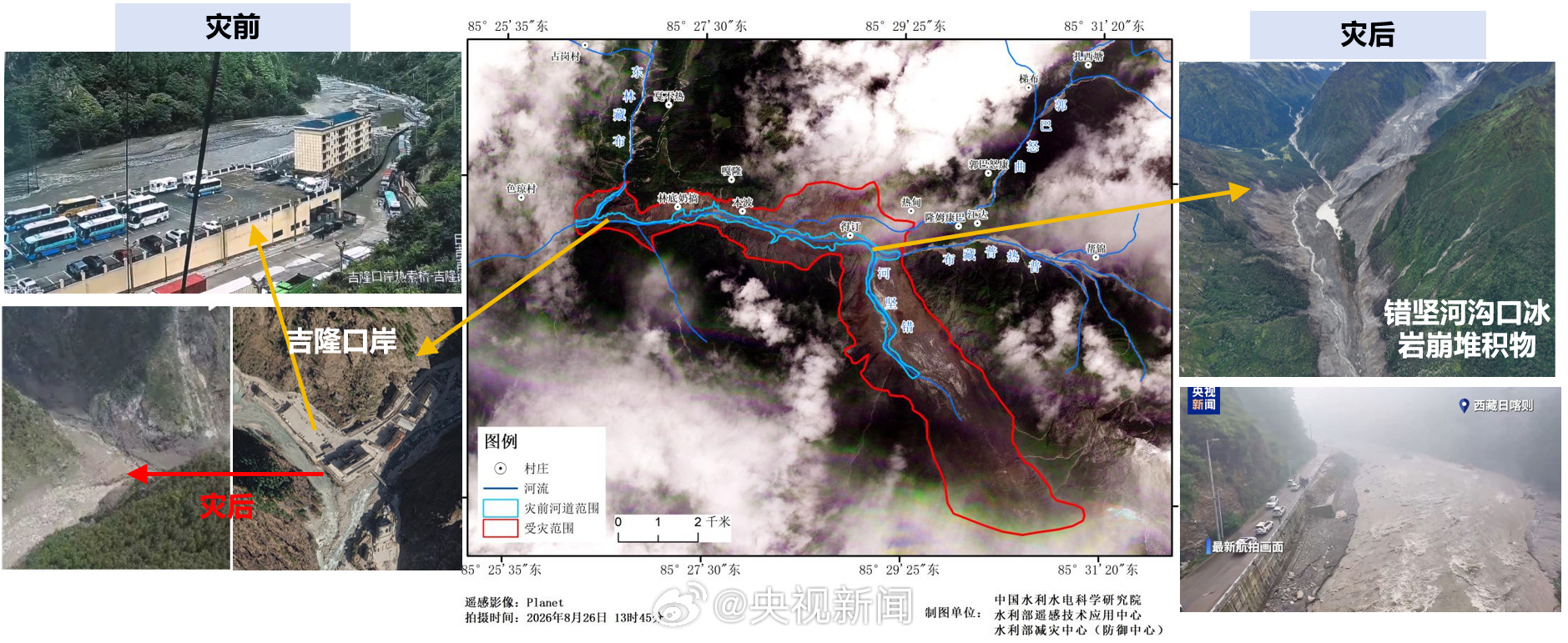
The disaster that buried China's Gyirong border crossing with Nepal on Tuesday began as an ice avalanche on the other side of the frontier — and it moved fast. Experts from the Ministry of Natural Resources said Thursday that glacial ice in the upper reaches of Nepal's Cuojian River collapsed from an altitude of 5,200 to 5,500 meters, gathered into a high-speed debris flow, and covered roughly 20 kilometers before reaching the Chinese border post about seven minutes later. "The glacier, like rock, suddenly broke away," one ministry expert explained in a CCTV explainer that drew more than 4,000 likes. The official determination answers the question that has hung over the rescue since the mudslide first cut the border crossing on Tuesday: what, exactly, came down the mountain.
Imagery released by the Ministry of Water Resources shows buildings at the crossing buried under silt, and a barrier lake swelling where the debris dammed a river junction — an estimated 2 million cubic meters of water, already spilling over, state media reported, with rain forecast for the next three days. The lake had already become the rescue operation's central hazard. "Filmed from a PLA helicopter this afternoon, the China–Nepal border post has completely disappeared," one photographer wrote on Weibo, urging readers to brace themselves for what that implied. (His aerial footage circulated widely.)
The human toll is being counted on both sides of the border. Nepali police said Thursday evening that the floods and landslides set off across the region have killed at least 359 people, with 910 missing — a far higher figure than on the Chinese side, where three deaths have been confirmed and hundreds remain unaccounted for. China's Foreign Ministry added that nearly 100 Chinese citizens are missing in Nepal's disaster zone, and that the embassy in Kathmandu is working with Nepali authorities to verify the number. Premier Li Qiang arrived in the disaster area to direct the response in person.
With roads buried and the valley still unstable, the response has leaned on aircraft — and on a piece of technology most outsiders do not associate with disaster relief. Two Wing Loong drones, China's homegrown surveillance-and-communications platform, are alternating flights at about 8,000 meters over the zone, using satellite links to act as flying base stations and keep 24-hour coverage over a valley whose ground towers are gone. Aerial images the drones captured are feeding directly to commanders; by Thursday afternoon, communications had been restored to within three kilometers of the border gate.
The disaster reached into China's entertainment industry within a day. The Golden Eagle Awards, one of Chinese television's principal prizes, had been scheduled for August 28–30 in Hunan; on Thursday the organizers postponed the ceremony and its festival, saying that "artists forever breathe the same air as the people and share their fate" (文艺工作者永远和人民同呼吸、共命运). The decision was widely read as a mark of respect — and, for some users, a rebuke to fan camps that had spent the week turning the disaster into ammunition against rival actresses competing for the same trophies.
On Zhihu, whether such chain disasters will grow more frequent as glaciers thin became one of the day's leading discussions, with geologists noting that high-altitude collapses in remote Himalayan valleys are nearly impossible to monitor from below. For now, engineers are watching water rather than rock: a lake that did not exist a week ago, already full, with three days of rain ahead.