They Never Took Out a Loan. Then They Were Liable for ¥10 Million.
Eight farmers in rural Henan say a neighbor's 'quick favor' of a signature left them registered as company bosses with bank loans and guarantees in the millions. Police are investigating; the bank says the paperwork was signed by their own hands.
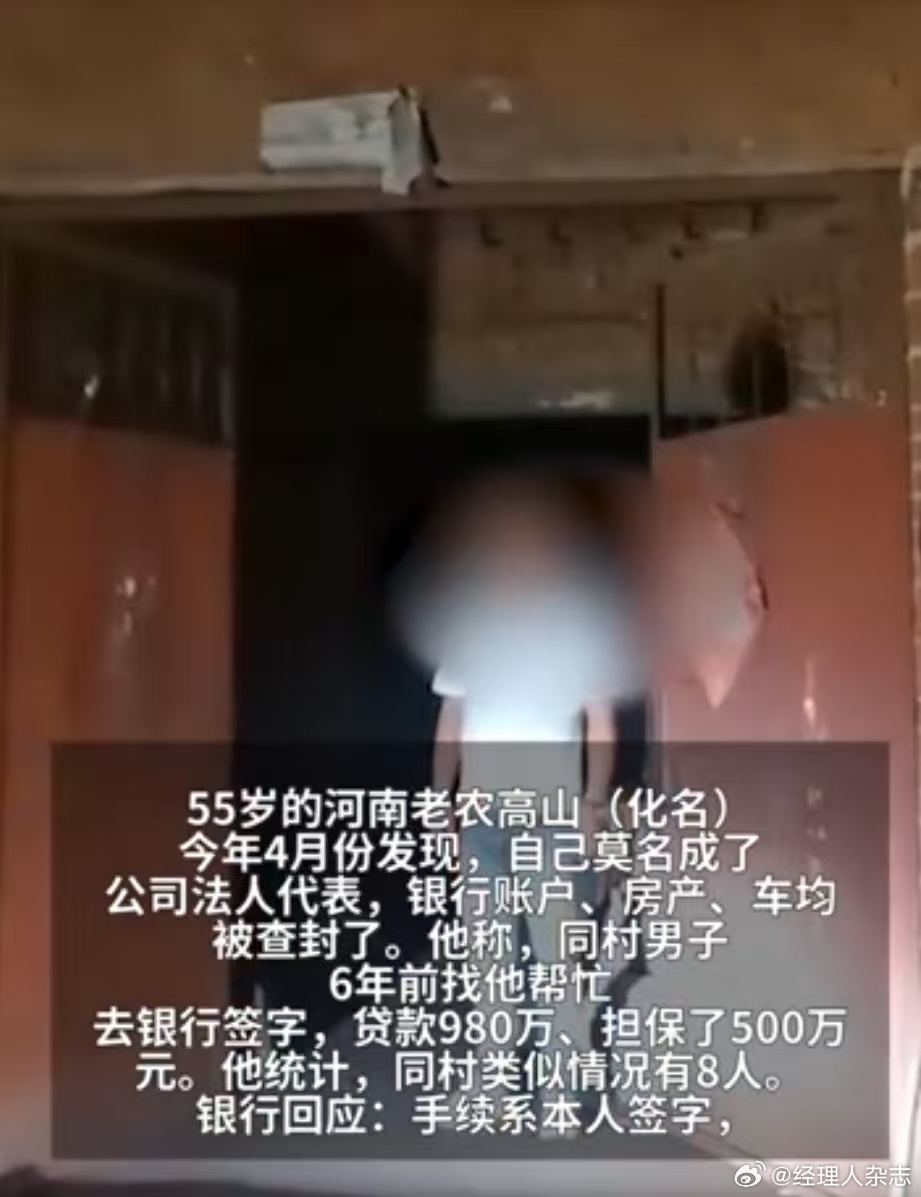
Gao Shan, 55, farms in Nanyang, in Henan province, and earns less than ¥30,000 a year. In 2020 a fellow villager, Lu Moufa, asked him to sign a few papers and verify his identity at a bank, promising a subsidy. Gao signed. This year he discovered what the papers actually did: they made him the legal representative of a company, attached a ¥9.8 million loan and ¥5 million in guarantees to his name, and got his bank accounts, house and car frozen.
He was not alone. Seven other villagers in the same area tell a similar story, according to a Baidu trend item tracking the case this week — a group of farmers "packaged" as corporate shareholders and loaded with eight-figure debt. Police have opened an investigation. The rural commercial bank involved, Henan Rural Commercial Bank's Wancheng branch in Nanyang, has launched an internal review. Its public position, as one Weibo account summarized, is blunt: the procedures were complete, the signatures were the borrowers' own.
That is technically true, which is precisely what makes the case feel so alarming. China's rural banking networks have spent a decade digitizing "real-name" lending, building a system whose legitimacy rests on a signature and a fingerprint at a counter. What the system is less good at catching is the social setting around the signature — the neighbor's favor, the village trust, the promise of a subsidy, the farmer who has never read a loan contract and is not expected to. A signature that is legally authentic can still be factually involuntary.
The stakes are not theoretical. The same Weibo summary notes the human cost in plain terms: "ordinary people simply cannot bear this debt, and their lives have fallen into complete hardship." A farmer's entire collateral — a house, a car, a bank account — can be sealed on the strength of documents he signed to help a neighbor.
What the public is waiting for now is whether the investigation looks past the paperwork. The question is whether a "complete" set of forms, signed by hands that did not understand them, can be treated as consent — and whether a bank that cheerfully issued a ¥9.8 million loan to a man earning ¥30,000 a year should have asked a few more questions of its own.