Kim Jong Un Visits Dandong, Laying a Wreath at China's Korean War Memorial
North Korea's leader crossed the newly opened Yalu River bridge to honor the Chinese volunteers who fought in Korea, in a visit heavy with symbolism for the alliance — and for the border city that connects the two countries.
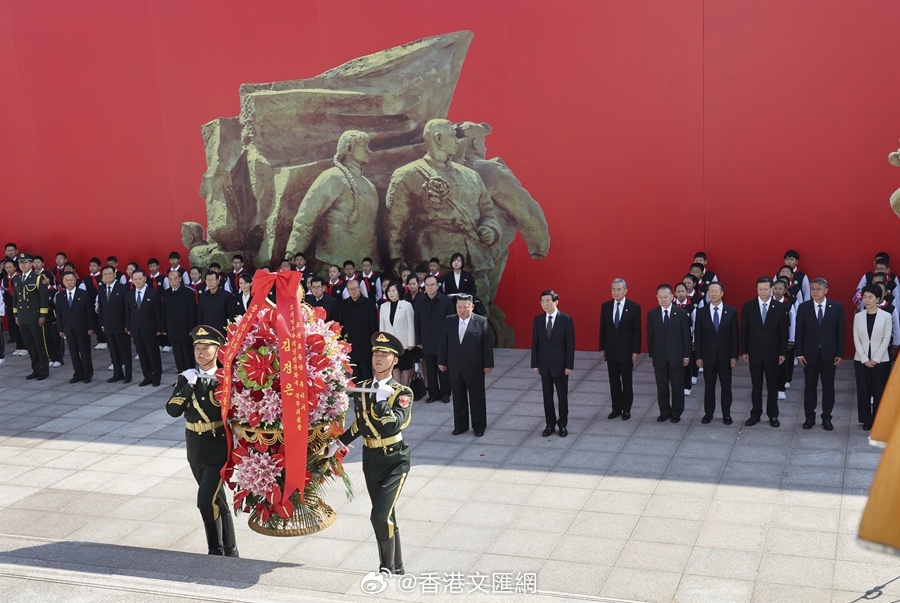
Kim Jong Un spent Saturday morning in Dandong, the Chinese border city where the story of the Korean War is told in granite and bronze, laying a wreath at the War to Resist US Aggression and Aid Korea Memorial in the company of Wang Huning, a Politburo Standing Committee member and the chairman of China's top advisory body. State media read out the details deliberately: both countries' national anthems, a wreath ribbon in Korean script reading "Forever remember the martyrs of the Chinese People's Volunteer Army," and a guided tour of the memorial hall that displays the two nations' shared wartime record.
The occasion was the 76th anniversary of the Chinese volunteers' entry into the Korean War, and the route Kim took to get there carried its own message. He crossed the Yalu River by the new bridge that opened barely a week ago after a decade of waiting — coverage this site ran as the crossing was finally set to open — turning a piece of long-idle infrastructure into the stage for his most visible China trip in years.
The memorial visit was the public half of the day. In the meeting that followed, Wang spoke of a friendship "forged in blood" between the two parties, and the Chinese readout framed Kim's visit itself as proof that Pyongyang treasures the wartime bond. The symbolism lands differently at each end of the border. For a Chinese audience, the volunteers who "crossed the Yalu" in 1950 remain the founding story of the alliance; for a North Korean one, the wreath and the museum walkthrough signal that Pyongyang is willing to stage that gratitude in person, on Chinese soil, at a shrine built to the alliance itself.
The staging is doing quiet diplomatic work too. It comes in the same week as the Global Governance Forum in Xiong'an, the new-model multilateral conclave that Beijing's state media have been promoting as a platform for a fairer international order — a gathering introduced to Chinese audiences with a CCTV commentary on "gathering strength through confidence and solving problems through cooperation" — and receiving North Korea's leader at the memorial to the war in which the two countries' armies fought as allies fits that picture: shared history, hierarchy, and the promise of an alternative bloc, all in one frame.
For the border city itself, the visit was a showcase. Dandong's riverside economy has long traded on being the gateway to North Korea, and the bridge reopened only days ago; a head-of-state crossing puts the city back at the center of a relationship that had visibly cooled.
What comes next is the practical question the ceremony leaves open: whether the newly opened crossing becomes a routine corridor for the trade and travel both governments have an interest in reviving. Neither side announced agreements on Saturday — only the flowers, the anthems, and the photographs.