Shanghai Makes Childbirth Free as Wuhan Seals an Underground IVF Lab
From October 1, compliant childbirth in Shanghai will cost patients nothing out of pocket, with a 4,500-yuan prenatal allowance and full reimbursement for delivery. The same week, Wuhan sealed an underground assisted-reproduction lab and detained eight people — two edges of China's struggle to make having children affordable and safe.

From October 1, giving birth in Shanghai will cost compliant patients nothing out of pocket. Under a policy the city's health-care bureau announced on September 8, prenatal check-ups now carry a 4,500-yuan (about $630) allowance — and if the bills run past it, maternity insurance picks up the rest; hospital delivery costs within policy are reimbursed in full. The city even made the allowance refundable: whatever a family does not spend on check-ups can be withdrawn as cash.
The announcement, reported by ThePaper and splashed across Baidu and Zhihu's hot boards, is the most generous version yet of the pro-natal perks Chinese cities now compete to offer. It lands in a country where the birth rate has become a standing emergency — we covered the 2025 figures here: 7.92 million births, a 17 percent drop. On Weibo, the reception was warm but unsentimental. “Anyone who has had a child knows: giving birth costs little. Raising the child is the real bill,” one popular comment read, under a post carrying the policy explainer.
That gap — between subsidizing the moment of birth and the lifelong cost of a child — is exactly where the week's other fertility story sits. On September 7, users reported that an underground assisted-reproduction laboratory was operating in Wuhan's Wuhu subdistrict. By the next day, the municipal health commission, in a joint inspection with police, had sealed the site and handed eight people to public security for control, promising to investigate and punish “in accordance with the law.” Xinhua carried the notice; a People's Daily post on it drew nearly 3,000 likes.
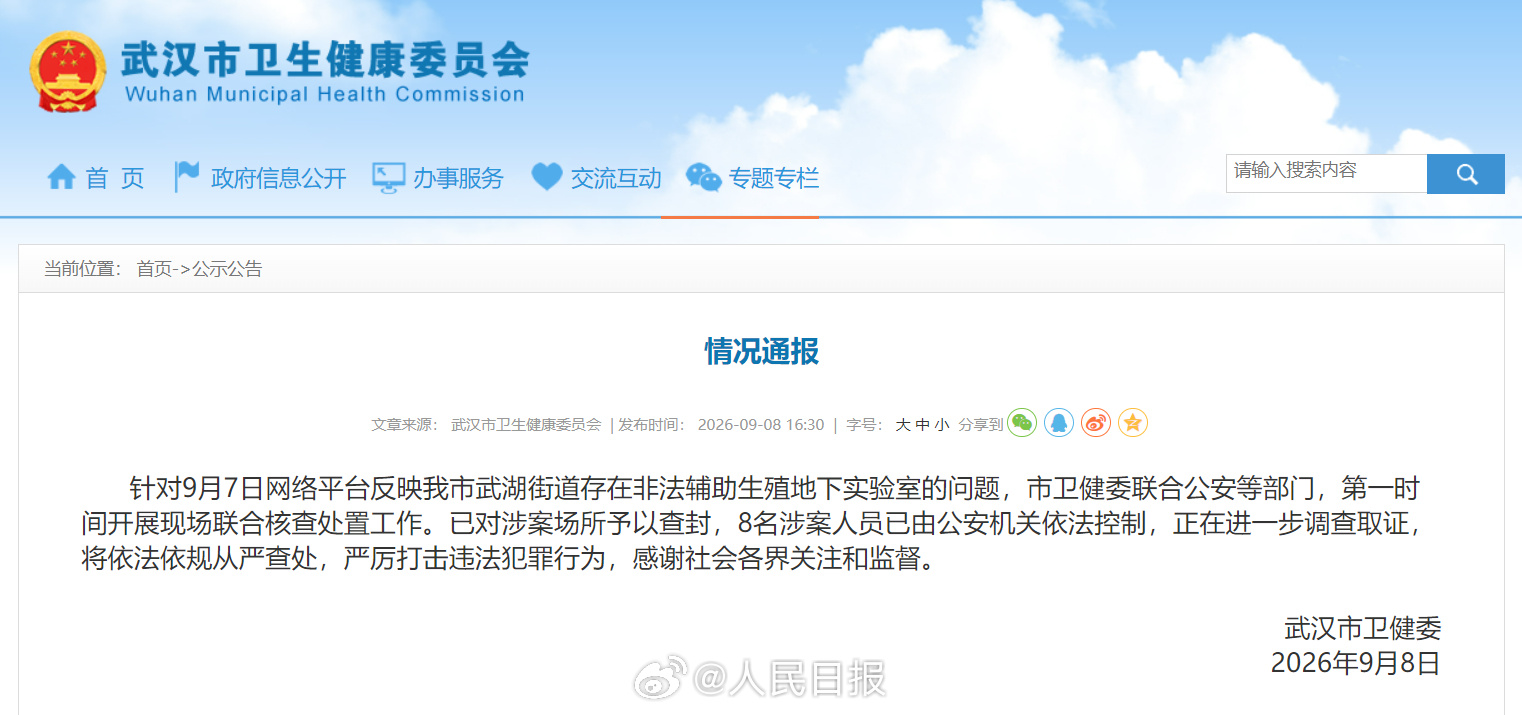
Read together, the two stories sketch the edges of the same problem. Cities are pushing the cost of having a child toward zero at official facilities; yet demand for fertility services — IVF, egg freezing, surrogacy arrangements — remains tightly restricted, and an illicit lab in a residential district of a major city flourished until neighbors blew the whistle online. The Wuhan case is now one of the most-discussed topics on Zhihu, where readers are asking what exactly deserves scrutiny: the operators, the regulators, or the rules that push patients toward the gray market.
For now, the policy momentum runs one way. Shanghai's coverage takes effect October 1, and other cities will face the obvious question of whether to match it; the eight people in Wuhan await the outcome of a criminal investigation that will say something about how firmly the line around legal fertility care is drawn.