China's Births Fall to 7.92 Million, a 17% Drop That Erased the Dragon-Year Bump
Figures showing 7.92 million births in China in 2025 — 1.62 million fewer than the year before, and barely three-quarters of the 2016 total — raced to the top of Baidu and Weibo, dragging along an argument about whether any policy can stop a fall that young people themselves describe as an answer, not an accident.
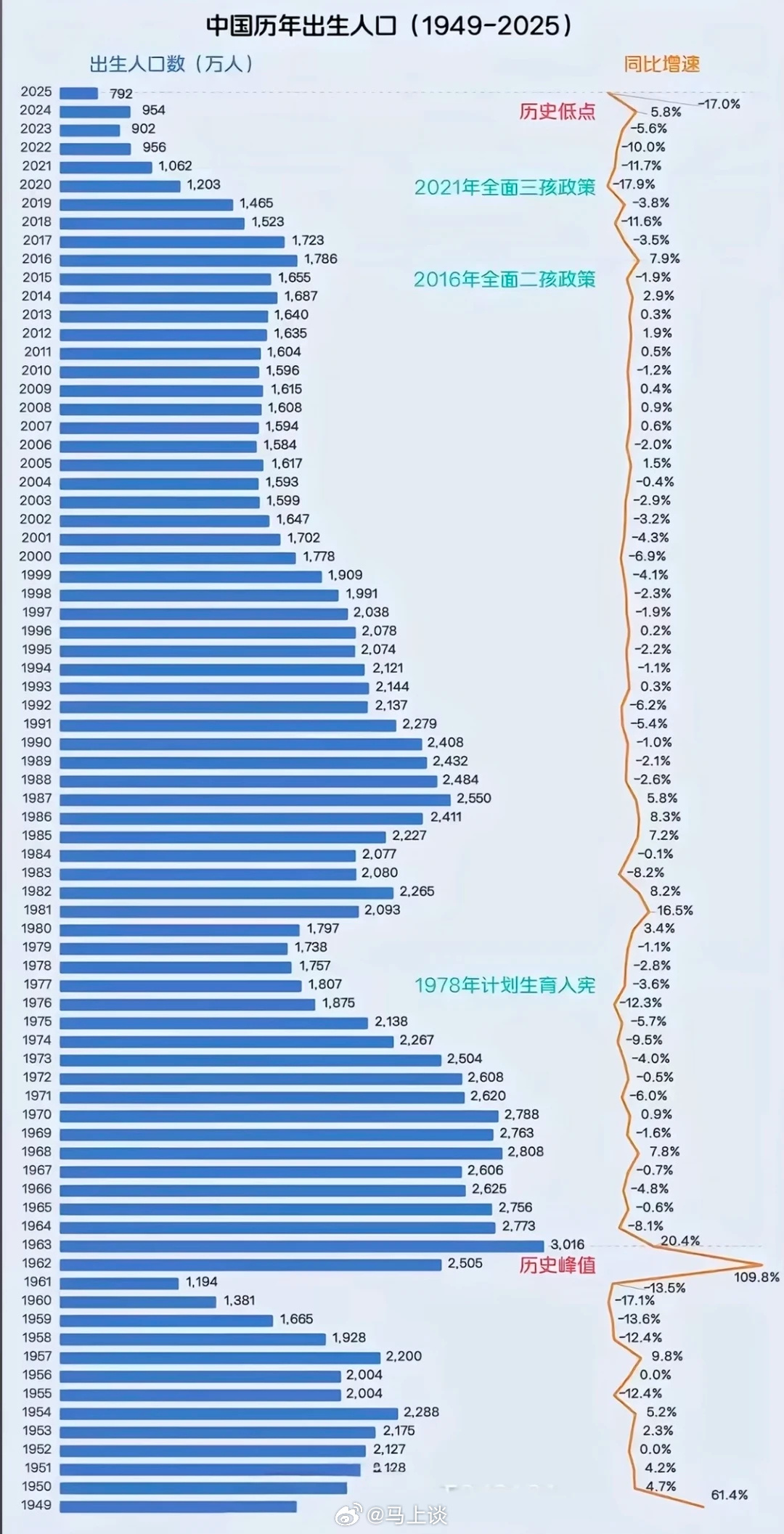
The number that dominated Chinese social media this week was small, and that was the point: 7.92 million. Posts giving 2025's newborn total as 7.92 million — down 1.62 million from 2024, a drop of about 17 percent — carried the hashtag to the top of Weibo's trending board and onto Baidu's hot search list, where it sat alongside a companion item noting that South Korea's newborn count, too, has just set an unwelcome record.
The chart that traveled furthest showed annual births from 1949 to 2025, and its annotations read like a history of Chinese population policy: the two-child policy of 2016, when births briefly rebounded to 17.86 million; the three-child policy of 2021, when they were already down to 10.62 million; and the long slide since. The one bright spot was 2024, the auspicious Year of the Dragon, when births ticked back up to 9.54 million. "Stop using the Dragon Year as a fig leaf," one widely shared post put it. "The trend is down, and it hasn't found the bottom."
"Answering the era with their choices"
What made the topic burn was less the figure than the framing it invited. The most-shared summary described young people as "answering the era with their choices" (年轻人正在用自己的选择回答这个时代) — births as a deliberate verdict, not a statistical accident. The same post laid out what it called three mountains that hadn't moved: cannot afford to raise a child, dare not, do not want to. It pointed to a detail demographers have long flagged: a sex ratio at birth of 111.5 boys for every 100 girls, evidence that son preference, too, persists.
Nor did commenters spare policy. Subsidies, childcare places and housing perks will keep coming, the argument ran, but none of it touches income expectations or the cost of raising a child — "a light rain," as one post had it, against education, healthcare and housing bills that would require real sacrifice. The housing lever is already being pulled: last week's mortgage overhaul, which stretched loan terms to 40 years to cut monthly payments, was pitched partly as relief for young families.
There was one more number in the discussion, and it pointed forward. Official data on first-half marriage registrations shows a record low — less than half the historical peak, as one commentator noted — and marriages are the leading indicator of births. On current form, 2026 will set a lower floor still. The comment that gathered the most agreement asked the question the figures now pose for the decades ahead: with pension gaps widening and the workforce shrinking, "these are bills that will come due sooner or later. If we don't act now, there won't even be a window to adjust in ten years.