Xiao Zhan Puts Every Ticket of His New Tour on Public Sale, Breaking a Concert-Industry Rule
Tickets for Xiao Zhan's 'Exit · Us' tour go on sale through Damai with no reserved house allocation, after the star's studio reportedly gave up the industry-standard 15 percent of seats that usually feed scalpers. More than 1.5 million fans registered interest in the Nanjing shows within a day.
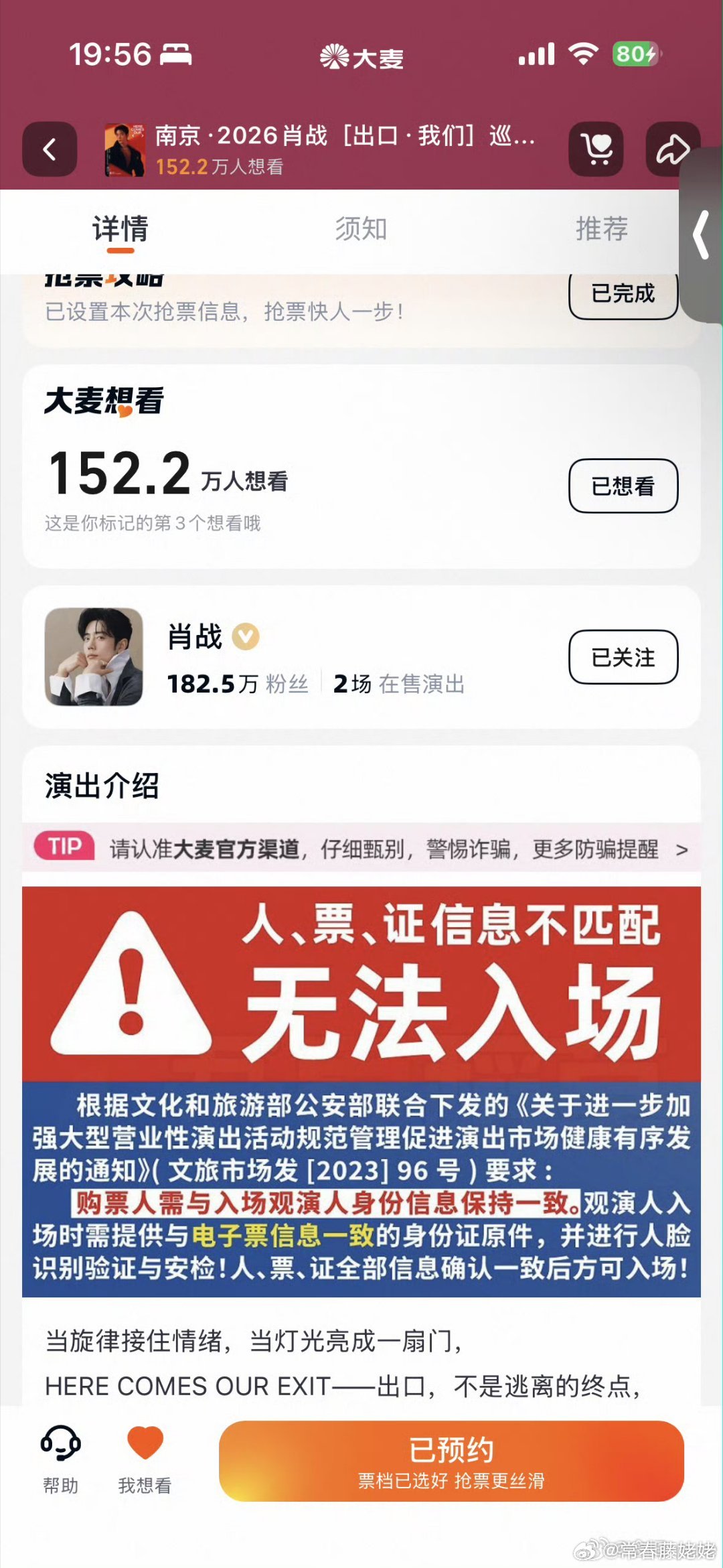
When the actor and singer Xiao Zhan announced his 2026 "Exit · Us" tour on Monday — two nights each in Nanjing on October 23 and 25 and in Shanghai on November 6 and 8 — the announcement itself was an event. His post was reposted more than a million times within hours; by evening, the topic page showed 830 million reads, and Damai, the ticketing platform, counted over 2.5 million registrations of interest across the four shows. A fan account screengrabbed the app at 1.52 million for Nanjing alone, beneath a red banner warning that tickets, ID cards and faces must all match at the door.
But the announcement's second act is what turned a concert into an industry story. On the same day, entertainment outlet Jimu News reported that Xiao Zhan's studio had, in its contract with Damai, given up the roughly 15 percent of tickets that concert organizers conventionally reserve for internal channels — the block that, once it leaks, feeds the scalper market — and required every seat to be sold in the public pool through one official channel, with strict real-name verification: ID, e-ticket and face recognition must agree, and nothing may be transferred.
The scale of demand is exactly why the allocation matters. In China's live market, a hit show's reserved "channel tickets" routinely surface on resale sites before the public sale even opens, at several times face value. A screenshot circulating on Monday drove the point home: an account posing as an insider claimed to have "internal tickets" for sale, followed by what was reported to be a WeChat Moments post from Xiao Zhan's own manager reading, in full, "The team has no internal purchase channel. Thank you for your support and understanding."
The studio's own notice to fans was blunter — buy only through Damai, distrust anyone selling "internal" tickets, transfers are impossible — and ticketing-platform warnings are now standard at this scale. What is not standard is the contract term. Commentators framed the move as tearing the cover off a long-unspoken rule of the business. "For years, reserved tickets have quietly flowed to scalpers, and ordinary fans face an empty ticket pool at face value," one popular post put it. "Using the rules to win a bit of fairness matters beyond one concert."
There is a limit to what one tour can change: the reserved-ticket practice persists because it suits promoters, venues and corporate buyers, and no regulator has ended it. The test of the experiment arrives the moment tickets go on sale — with 1.5 million people registered for a single venue, even a spotless public pool will leave almost everyone without a ticket. The difference, if the contract holds, is that the scalpers will be empty-handed too.