China's State Council Tells Employers to Slow AI's Replacement of Workers
A new State Council directive asks companies to cushion workers before rolling out AI — advance notice, 'unemployment buffer periods', and a prudently slower pace in labour-intensive industries. It is Beijing's most explicit signal yet that AI-driven job loss is something to be managed, not just endured.
When China's cabinet addresses artificial intelligence, the phrasing is usually about opportunity. The document the State Council's General Office released on October 23 is about damage control. The Opinions on Adapting to AI Technology Development to Help Build an Employment-Friendly Mode of Development direct the country to slow down — to manage the pace at which AI replaces human labour, and to cushion the workers it displaces.
The most striking instruction is about sequencing. AI should be applied first in sectors where labour is scarce or the work is dangerous, the document says, and in labour-intensive industries its spread should be handled "steadily and prudently" (稳慎), so as to "minimise the shock to workers as much as possible." Companies are encouraged to experiment with an "unemployment buffer period" (失业缓冲期): before AI is deployed at scale, affected workers receive advance notice and support for retraining or reassignment. The document also asks officials to develop new AI-era occupations and new models of employment and entrepreneurship.
The phrase that trended was blunter. 减缓人工智能应用就业替代影响 — "mitigate the employment-substitution impact of AI applications" — hit Weibo's trending list within hours, and the most substantive response came from the economist Chen Jing, who argued that China's problem is now the opposite of the one it has spent four decades solving: too much efficiency. One Weibo user put it plainly: Chinese society is "too obsessed with efficiency, and it has gone too far" (太讲究效率了,过头了). With the trade surplus pushing past a trillion dollars, he suggested, the marginal gains no longer justify the social cost — and he proposed a four-day work week, shorter hours for everyone, and pointed to actors as the warning case: with AI drama production scaling up, performers were on the verge of being "almost entirely unemployed."
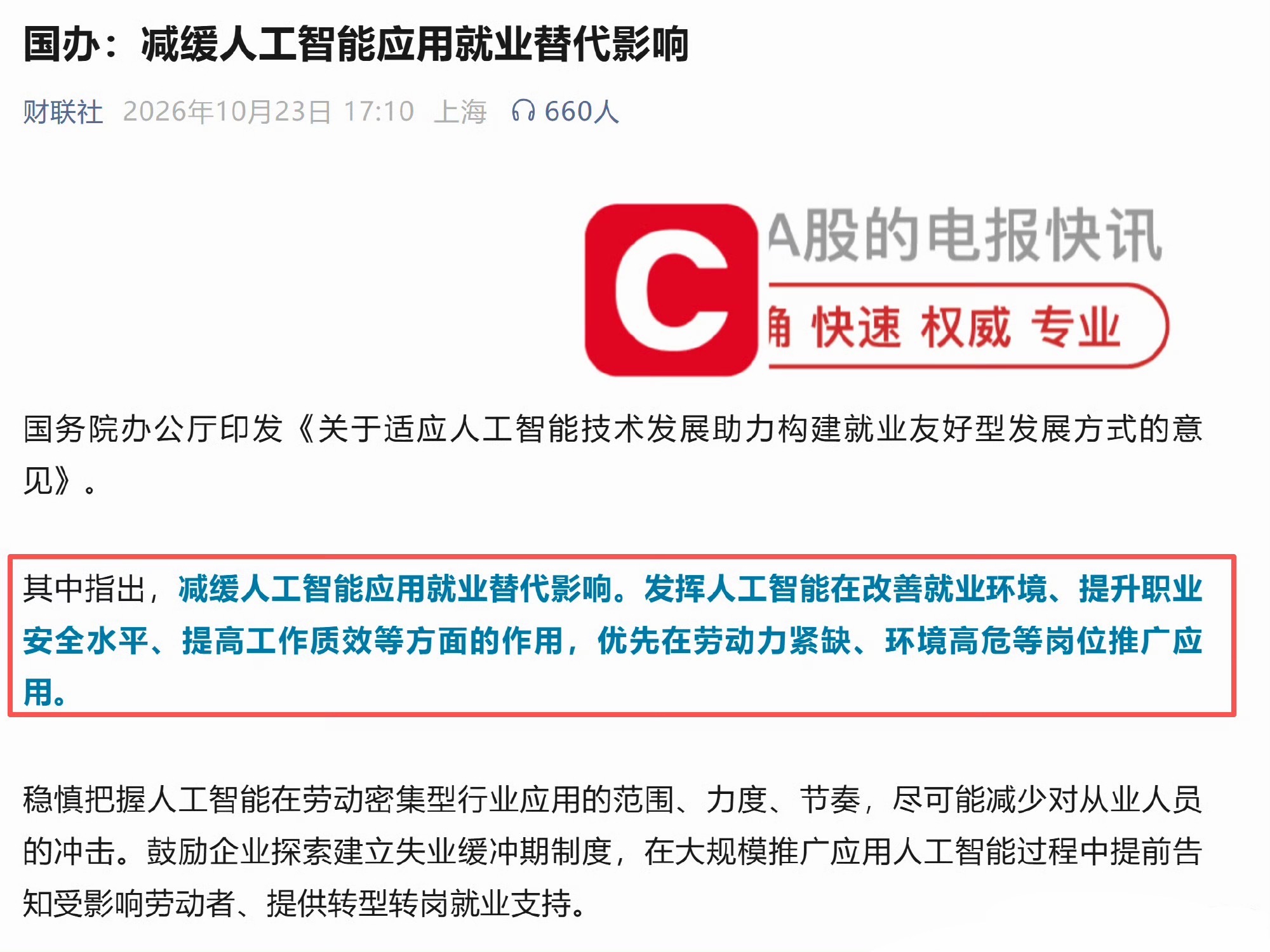
The directive lands on ground this site has been mapping for weeks: China's graduates already face AI interviewers on the other side of the hiring table, and a lawyer's viral essay urged young Chinese to hoard cash as AI reprices office work. What is new is where the answer is coming from. This is not a platform content policy or a company's goodwill gesture — it is the State Council's General Office, the body that executes cabinet decisions, telling employers that displacement is a cost they will be expected to manage.
There was also a counterpoint the same day. The Hong Kong Exchange launched new AI and semiconductor indices, formalising a market that is pouring money into the very technology the mainland is now trying to slow. Capital sees the future arriving quickly; the policy document insists it arrive gently.
The buffer period, for now, is an invitation rather than a rule — the document is guidance, not law. Whether "advance notice" acquires teeth, and whether a worker replaced by a model learns about it from a manager or from a layoff notice, is the question it leaves open.