Young Chinese City Dwellers Have Taken to Selling Their Scrap — Under Cover of Darkness
In Beijing, Shanghai, Guangzhou and Shenzhen, a new late-night ritual is quietly spreading: young professionals hauling cardboard and bottles down to the recycling station after 11 p.m., hoping not to run into the retired women and men who have worked these beats for decades. Phoenix Weekly spent a week selling scrap to understand why.
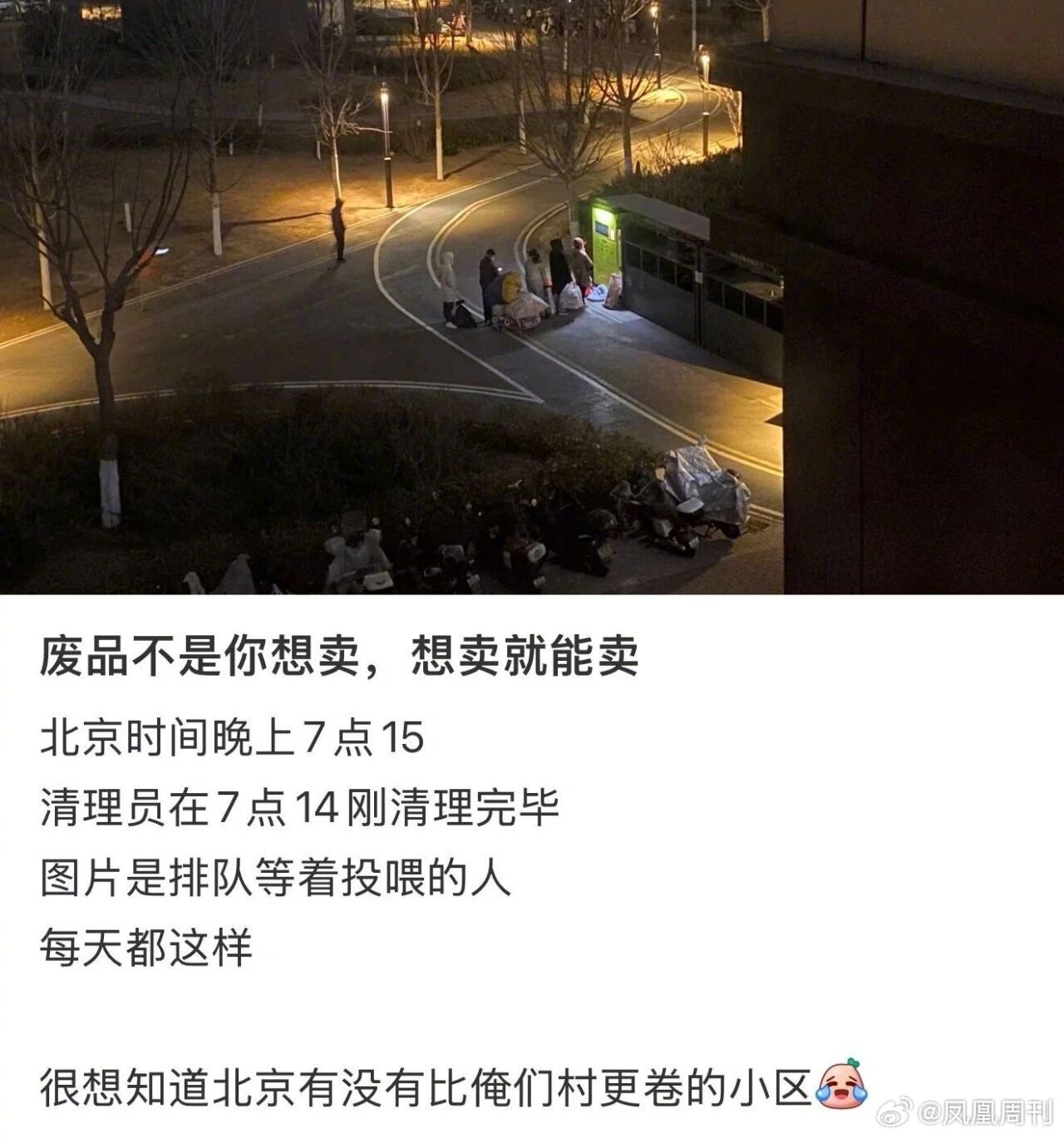
In the big Chinese cities, the people who collect recyclables have always been easy to spot: older, often retired, methodical, territorial about their rounds. A new trend piece from Phoenix Weekly — carried on Weibo under the hashtag #一线年轻人开始半夜卖废品了# ("young people in tier-one cities have started selling scrap in the middle of the night") — documents a quiet inversion. Now, at 11 p.m., a second shift appears: young office workers sneaking downstairs with their cardboard, deliberately timed to avoid the professional collectors.
The awkwardness is the point, and the piece leans into it. A generation that once handed its empty bottles and delivery boxes to the nearest granddad without a second thought has started competing for them, and it does so with what the article calls 偷感十足 — "full of sneakiness": the posture of someone doing something slightly embarrassing. The fear is social, not financial — running into the aunties at the compound's garbage station and having to negotiate, adult to adult, over a pyramid of flattened boxes.
The economics, though, are real enough to change behaviour. Once a person starts selling scrap, the article observes, "their life gets defined": you begin pre-sorting your trash, weighing which packaging is worth money before you throw anything away. The reporter went further than interviewing — she sold scrap for a week to write the piece, and her field notes are the article's best material. One entry, timestamped 7:15 p.m. in Beijing, describes arriving at a compound recycling point one minute after the attendant finished clearing it and finding a queue of residents already waiting to feed the machine. "I'd really like to know," she writes, "whether there's a compound in Beijing more fiercely competitive than ours."
The deeper economics sit inside a screenshot the post carries, drawn from a longer essay on clothing recycling: China's second-hand clothing trade generated 18.1 billion yuan in retail value in 2023, with tens of billions more in related industries — an entire secondary economy that runs on precisely the behaviour the young scrap-sellers are relearning. The internet, the article dryly notes, is full of get-rich-quick legends; the recycling station offers only "solid, down-to-earth life."
Why it resonates is easy to see and hard to say plainly. The trend is one more entry in a growing genre of micro-income stories — young Chinese documenting small, unglamorous cash streams alongside their salaries, from weekend stall-keeping to reselling. Selling scrap is the least romantic of them: it pays little, and it makes the cost-of-living arithmetic visible in the most literal way, one kilo of cardboard at a time. What the article captures is not poverty but a shift in posture — a generation that once treated disposability as normal now sorting, saving, and hauling its own waste at midnight, somewhere between thrift and a quiet acknowledgement that every yuan has to be chased.