Guangzhou Metro Defends Its 270-Minute Limit After a Reader Is Charged 15 Yuan
A woman who read a book in a Guangzhou station for five hours was charged a 15-yuan 'overtime fee' under a 270-minute travel limit few riders knew existed — and the operator's defense that 'the metro is not a place to linger' has collided with its own reading rooms and gyms.
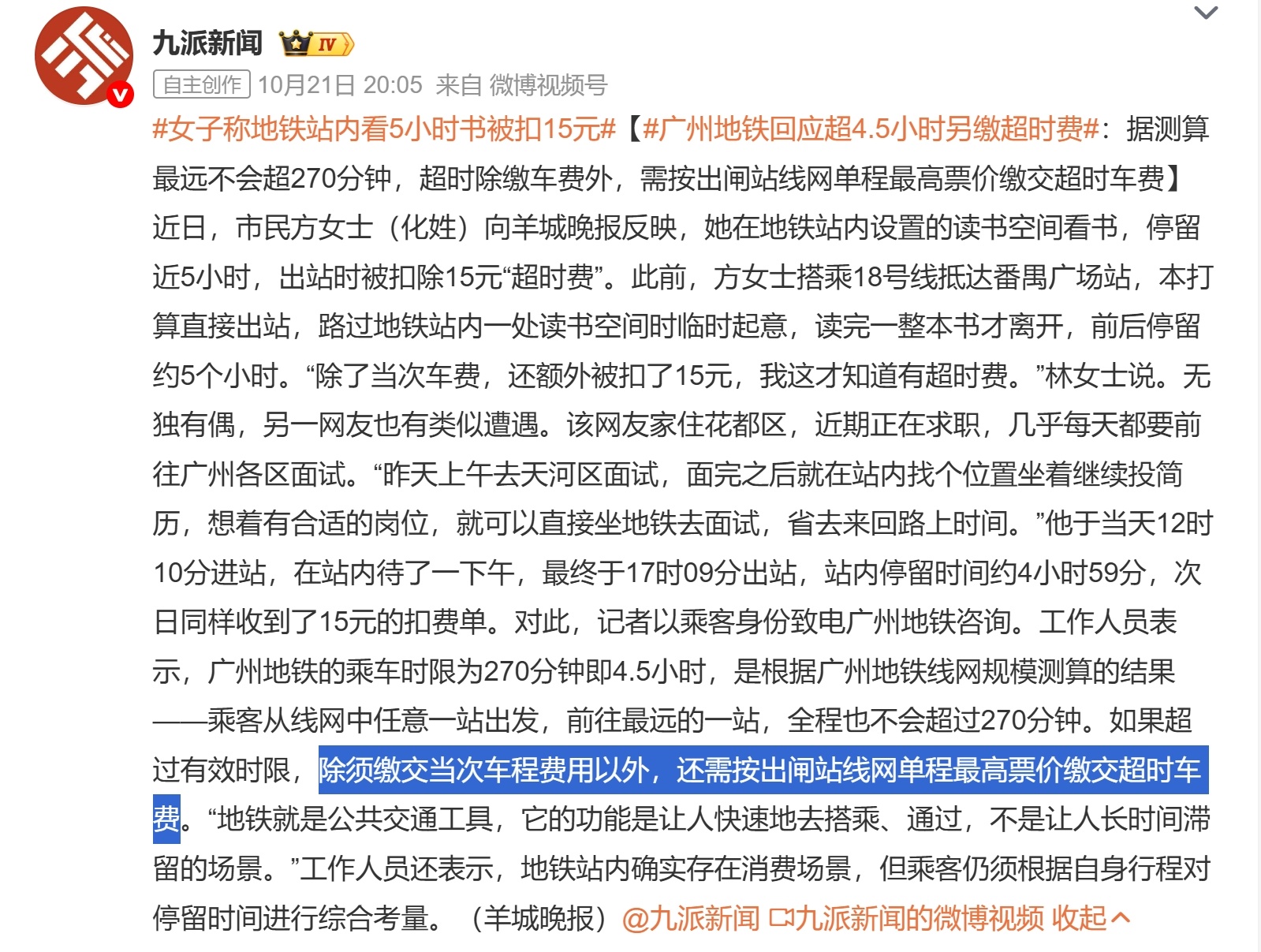
For five hours, the passenger Chinese social media knows only as Ms. Fang sat in a reading nook inside Guangzhou's Panyu Plaza metro station and read a book to its final page. She had ridden Line 18 in that morning, meaning to leave at once, and then passed the station's reading space and changed her mind. When she finally swiped out, 15 yuan more than her fare had gone with it. "On top of my trip fare, they deducted another 15 yuan," she told the Yangcheng Evening News. "That is how I learned there was such a thing as a timeout fee." Her account was picked up by Jiupai News and drew more than 900 likes within a day.
The rule she had run into is real, and little known. Guangzhou Metro imposes a 270-minute limit — four and a half hours — on every journey in its network. The figure is not arbitrary: by the operator's own calculation, the longest possible ride across one of the world's largest metro systems, from any station to the farthest, takes no more than 270 minutes. Anyone inside the gates longer than that is assumed to have stopped traveling. The penalty is not a per-minute charge. Once past the limit, a passenger pays the highest one-way fare from the exit station, on top of the fare already paid.
"The metro is public transport. Its function is to get people boarding and moving through quickly — it is not a place for people to stay for hours," a Guangzhou Metro staff member told a reporter who called posing as a passenger, adding that although stations now contain places to spend time and money, passengers "should weigh their own itinerary against how long they stay."
The explanation did not settle the matter, because Ms. Fang was not alone. A job-seeker from the city's Huadu district told a nearly identical story: he entered a station at 12:10, spent the afternoon in it sending out résumés between interviews, and swiped out at 17:09 — four hours and fifty-nine minutes inside the gates. The next day, another 15-yuan deduction appeared. Since July, calls to the metro's service hotline about timeout deductions have risen 7.61 percent on the month before, according to figures the operator shared with the Yangcheng Evening News — the report that assembled the tally also noted that most callers said they had been waiting for someone, or watching videos, and simply lost track of time. Many readers said they had ridden the network for years without ever hearing of the limit. Nor is the rule unique to Guangzhou: Shenzhen's limit is 210 minutes, and Dongguan's network allows just 120, with the same highest-fare penalty.
What turned a 15-yuan fee into a hot search — it ran at No. 2 on Baidu's board — is the mismatch at its center. Guangzhou's stations are being deliberately redesigned as places to stay: the reading nook that charged Ms. Fang exists precisely so that passengers will linger, and the network has previously drawn attention for putting a gym inside a station. "They set up reading spaces in the metro, and then it feels odd," one user wrote in a post that repackaged the news screenshot. "Something about it just feels strange."
The two instincts are pulling in opposite directions: an operator that wants passengers inside its stations has built the amenities to keep them there, and the same operator's tariffs hurry them out. Guangzhou Metro has given no sign it will change the rule. The likelier effect of the week's argument is a quieter one — that a fee most riders had never heard of is now, 15 yuan at a time, widely known.