DeepSeek Is Giving Away Its Whole Playbook, Revenue Math Included
In a single week the Chinese AI lab open-sourced a search engine, an inference framework and the tools that run its models on Huawei chips — and published how much money each GPU-hour earns it. The giveaway is also a bet on surviving Washington's next move.
Over one remarkable week, DeepSeek released its own search engine, the inference framework its models run on, and a set of codec components — open-sourcing nearly all of it. The search service starts charging on November 1; the rest is free under open licenses. The practical upshot, as 36kr's write-up works it out: whatever hardware, harness or model you run, the pieces now exist to stand up a DeepSeek-equivalent stack and call DeepSeek-equivalent APIs.
The strangest disclosure of the week was financial. The lab published how much revenue a single GPU-hour of its service actually earns — the kind of number AI companies guard like state secrets — which is why the 36kr headline says Liang Wenfeng has open-sourced the secret of making money. The founder's position is well known inside the industry; at a closed-door meeting he put it flatly: we would never open-source a worse version and keep a better one for our own deployments.
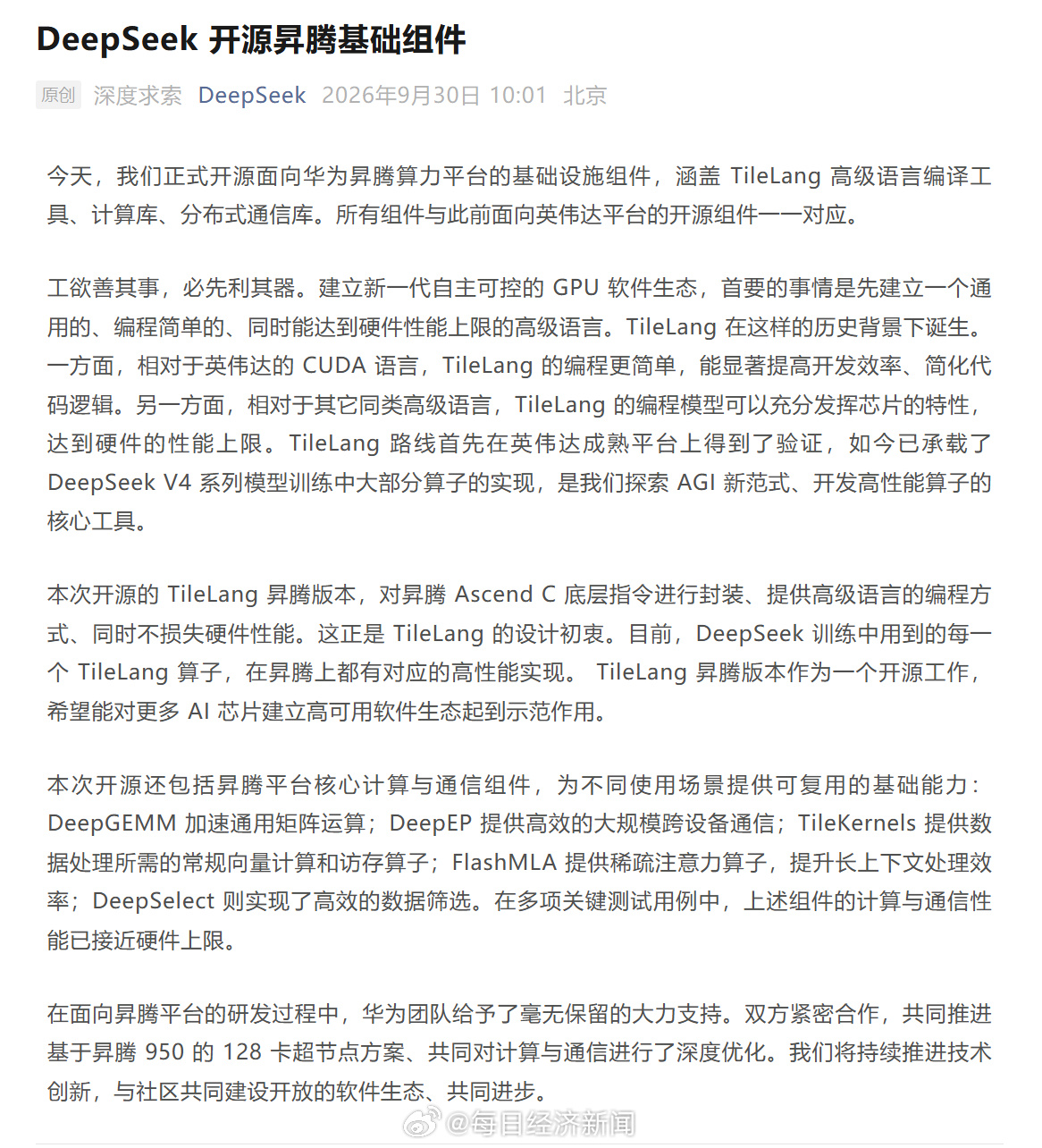
The quieter half of the story is where the models learn to run. On September 30 the lab open-sourced its infrastructure stack for Huawei's Ascend chips — the TileLang programming language plus matrix-math, communication and attention components, each mirroring its NVIDIA-side twin — saying the language already carries most of the operators that train its V4 models. The announcement carried a headline of its own: DeepSeek credited Huawei with unreserved support. For anyone watching the chip war, that is the sovereign-stack story in one line — Chinese models, Chinese framework, Chinese silicon, all of it given away.
The generosity has an adversary-shaped backdrop. In June, Reuters reported the US had held off blacklisting DeepSeek even while flagging more than a hundred Chinese firms as security risks; fresh reports of planned restrictions on Chinese open-weight models have since done the rounds. The tech commentator Li Nan's objection became one of the most-liked takes on the subject: restricting open models, he argued, is like forbidding your child from taking free steamed buns off the street — then charging him for eating them at home. China's models, he wrote, are a gift China gives the world.
The timing also lands amid the AI-bubble jitters shaking global markets this week, as Caixin's markets coverage reflects. And it is a rapid change of register for a company that three weeks ago was in the news for refunding every API customer after outages. Now it publishes its unit economics and hands over its tools. The November 1 paywall on search suggests the plan: fund free infrastructure with one billable edge, and make the openness itself the brand. Whether Washington lets the gift keep giving is the question the next entity-list filing will answer.