How WeChat Became the Office That Never Closes
A Weibo hashtag asking "who on earth turned WeChat into a work app" drew thousands of complaints from Chinese workers this week, and the answers point at something structural: the app that carries daily life also carries the job, so the workday has no edges.
On Monday, a question with an edge of exhaustion climbed Weibo's trending list: 到底谁把微信变成工作软件的 — "who on earth turned WeChat into a work app?" The most-shared post under the hashtag called WeChat "the worst invention in workplace history," and the complaint was specific: not spam, not scams, but the boss. "Back when there were no WeChat calls, when you got off work you were really off work," it read. "Now you're on standby on WeChat after hours." The post was liked more than 4,000 times within a day.
The grievance resonates because it is structural. In much of the world, work runs on one set of software and private life on another — Outlook and Slack against WhatsApp. In China, one app does everything: chat, payments, taxis, school groups, hospital registrations, government services. Work never had to break in, because there was no wall for it to break. Tencent does offer a work-flavored version, Enterprise WeChat, which displays "online" statuses and binds employees to company accounts, and commenters reserved some of their sharpest words for it. "The worst part is Enterprise WeChat existing at all," one wrote.
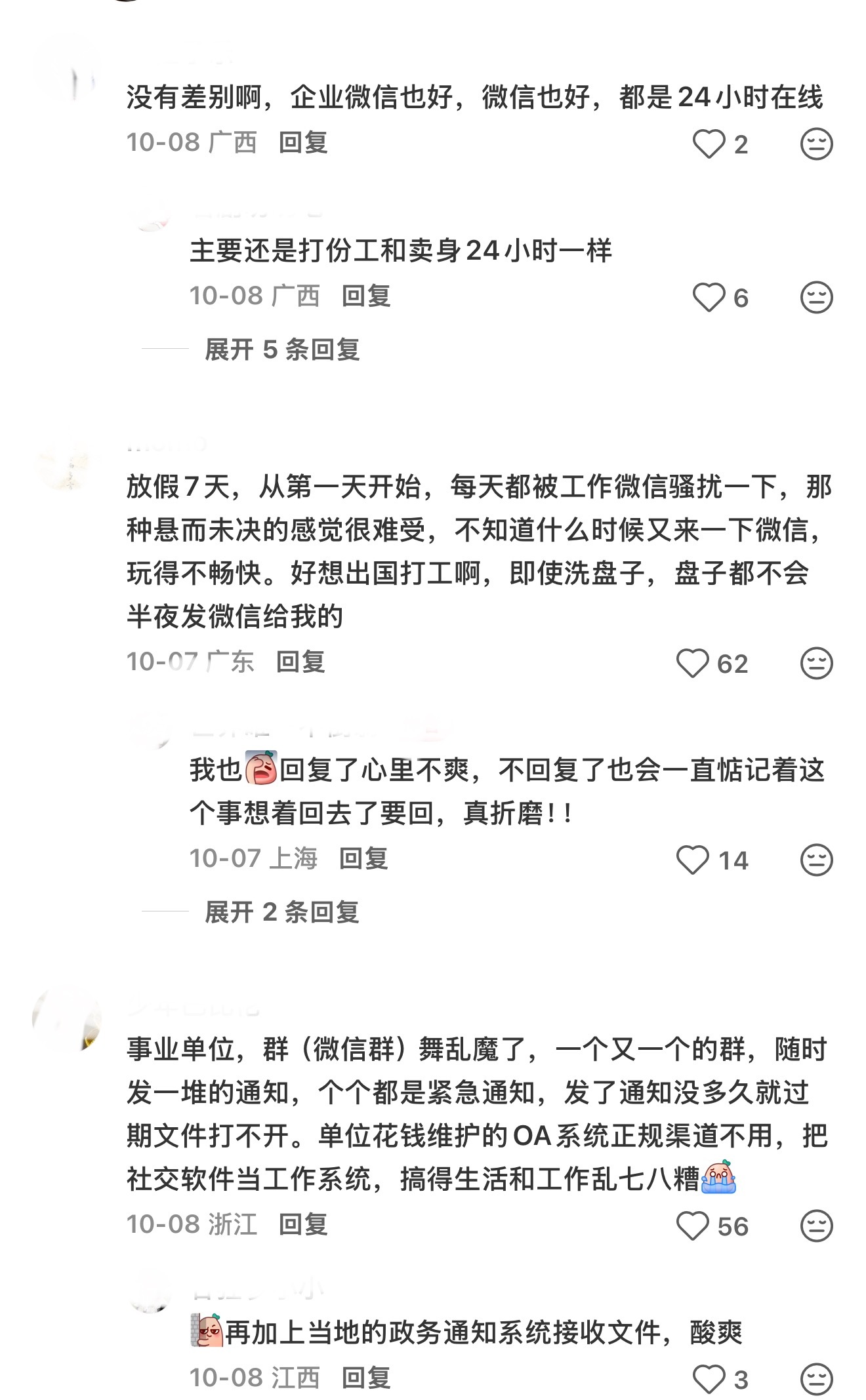
Screenshots of the comment section circulated with the post. A user in Guangdong wrote that after a seven-day holiday spent "harassed by work WeChat every day," they had begun fantasizing about emigrating: "I want to go abroad and wash dishes — at least dishes don't send you WeChat messages in the middle of the night." Another praised what they saw as Western practice: "I really like foreigners' email culture — email first, everything else supplementary. It completely separates work time from private time." Others reported personal workarounds. "So I keep two WeChats," one said; "now my first reaction to any WeChat message is irritation, even from friends," said another.
The debate over after-hours availability is not new in China. The "996" schedule — nine to nine, six days a week — became a national controversy in 2019, and labor law technically requires paid overtime, though enforcement is thin and proving off-the-clock work is harder still. A group chat makes the standby invisible and free: no call, no office, just a "work group" pinging at eleven at night. One commenter pushed back on the app itself: "It's not WeChat's problem, it's people's problem."
What makes the problem stubborn is the same thing that makes WeChat indispensable. The app that carries a grandmother's hospital registration and a class parents' group is the one a manager can use to assign Saturday's shift at ten at night — and courts now treat its chat logs as formal evidence, with a Shanxi court recently awarding damages in a contract dispute proved entirely on WeChat records. The boundary workers say they want was never built into the tool. They are left to build it themselves, one muted group at a time.