The 'Chinese Sherlock Holmes' Is Laid to Rest in Yangzhou, Half His Ashes Bound for America
Henry C. Lee — the forensic scientist who examined evidence in the O.J. Simpson trial and thousands of other cases — was buried in his ancestral Yangzhou on Thursday, with nearly 100 metres of flower baskets and no funeral money accepted. His widow's farewell, and the split of his ashes between two countries, turned the service into a story about homecoming.
The flower baskets stretched for nearly a hundred metres outside the memorial park in Yangzhou on Thursday. The mourners had come to bury Henry C. Lee, the forensic scientist whom Chinese media routinely call the "contemporary Sherlock Holmes" (当代福尔摩斯), and the family had asked for no funeral money — each guest received a return gift instead: sweets, a photograph, and a pocket-sized "polygraph ruler," a replica of the instruments Lee spent a career using to separate truth from lies.
Lee, born in 1938 in Rugao, not far from Yangzhou, left for the United States as a young man and became one of the most famous criminalists in the world, working evidence in thousands of cases including the O.J. Simpson trial. He died on March 27 at his American home, aged 88. On Thursday, half of his ashes were buried in Yangzhou. The other half stays in the United States, where the family says it may one day be buried beside Song Meijuan, his first wife, who died in 2017.
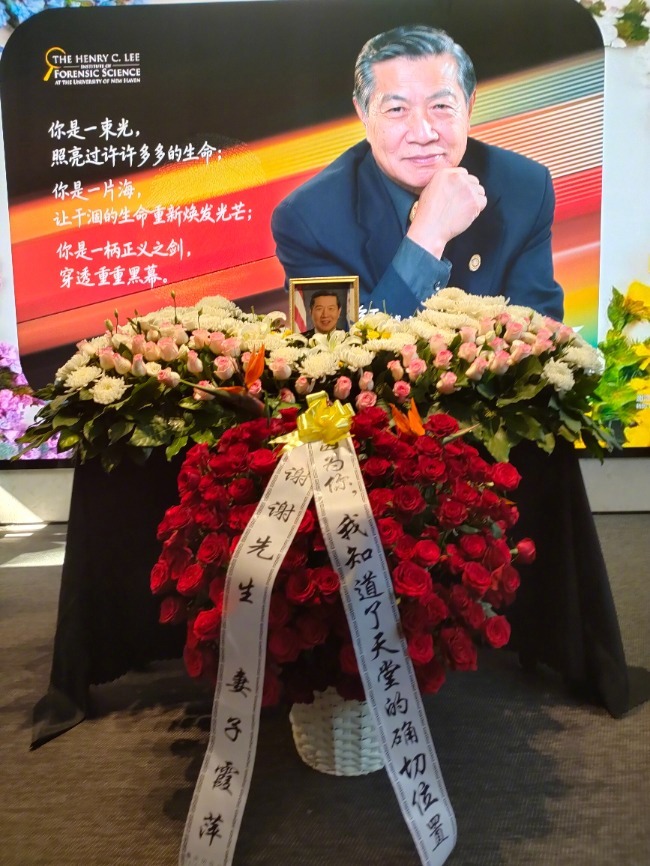
The funeral also became the public telling of his second marriage. Jiang Xiaping, a businesswoman, had met Lee through an overseas Chinese chamber of commerce, but after Song Meijuan's death she wrote a mourning poem, and the two began a long correspondence. Lee initially said he would not remarry for three years; he proposed in 2018, and the two married in the United States that year — an 18-year age gap between them. In private, she told an interviewer, they called each other "sir" and "angel" (先生 and 天使), and he did the cooking. At the graveside she wept "I'm taking you home!" (我带你回家!), and told reporters: "Wait for me 18 years, and we'll be buried together" (你等我18年,我们一起合葬).
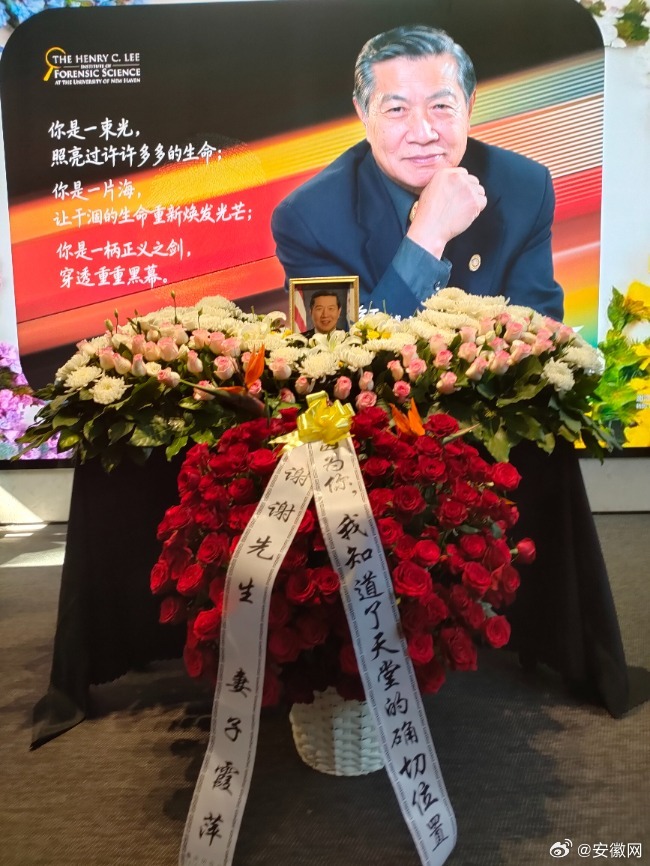
The family shared one more image: a photograph taken on March 10, seventeen days before his death, showing Lee in bed, silver-haired and smiling "like a baby." The ribbon on the flowers read, in Jiang's words, "Thank you — I now know the exact location of heaven."
Jiang also recalled the streak of temperament behind the courtly public figure. At an overseas event, she said, Lee had once risen from his seat to rebuke remarks questioning his Chinese identity: "The day your descendants no longer acknowledge you, you will regret it" (等到有一天你的子孙不认你了,你就后悔了).
The memorial led Baidu's trending board through the day, with coverage of the flower baskets and the split burial sitting among its top stories. A man who spent his life in American courtrooms has been divided the way diaspora lives often are: half at rest in the country he left, half in the one that made his career — and his widow has set an 18-year clock for the two halves to meet again.