Fingerprints Show Women and Teenagers Helped Build the Terracotta Army
A fingerprint study of 23 figures from Pit 1 suggests nearly a third of the Terracotta Army's makers were women and more than a fifth were children under 15 — revising the long-standing assumption that the clay legion was an all-male project.
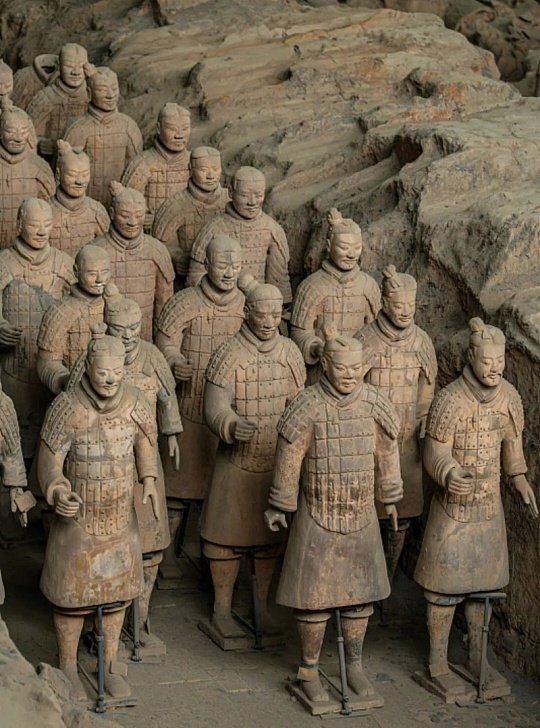
The Terracotta Army has stood in the earth near Xi'an for more than 2,200 years, and the men who built it were long assumed to be, well, men. A new study published in the Journal of Cultural Heritage by researchers from the Emperor Qinshihuang's Mausoleum Site Museum and Shandong University makes that assumption much harder to hold. The team lifted 79 fingerprints from 23 clay figures in Pit 1 and estimated, from ridge patterns alone, that roughly 45% came from adult men — but 32.7% from adult women, and 22.3% from children under 15.
The method is a piece of forensic statistics. Fingerprint ridge lines differ measurably between groups: women's tend to be finer and denser, men's wider and sparser, and children's shallow and delicate. Using a high-depth microscope to measure ridge width on each ancient print, the researchers ran the numbers through a Bayesian mixture model to estimate the age and sex structure of the workforce as a whole. They are careful about the limits — the technique cannot identify any individual maker, only a population-level estimate from a modest sample. But the fingerprints cluster on heads, arms and armor pieces, which fits what archaeologists already knew about how the army was produced: figures were made in parts with molds, finished by hand, then assembled.
The finding has struck a nerve in China less for the statistics than for what the statistics quietly undo. Qin official records practiced "wu le gong ming" (物勒工名) — inscribe the work with the maker's name — as a quality-control regime, and 87 such names have been found on the warriors. Imperial histories recorded the project in one line: more than 700,000 laborers. Everything else about the individual hands was never written down. "We always stared at those 87 carved names and thought they were the whole story. But names were the institution, the proof of delivery to the empire; the fingerprints are the body, a real trace left in wet clay," one Weibo commenter wrote. "History handed the names to whoever was entitled to them. The fingerprints handed the silent people back to us." (@说车的姚老板)
The reaction online has been mostly of one cast: awe that a thumbprint pressed into wet clay two millennia ago survives at all, and a recalibration of who the makers were. "It's hard to imagine that across two thousand years, a tiny fingerprint connects us to a Qin dynasty craftsman," another user posted after the findings spread. (@银子堆成山) Provincial broadcaster Shaanxi TV, which broke the news, noted that women and teenagers may have taken part in shaping, carrying and assembling the figures — labor that name-carving, and the history books, never recorded. (@陕视新闻)
The study is a reminder that the most famous excavation in China is still yielding firsts — and that the people who left no names left other evidence. The museum says the research continues; with thousands of figures still buried, so do the fingerprints.