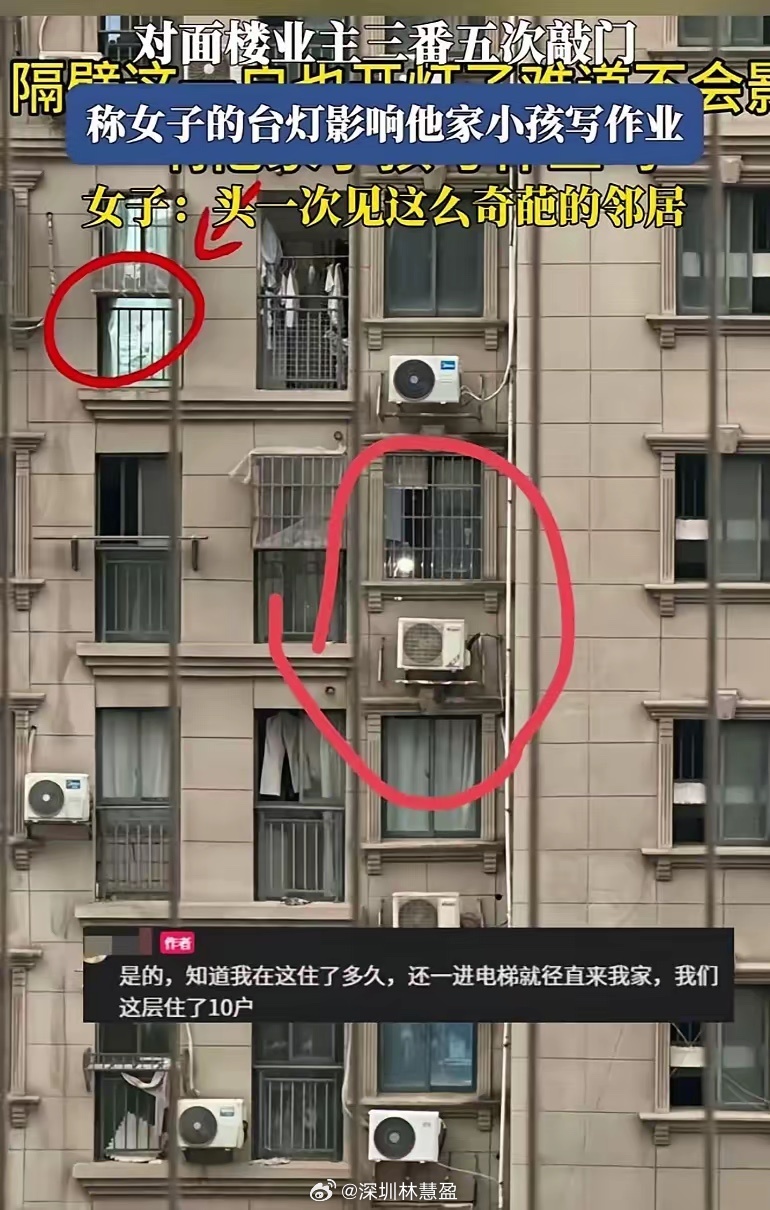
A woman on the 23rd floor is told her desk lamp is too bright for a neighbor below — and across the street
A Changsha woman says a man in a neighboring building has repeatedly demanded she turn off a small desk lamp at night because its glow 'disturbs his child's homework' — a dispute about who gets to control the light that has become China's latest viral debate over neighborly boundaries.

The hotword #多方回应23楼开灯被对面20楼投诉# ("Multiple parties respond after a 23rd-floor resident is complained on by a 20th-floor neighbor opposite") is exactly the kind of small, absurd dispute that Chinese social media loves to dissect.
The facts, as reported by 大河报 (43 reposts, 1,889 likes): a woman in Changsha's Sunlight Jincheng apartment complex says a man living in a different building — on the 20th floor, with windows facing hers — showed up at her door to complain that her desk lamp was too bright and was interfering with his child's homework. She wasn't home, so he went to security, then to property management, and on the afternoon of August 19 the property staff knocked on her door repeatedly for hours.
The woman told reporters the police came to mediate and reportedly said her light "did affect the complainant's home" — a conclusion she rejects. "My home only has one small desk lamp, and we're in the opposite building, not even the same floor," she said. She argues the light did not shine directly into his home and that using normal lighting in her own home is her right.
Weibo users overwhelmingly took her side. "没事吧没事吧,在自己家开灯会被对面投诉,自己觉得亮,你可以买个窗帘哈" — "Are you okay? You can't even turn on a light in your own home without the building opposite complaining? If you think it's bright, just buy curtains" — wrote one user named 假-xing-xing-xing.
Another widely shared account from 深圳林慧盈 spelled out the absurdity in detail: "A small desk lamp at home is normal household lighting, and it's an entirely normal daily need. The light isn't shining directly into the other person's house. There's no reason to change your own household habits because of another person's subjective feeling." The post added the line that became the moral of the story: "The most basic boundary between neighbors is managing your own home, not arbitrarily interfering with the daily life of someone else's."
The complaint resonates because Chinese cities are dense, and apartment windows often face each other across narrow gaps. Light pollution disputes — from neon signs to strong balcony lights — are common, but a single desk lamp crossing the gap between two buildings struck many as a new extreme. The debate, as usual, is less about the lamp and more about a question everyone in a mega-city understands: where does my home end and my neighbor's sensitivity begin?