China's Young People Are Trading Milk Tea for Two-Litre Bottles of 'Big Water'
A meme called 'Big Water Theory' (大水理论) is sweeping Weibo and Douyin: carry an oversized bottle of plain bottled water instead of ordering milk tea or coffee. Behind the absurdist swagger sits a real shift — young consumers pricing health and thrift against the drink economy that marketed to them for a decade.
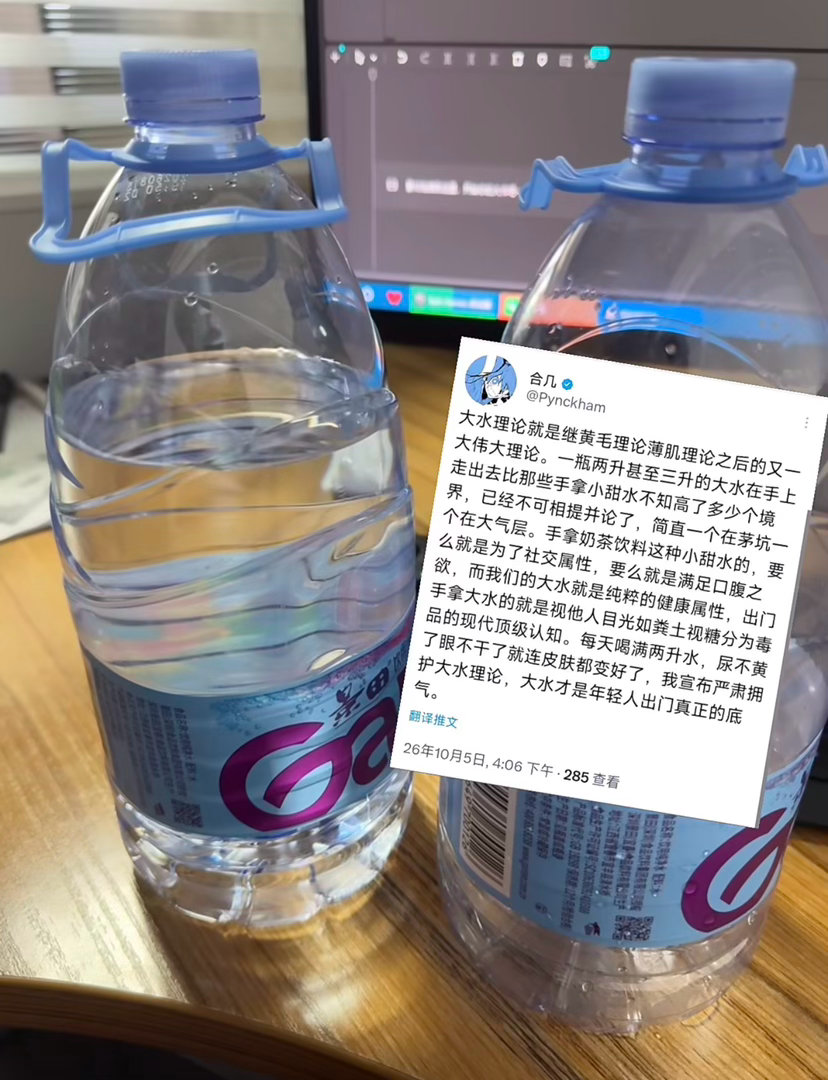
The manifesto, as it spread across Weibo in early October, reads like a self-help book written by a deadpan comedian: "Only the weak drink beverages. The strong drink Big Water straight" (强者都是直接喝大水). The strong, it continues, choose the most down-to-earth vessel available — the large bottle of plain bottled water, the size the meme's chroniclers put at roughly two litres — and wherever they go, they "plop the Big Water on the table, enough for the whole day, and it even gives the people around you the happiness-yielding principle." The trend is tagged 喝大水, "drinking big water", and its frame of reference is 大水理论, Big Water Theory.
The theory fits on a label. Swap the milk tea and the coffee for a big bottle of water. An explainer posted for bewildered newcomers spells it out: a litre-plus of mineral water instead of a designer drink — cheaper than the small bottles and healthier, no sugar, none of the coffee's heartburn, and "peace of mind: the king of cost-performance. Just don't drink the price up!" The joke's architecture is the point: grandiose philosophical framing applied to the least glamorous object in the convenience store, in the same mock-canonical series as "lean-muscle theory" and "big-sleep theory", which the trend's chroniclers list alongside it as young China's lifestyle canon.
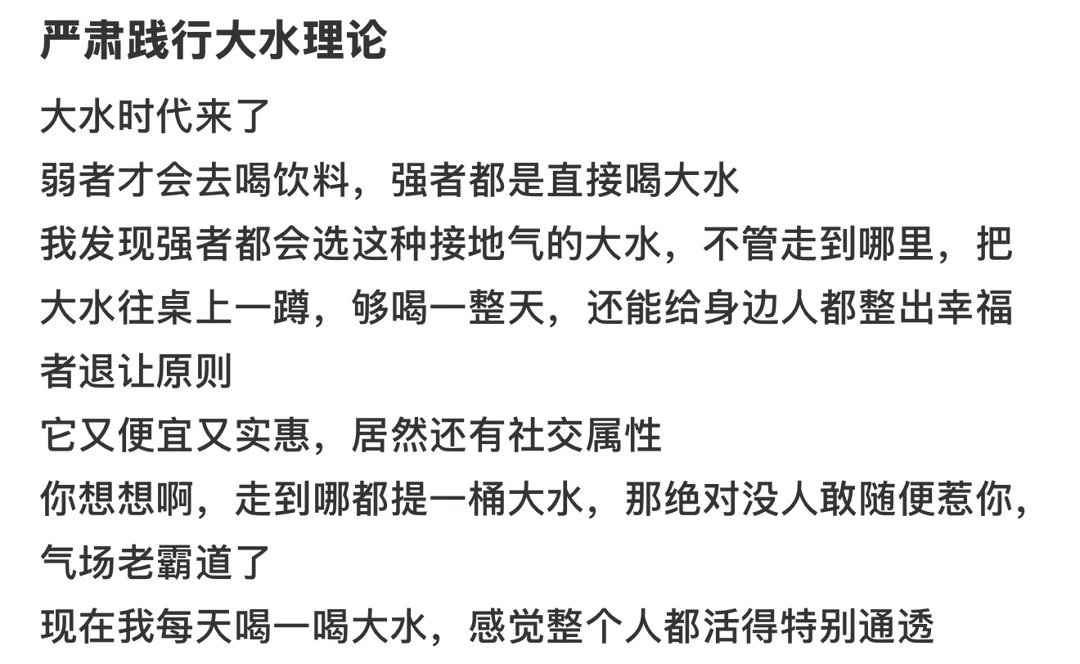
The performance extends to posture. The manifesto claims a bucket of big water carried anywhere projects an aura "so domineering that absolutely nobody dares mess with you", and even confers the "happy-person yields" principle on bystanders — the idea, currently doing its own rounds, that people whose lives are going well can afford to step aside from petty conflict. Another convert put it as a social ultimatum: coffee and milk tea are over, carrying a bucket down the street is the most intimidating thing you can do, and "if you don't drink big water, I don't talk to you."
Underneath the swagger is a straightforward economic mood. Milk tea became China's defining youth drink over a decade of premiumisation, chains competing on toppings, queue-worthy launches and collab merch — a boom that even drew official caffeine warnings. Big Water inverts every term of that pitch: no brand fantasy, no sugar, no queue, a container you can refill your own bottle from. The meme spreads because the punchline flatters both the wallet and the body, and because self-mockery is the accepted register for saying something sincere about money.
The tell comes at the end of the explainer posts: the half-joking fear that if enough people convert, the big bottles will be "drunk up to a higher price" (别把大桶水喝涨价了). Even the cheapest object in the store, young China has learned, is not safe from the market it just joined.