Nanjing's Free Noodle Shop Is Hurting the Noodle Shops Next Door
A Nanjing man gives away noodles free to anyone who queues, no questions asked. The problem is what it did to every other food business on his street.
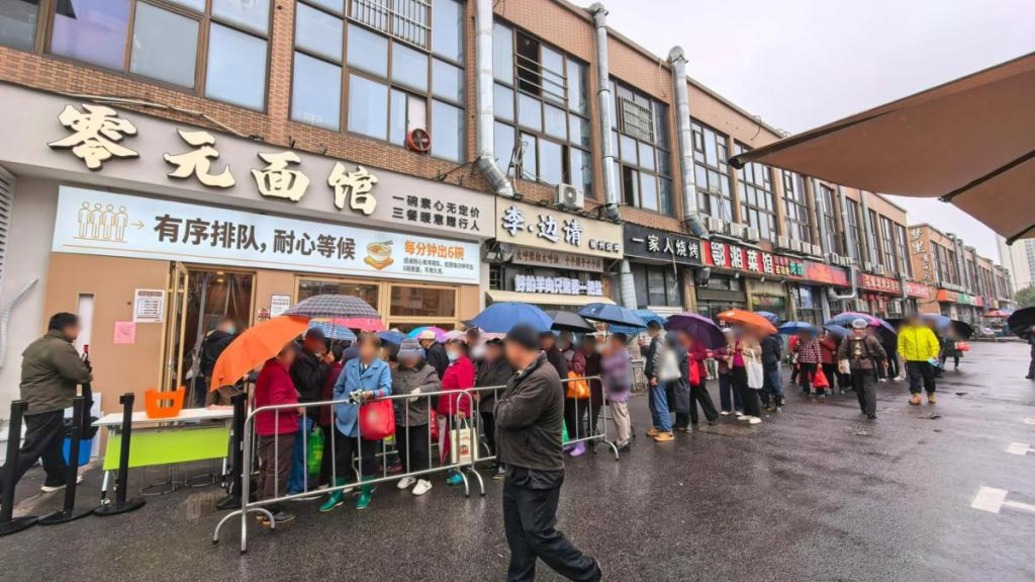
The shop has no prices, no menu, and no questions. In Nanjing's Jiangning district, a man surnamed Zhang runs two "zero-yuan noodle shops" that serve free vegetarian noodles to anyone willing to queue — no means test, no proof of hardship required. He has told reporters he intends to keep it free and has set up no way to make money from it. He just wanted, as he put it, to do some good.

The queues have grown long enough to become a spectacle in themselves. A photograph carried by The Paper shows dozens of people with umbrellas waiting behind metal barricades on a wet street, under signs reading "queue in order, wait patiently," "a bowl of love, no fixed price," and — the detail readers keep quoting — "six bowls per minute." One Weibo user captured the mood bluntly: this is "the city of universal love, the zero-yuan noodle house, giving strength to the powerless."
But the goodwill has spilled past its recipients, and that is where the argument begins. According to reporting picked up across Chinese media, a neighboring fried-noodle stall that survives on volume has lost two or three hundred yuan a day since the free shop opened; its owner says he intends to leave when his lease runs out. Another nearby restaurant selling a different style of noodle reports no impact at all.
For Chinese opinion writers, that gap raises an uncomfortable question about what charity owes the people standing next to it. An editorial in Anhui's Dawan News argued that genuine kindness cannot "create new unfairness while helping some people" — that even a philanthropist with ample funds must "mind the boundary" so that small businesses already operating on thin margins are not crushed as collateral. The Paper went further, arguing that when generosity deliberately overflows beyond its intended recipients into "anyone who queues," it effectively builds a price black hole in a street-level economy: a competitor whose product costs nothing is not something a noodle shop can beat by making better noodles.
The framing matters because of how ordinary both sides are. No one accuses the owner of anything but sincerity; indeed, diners report most visitors are elderly locals, sanitation workers, and delivery riders, exactly the people such a service should reach. And no one doubts the pain of the man running a low-margin noodle stall two doors down.
Chinese readers have debated questions like this before — whether generous acts inevitably cost someone else something. But the noodle shops put a sharper point on it than usual: if feeding hungry strangers for free is wrong, that seems absurd; yet if doing it drives your neighbor out of business, the good deed has consumed something too.