A Wuxi Bar Put Standing Urinals in the Women's Room, and China Remembered a 1996 Patent
A woman walked into a women's room near a Wuxi nightlife street and found three pink urinals under the slogan 'Sisters, stand up.' The fixture has a three-decade history in China — invented in 1994, patented in 1996, first installed at a university in 2010 — and it still divides users on practicality.
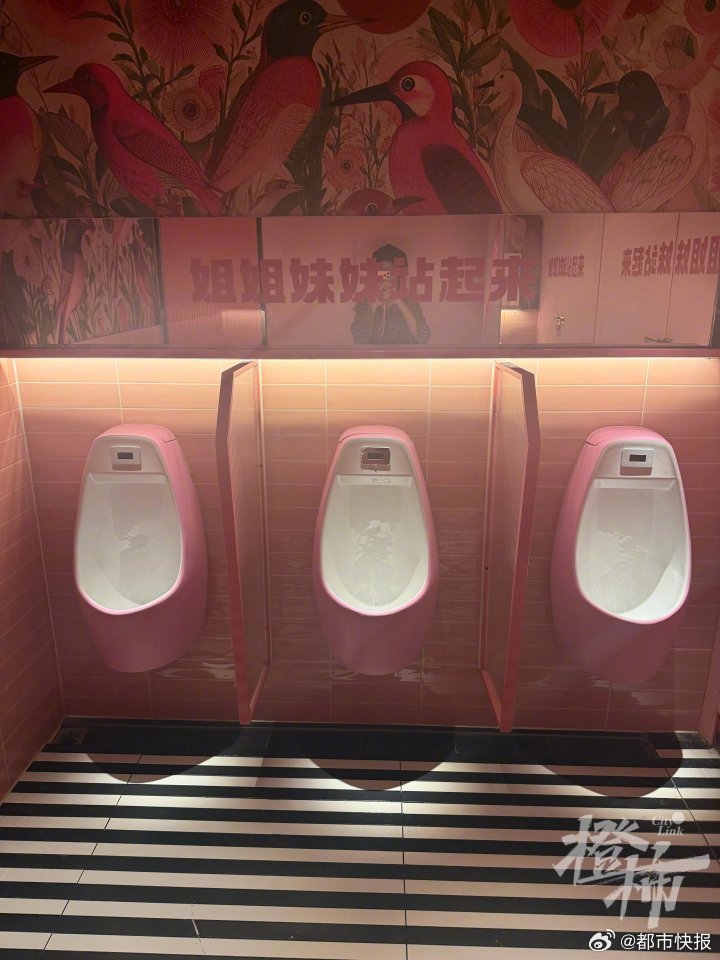
The post appeared on November 4 and resurfaced this weekend with a new wave of attention. A woman visiting a bar near Wuxi's Nanchang Street, a pedestrian shopping strip, walked into the women's room and found three pink-and-white standing urinals, with a line painted on the wall above them: "Sisters, stand up." "I was stunned for two minutes and thought I had walked into the wrong room," she told Metropolitan Express, the Zhejiang outlet that chased the story down. "It was only when the cleaner told me it really was the women's room that I believed it."
Her own verdict was the measured one that most of the commentary echoed: the fixtures exist because somebody needs them, but "I still can't figure out how to use one, and at the very least there should be instructions — most women won't know how." The replies underneath were blunter. "Bizarre — is it necessary?" one user asked, wondering whether the men's room next door had simply run short. Another called the idea novel but impractical: interesting to look at, not something she would try.
The reporter's answer to "how does this even work" is where the story stops being a curiosity. The fixture depends on a funnel-shaped paper adaptor that lets a woman urinate standing into a wall-hung basin without contact — a device designed in 1994 and patented in 1996, with a slanted channel meant to guard against cross-infection. Its promoters pitched it at exactly the people a standing toilet might help most: elderly women, pregnant women, and people with disabilities.
The most committed advocate was Qu Yajun, a professor at Shaanxi Normal University and a delegate to the National People's Congress, who got the first public installation running at the university's toilets in September 2010. Her caveat, quoted in the outlet's report, has aged well: the adaptor demands the right position, angle and technique, and it takes "at least five practice runs" before a user stops fumbling.
Sixteen years after that pilot, the standing women's urinal remains rare enough that one bar's three pink fixtures count as news — and, perhaps, rare enough that a cleaner had to reassure a customer she was in the right room. The slogan on the wall promises a small revolution in plumbing. The users' consensus is that it will stay a novelty until somebody writes the instructions.