Why Chinese Offices Don't Run on Email
A viral post asking why China doesn't use email as its primary work tool drew 15,000 likes. The most-tractioned answer is about the boundary between work and life — and about who has to adapt to whom.
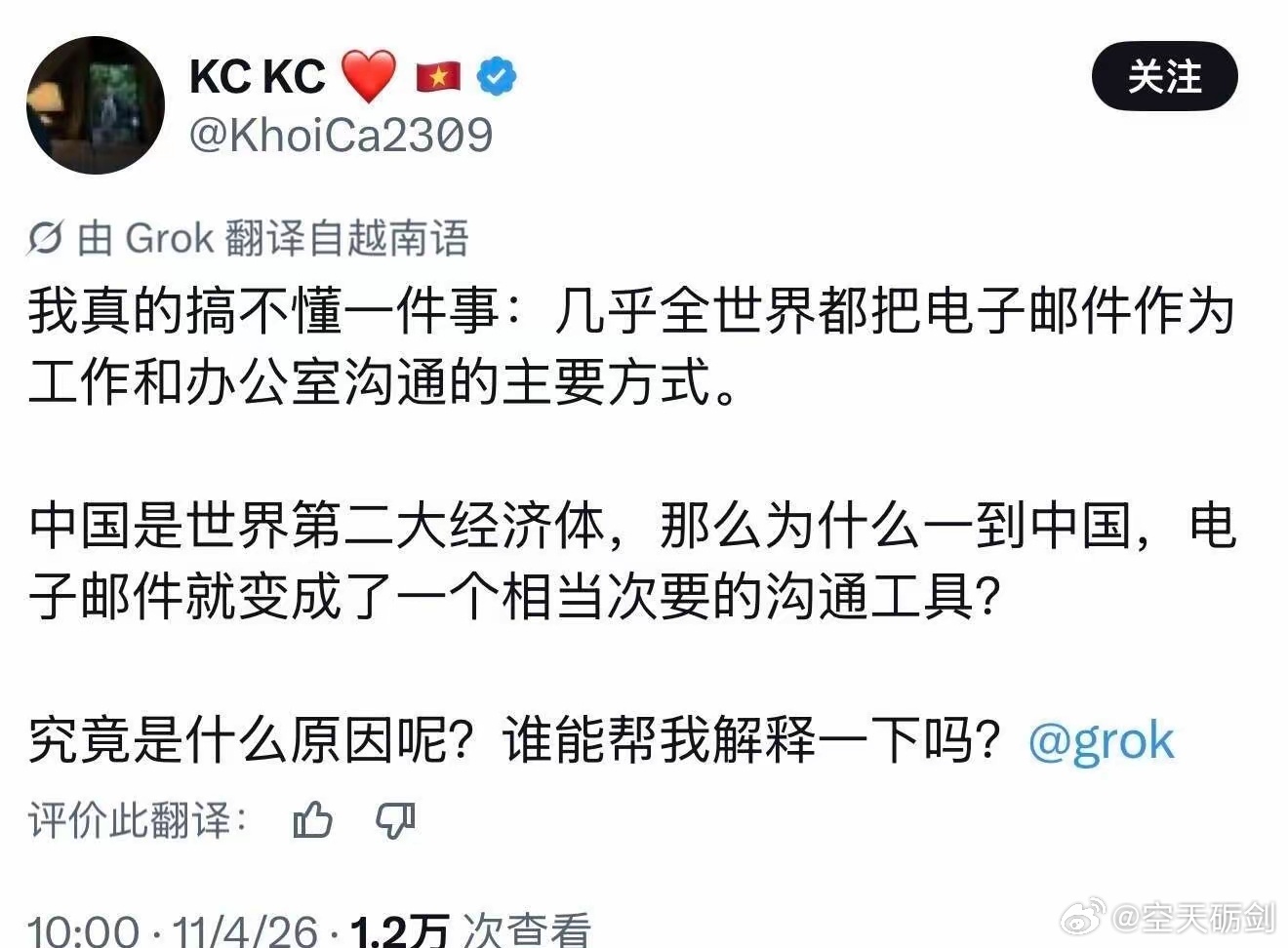
The question that started the conversation was a small one: a Vietnamese user asked Grok why China, the world's second-largest economy, treats email as a secondary communication tool, and the screenshot was reposted on Weibo with a caption that simply read "foreigners don't understand why Chinese people don't work by email." The post was liked more than 15,000 times and drew 1,300 comments — the kind of engagement that turns a casual question into a national argument about how work actually happens.
The answer that gained the most traction came from a legal scholar's account, and it cut through the cliches. In many European and American companies, the post argued, the reason email is the primary tool is not that it is better — it is that the boundary between work and life is enforced by unions. Email is work, WhatsApp is life, and a boss who sends a message to someone's WhatsApp is crossing a line that the union can question. "If he's overstepping, the union questions it, and then it gets uncomfortable," the post read. In the United States, where the work-life boundary is weaker, colleagues do send emails after hours — but always through email, never a private chat.
The practical consequence of that difference is the real story. Chinese offices run on WeChat and DingTalk, and the same app that carries the work group chat is the one that carries your family, your friends, your landlord. The boundary is not a feature, it is a bug — and the post's cynical observation is that the choice depends on who holds the power: "if he's earning your money, he'll install WeChat; if you're earning his money, you'll be doing it on email." The asymmetry is the point: the tool that carries the work is also the tool that erases the boundary between the person who is trying to reach you and the person who is just trying to reach you.
The question is also a common one in the "foreigners don't understand" genre — a viral post asking why Chinese users do X differently, and the answer that turns into a cultural explainer. But the difference it highlights is real: the difference between email and IM is not a difference between a tool and a tool, it is the difference between a message you can answer at your own pace and a message you can't, and the country that has built its work culture around the latter has also built its life around it. The post's last line is the one that has made the rounds: "some foreigners who do business with China a lot know that Chinese people don't use email, and they install WeChat or DingTalk — and the difference is in who earns the money from whom."