A 2,699-Yuan 'Smart Ring' That Promised to Keep the Elderly Steady Is Pulled From Platforms After a Billionaire's Video Debunked It
A Chinese 'smart ring' sold for 2,699 yuan and marketed as a 'wearable anti-fall device' has been pulled from e-commerce platforms after a viral video of its balancing demonstration was debunked as a physics trick. The story is a case study in how China's online health market preys on the elderly.
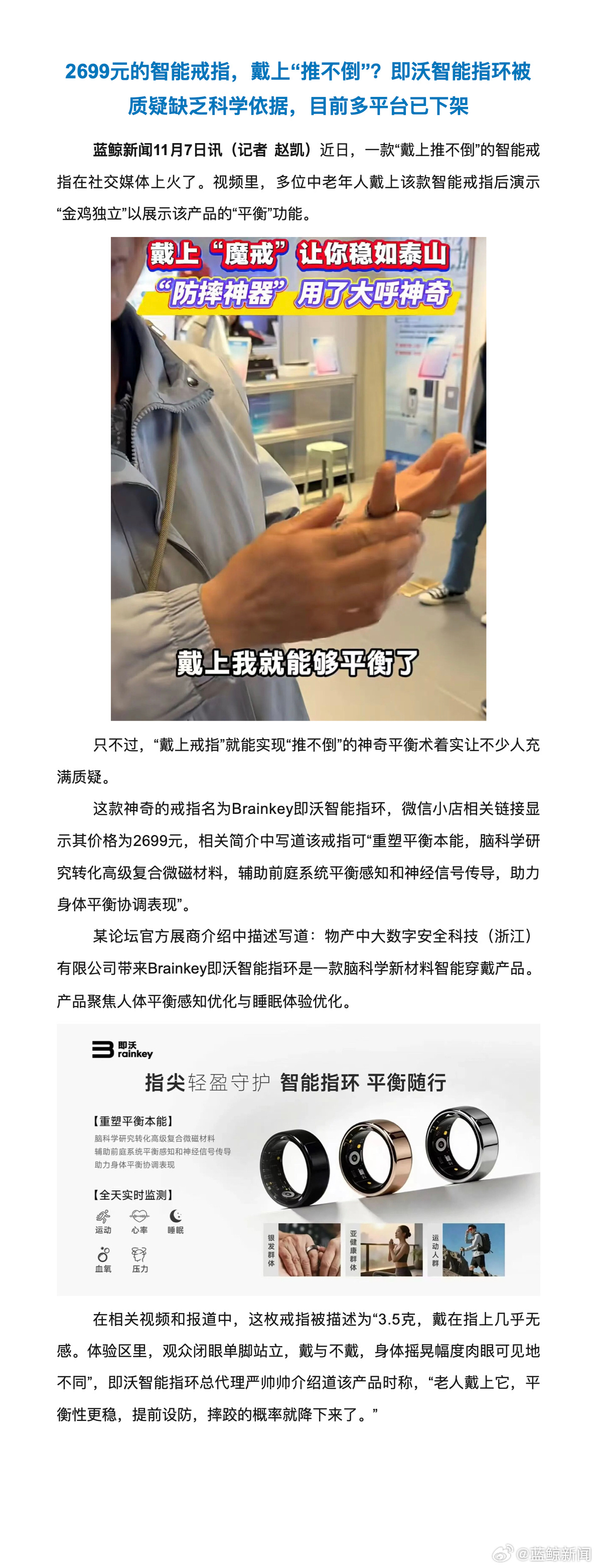
A 2,699-yuan "smart ring" that promised to make its wearer, in the words of a viral video caption, "as steady as Mount Tai" has been pulled from e-commerce platforms after one of China's best-known tech entrepreneurs called it a scam in public.
The product, the Brainkey "Jiwo" smart ring, was sold on WeChat's mini-store and other platforms with a marketing claim that read like a gadget: a ring that could "rebuild the balance instinct" and "assist the vestibular system's perception of balance and nerve signal transmission." In promotional videos, elderly people wearing the ring demonstrated a one-legged stance while a colleague pushed them — and they did not fall over. The video was captioned "wear the magic ring and you won't easily fall."
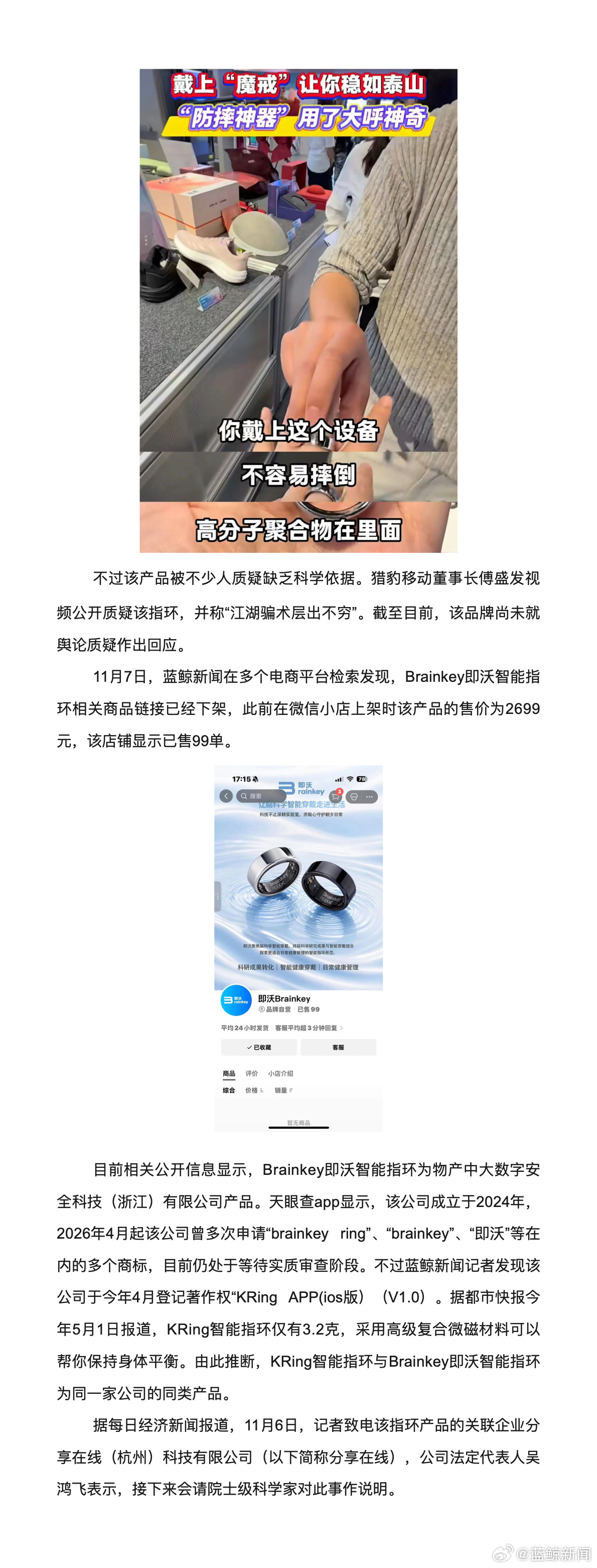
The physics was debunked almost immediately. The demonstration, as the independent tech blogger Fu Sheng — the founder of security firm Cheetah Mobile — pointed out in a video, is a classic conjuring trick: the person pushing is applying the technique of a martial-arts "rooting" exercise, where a slight downward pressure on the subject's shoulder and a timed shift of weight makes the subject look immovable. The same trick works with no ring at all. The Chinese internet meme of a TV shopping show, the "Haci five-element needle" (a 1980s medical device marketed as a cure-all), resurfaced in comments as a shorthand for the genre.
Market regulators in China are now investigating the product's marketing claims. E-commerce listings on WeChat and other platforms have been taken down. The company behind it, Wuchan Zhongda Digital Safety Technology (Zhejiang), was registered in 2024 and has applied for trademarks including "brainkey ring" and "Jiwo" since April 2026 — but those applications are still pending substantive review, and the company's only other registered asset is the copyright for an iOS app called KRing.
For a Chinese reader, the story is a familiar one. The country's online health market has become a repeat site for the sale of unverified devices to elderly people, from the Haci five-element needle of the 1990s to today's app-based "smart" devices. The lesson is not that the device is uniquely dangerous — it is that the marketing language of "brain science" and "micro-magnetic materials" is enough to sell a gadget at a 2,699-yuan price point to a demographic that has been sold the same promise before. As one Weibo user put it, "this kind of 1980s TV shopping has reappeared in the 21st century, brazenly, on all the platforms. The elderly are the easiest to cheat." The story is a reminder that a shiny gadget, a price tag, and a pushy video can get a product listed and sold — until a debunker with a physics background and a platform of their own takes a look.