Water, Watts, Clouds and Pipes: CCTV's 'Six Super Networks' Show Where China's Next Trillions Go
On the fourth day of China's Golden Week, state TV told hundreds of millions of holidaymakers which invisible systems are carrying them: six national networks — water, power, computing, communications, buried pipes and logistics — pitched as one investment program worth trillions.
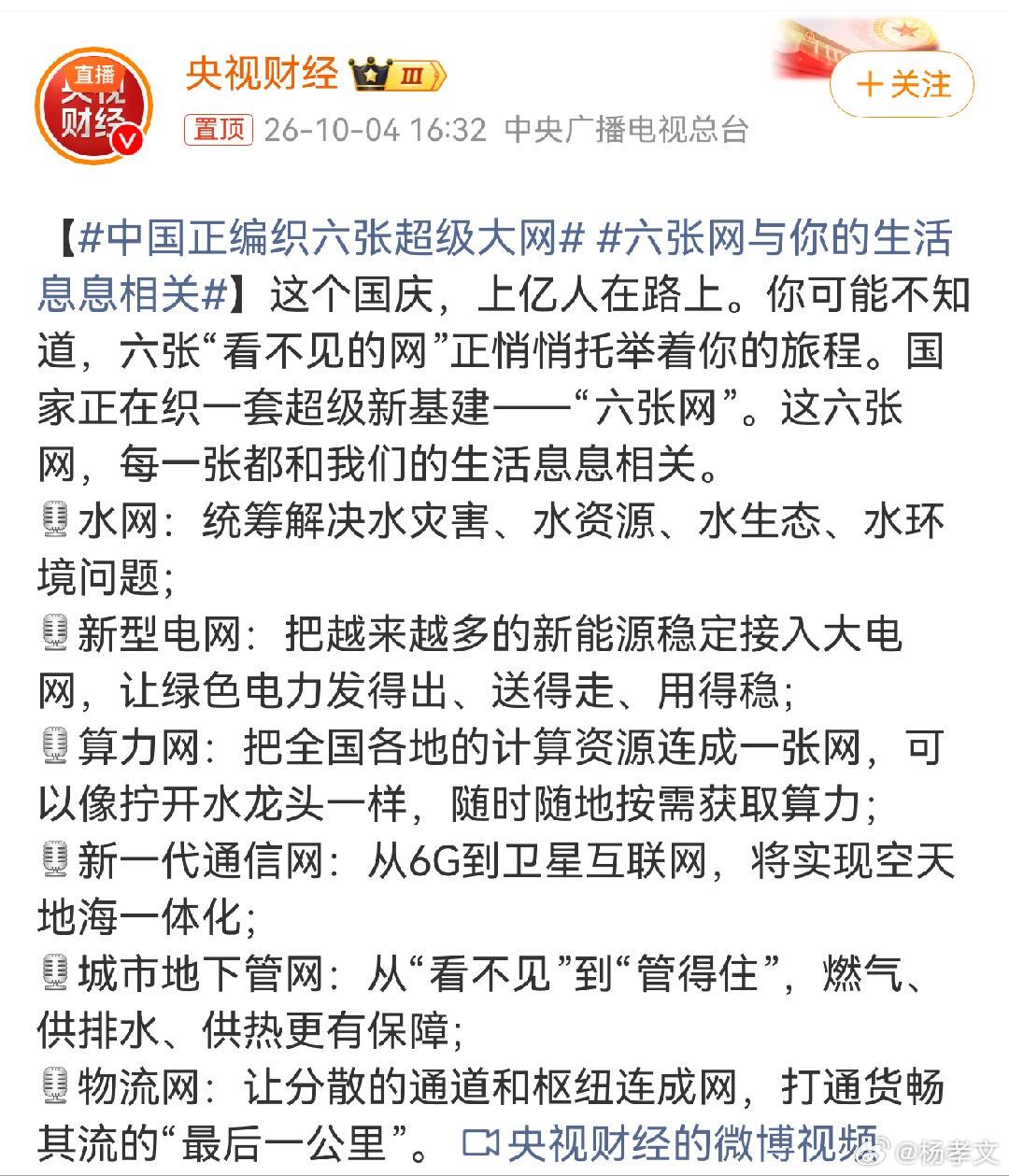
On the fourth day of the Golden Week, with hundreds of millions of people on the roads and rails, CCTV Finance offered its audience a way of seeing the journey: six "invisible nets" are quietly holding it up. The segment, posted under the hashtag "China is weaving six super networks", is really a window into how Beijing now talks about infrastructure — and where the next tranche of national investment is meant to go.
Six nets, in the state broadcaster's telling. A national water network that treats flood control, water resources, river ecology and water quality as one management problem. A "new-type" power grid built to absorb the surging output of wind and solar farms and deliver it stably. A computing-power network that treats processing capacity like a utility: "turn the tap, get compute on demand." A next-generation communications network running from 6G to satellite internet, "integrating space, sky, ground and sea." Urban underground pipeline networks, so gas, water and heating mains go from "invisible" to "managed." And a logistics network, stitching scattered depots and corridors into one grid to crack the "last mile."
The framing matters. "New infrastructure" (新基建) was the slogan of 2020, when it meant 5G towers, EV chargers and data centers. The six-networks formulation widens it into a single systems project spanning utilities and cloud — and a summary circulating under the hashtag put numbers on it: investment across the six fields has already passed 7 trillion yuan this year (about a trillion US dollars), positioned as a centerpiece of the current 15th Five-Year Plan period (2026–2030). CCTV's own research desk filed a feature under the same title the same evening.
Commentators read the list as a map of two anxieties. "These six nets hit China's two key needs precisely: underpinning livelihoods at home, rebuilding momentum abroad," as one widely shared commentary put it. The water network, the buried pipes and the logistics grid are what the writer calls "inner-face projects" (里子工程) — unglamorous work on the floors of cities that flood, gas mains that leak, deliveries that stall — while the power, computing and communications nets are "the competitive base layer": renewables need a smarter grid, the AI boom needs compute like water from a tap, and 6G-plus-satellites is a bid for the next generation of standards.
For an outside reader, the revealing word is 网 — net. Chinese planning language habitually turns national projects into single vast networks with proper names, from the railway grid to the South-North Water Transfer; the six-networks pitch extends the habit to computing and orbit. It also tells you how the state prefers to present industrial policy: not as a list of factories, but as weather — something ambient that carries you through the holiday without your noticing.
Whether compute-on-tap and integrated satellite links arrive on schedule is, as always with such plans, the open question. But the least futuristic items on the list — water routing and buried municipal pipes — are the ones Chinese urbanists have spent a decade demanding, after years of flooded metros and exploding manholes. The six nets are pitched at the sky; the ones residents will feel first are buried under the street.