China Boosts Border Security with Intensified Military Patrols in Southern Theater Command
In a bid to strengthen its military presence and safeguard national security, the People's Liberation Army's (PLA) Southern Theater Command has intensified its border patrols in recent days. According to a statement released by the command, on August 26, the PLA's Southern Theater Command dispatched army units to the border areas of Ruili and Zhenkang, among others, to conduct armed patrols and joint air-ground surveillance. The exercises aim to test the command's rapid response, three-dimensional control, and joint combat capabilities, ensuring the security and stability of the border regions.
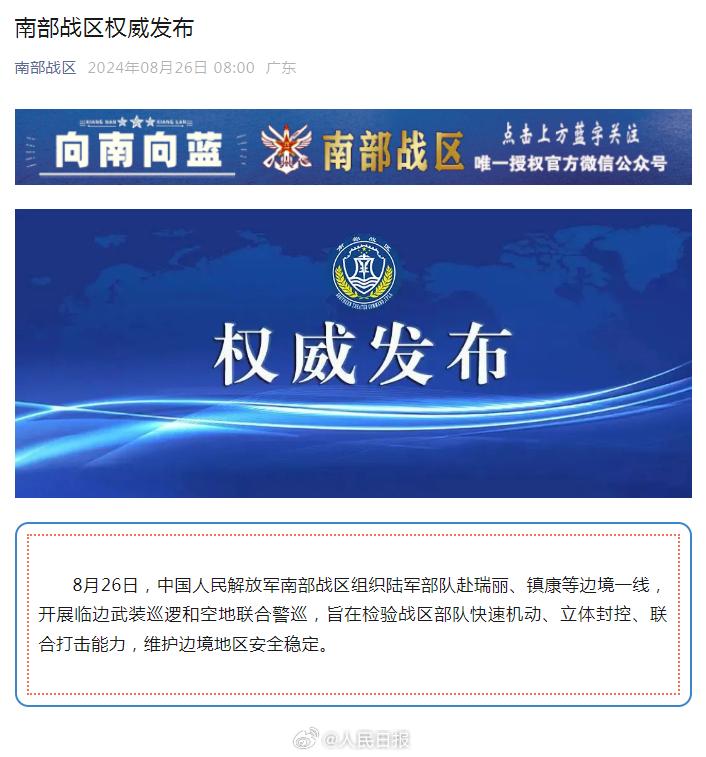
The move is seen as a significant step by the PLA to enhance its border defense and maintenance of social stability in the region. The Southern Theater Command's decision to conduct these exercises demonstrates its commitment to protecting China's sovereignty and territorial integrity, particularly in the face of increasing regional tensions.
Sources close to the PLA indicate that the command's heightened border patrols are part of a broader effort to reinforce the country's western border regions, where China shares borders with several countries, including Myanmar and Vietnam. By bolstering its military presence in these areas, Beijing aims to prevent cross-border crime, terrorist activities, and other security threats that could destabilize the region.
The latest patrol mission organized by the Southern Theater Command of the People's Liberation Army (PLA) has underscored the military's growing emphasis on rapid mobility and joint strike capabilities. By deploying land forces to the border areas of Ruili and Zhenkang, among others, the PLA aims to test its troops' ability to quickly deploy and respond to potential security threats. The exercise, which combines armed patrols with air-ground joint patrols, seeks to reinforce the theater command's capacity for "three-dimensional control" and joint strike operations. This approach enables the PLA to respond swiftly and effectively to emerging security risks in the border region, thereby safeguarding the stability of the area.
According to military experts, the recent border patrol and alerts conducted by the People's Liberation Army (PLA) Southern Theater Command are more than just routine exercises. They represent a deliberate effort to demonstrate China's military capabilities and reinforce its territorial claims. "The patrols are a clear display of the PLA's ability to rapidly mobilize and deploy troops along the border," said Dr. John Lee, a senior fellow at the United States Institute of Peace. "By showcasing their capacity for three-dimensional control and joint strike operations, the Chinese military is sending a strong message to potential adversaries about its resolve to defend its sovereignty."
The expert noted that the patrols also serve as a deterrent to extremist groups and other non-state actors that may seek to exploit vulnerabilities along the border. "The PLA is signaling that it is committed to maintaining stability and security in the region, and that any attempts to challenge its authority will be met with swift and decisive action," Dr. Lee explained.
Moreover, the patrols are seen as a key component of China's broader strategy to reinforce its territorial claims and assert its dominance in the region. "The PLA's activities along the border are part of a larger narrative that emphasizes China's status as a major military power," said Dr. June Teufel Dreyer, a professor of political science at the University of Miami. "By demonstrating its military capabilities, China is seeking to reshape the regional security landscape and expand its influence."
The patrols also underscore the importance of the Sino-Myanmar border, which has long been a sensitive region due to the presence of ethnic rebel groups and other security concerns. "The Chinese military is taking a proactive approach to securing its borders and preventing instability from spilling over into China," said Dr. Dreyer. "These patrols reflect a growing recognition that regional security is intricately linked to China's own national security interests."
While the recent military exercise demonstrates the Chinese military's capabilities in maintaining border security, the long-term strategy for strengthening border controls remains unclear. Experts say that the use of modern technologies, such as drones and artificial intelligence, could play a significant role in enhancing border surveillance and detection capabilities. However, the specifics of how these technologies will be integrated into the military's border security operations remain to be seen.
Furthermore, the relationship between the Chinese military and local law enforcement agencies in maintaining border security is also unclear. Will the military continue to take a leading role in border security, or will local authorities be given more responsibility? How will the two entities coordinate their efforts to ensure seamless and effective border control?
Additionally, the impact of the recent exercise on China's relations with neighboring countries is also uncertain. While the Chinese military has stated that the exercise is aimed at maintaining regional stability and security, some neighboring countries may view the increased military presence as a provocation.
As the Chinese military continues to modernize and expand its capabilities, the future of border security measures remains a pressing concern. While the recent exercise demonstrates the military's ability to respond to current security challenges, the long-term strategy for addressing emerging threats and maintaining regional stability remains to be seen.