China Coast Guard Seizes Philippine Vessel in South China Sea, Escalating Tensions in Disputed Waters
A tense standoff unfolded in the South China Sea on August 25, as a Philippine vessel, identified as the 3002, illegally entered the waters near the Second Thomas Shoal in the Spratly Islands without permission from the Chinese government. The Philippine ship repeatedly approached a Chinese coast guard vessel that was on a routine patrol, prompting the Chinese authorities to take control measures in accordance with the law.
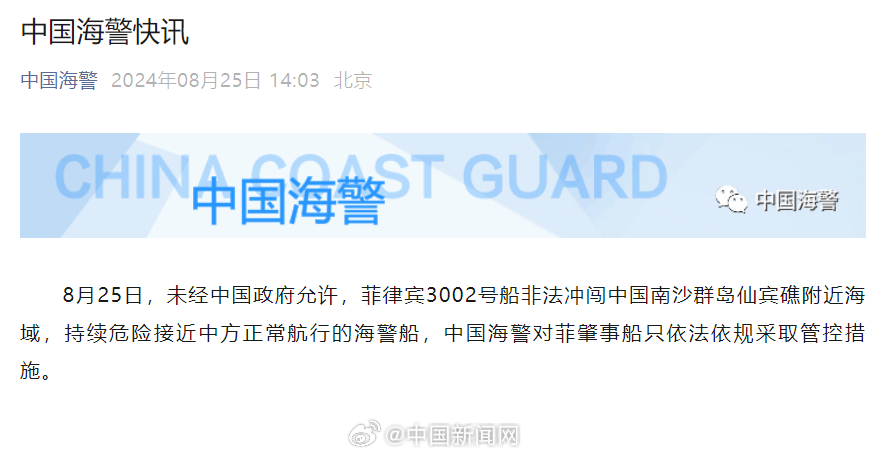
According to a statement released by the Chinese Coast Guard, the Philippine vessel's actions posed a danger to the normal navigation of the Chinese ship. In response, the Chinese coast guard took decisive action to assert its authority and maintain order in the disputed waters.
This incident was not an isolated event. On August 25th, the Philippine vessel had brazenly entered the waters near the Zhongsha Islands, a part of China's South China Sea territories, without the permission of the Chinese government. The vessel recklessly approached the Chinese maritime police ship that was patrolling the area normally, putting itself and others at risk. In response, the Chinese maritime police took lawful and regulatory measures to control the situation and prevent further escalation.
The Philippine vessel's actions have been widely condemned by Chinese authorities. The Chinese Foreign Ministry defended the Coast Guard's actions, saying that the Philippine vessel had "illegally entered Chinese waters" and posed a threat to the safety of Chinese vessels in the area. Beijing also accused Manila of "distorting facts" and "escalating tensions" in the region.
The incident highlights the ongoing tensions in the South China Sea, where China has been increasingly assertive in its claims to the region. The Philippines, along with several other Southeast Asian nations, has disputed China's claims, leading to a series of confrontations and standoffs in recent years.
The Philippine government has reacted strongly to the Chinese Coast Guard's actions. Manila has lodged a formal protest with Beijing, according to a statement released by the Philippine Department of Foreign Affairs. The statement described China's actions as "unlawful" and "aggressive," and demanded that China "immediately withdraw its ships from the area." The Philippine government also summoned the Chinese ambassador to Manila to express its "strong objection" to China's actions. In a separate statement, Philippine President Ferdinand Marcos Jr. vowed to "defend the country's sovereignty and territorial integrity" and urged China to "respect the Philippines' rights" in the South China Sea.
The incident has raised concerns among regional experts about the potential for further escalation in the South China Sea, a key shipping lane and a region rich in natural resources. The United States, which has a mutual defense treaty with the Philippines, has called on China to "exercise restraint" and respect the rights of all countries in the region.
The South China Sea sovereignty dispute has long been a contentious issue, with China asserting its dominance through the so-called "nine-dash line" that encompasses nearly 90% of the sea. The Philippines, Vietnam, Malaysia, and Brunei have all lodged protests against China's claims, arguing that they have overlapping rights to the territory. The United States, which has significant security and economic interests in the region, has also weighed in, with the State Department criticizing China's actions as "coercive" and "destabilizing".
Analysts say that China's increasing assertiveness in the South China Sea is part of a broader strategy to expand its regional influence and challenge the existing international order. "Beijing's actions in the South China Sea are driven by a desire to establish itself as the dominant power in the region," said Dr. Ian Storey, a senior fellow at the ISEAS-Yusof Ishak Institute in Singapore. "This has significant implications for the Philippines and other Southeast Asian countries, which are increasingly caught in the middle of a great power rivalry between China and the United States."
The incident has also sparked concerns about the impact on regional stability and the rule of law. "The use of force or coercion to settle territorial disputes is unacceptable and undermines the stability of the region," said a spokesperson for the Philippine Department of Foreign Affairs. "We urge China to respect the rights of other countries and to adhere to international law."