Chinese Couple Killed on Australia's Western Highway, a Road Rated 'Extremely High Risk'
Zheng Shuai and Wang Anqi, healthcare workers who had just received Australian permanent residency, died in a three-vehicle collision in Victoria. The crash has become a trending story in China, focused on a road the country's own assessments rate 'extremely high risk'.
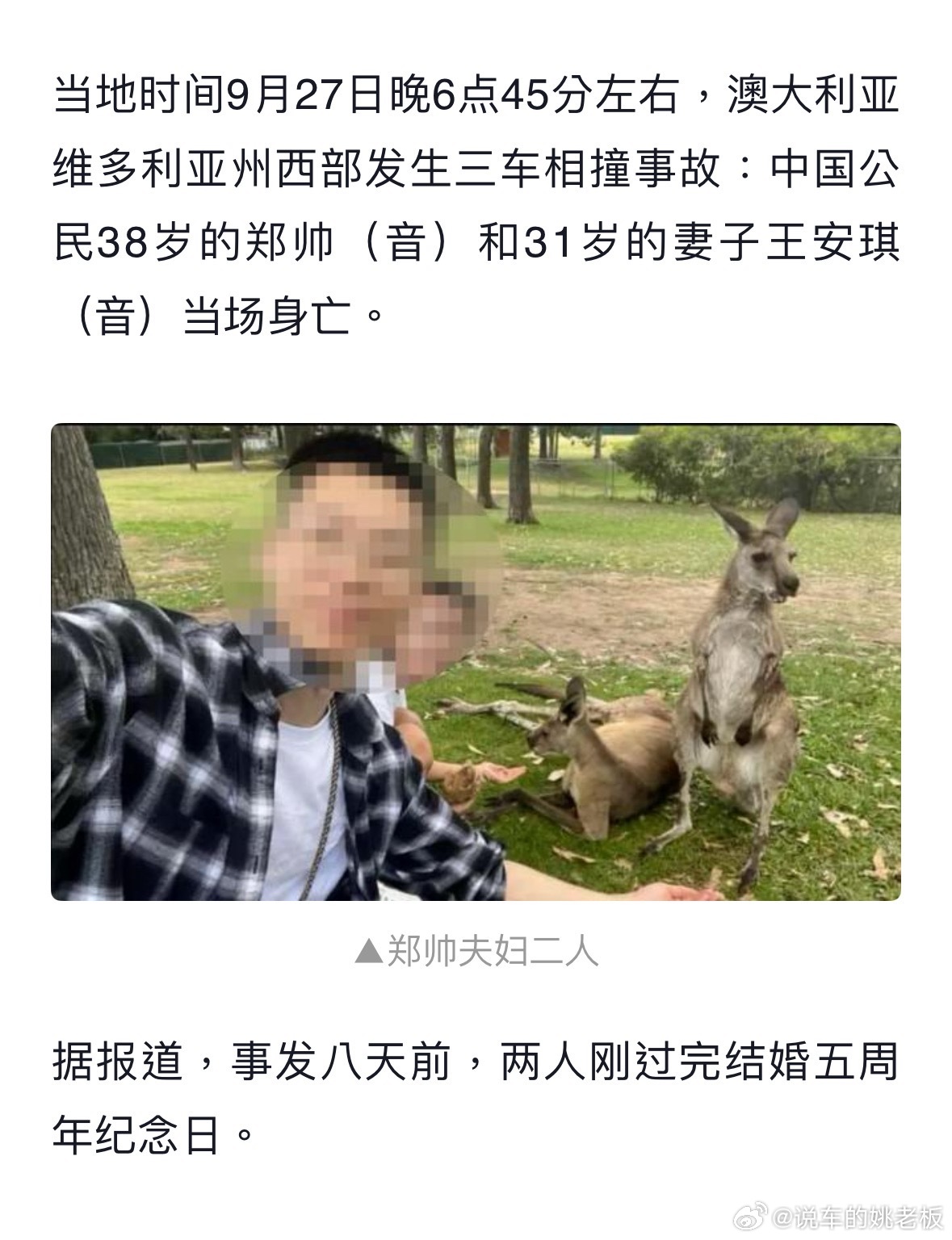
The two were healthcare workers, recently settled in Horsham, a small city in Victoria's west, and eight days before the crash they had marked their fifth wedding anniversary. On the evening of September 27, Zheng Shuai, 38, and his wife Wang Anqi, 31 — both Chinese citizens who had just received Australian permanent residency — died at the scene of a three-vehicle collision on the Western Highway. The details, reported by Red Star News and widely reposted on Weibo, turned a foreign road statistic into a trending topic in China, charting under two separate hashtags in a day.
The other vehicle was a Mitsubishi Triton ute. Its driver was 17, on a learner plate. A 14-year-old passenger in the ute, reportedly a teenage volleyball player, was flown to hospital by helicopter and later died; an 11-year-old girl was lightly injured and a 43-year-old woman unhurt, as was the 29-year-old truck driver. Victoria Police's major-collision unit is investigating and has appealed for dashcam footage.
It is the stretch of road that gave the story its second life. The Western Highway between Ballarat and Stawell is, by traffic volume, Australia's busiest single-carriageway highway, and the figures now circulating in Chinese coverage are stark: one official project page counts 158 crashes and 22 deaths on the Ballarat–Stawell section in recent years; another count records 174 crashes and 16 deaths between 2015 and 2024. In Australia's road-safety rating system, the unupgraded Buangor–Ararat stretch scores one to two stars out of five, the lowest band, and is classified as extremely high risk.
That risk has a political history. A fatal crash near Buangor in March 2025 prompted a residents' petition to fast-track the duplication works; a five-car pile-up near Ararat that May killed three. Federal MP Dan Tehan said last October: "Since the federal government promised 360 million Australian dollars in 2019, the duplication hasn't even reached Ararat. This is not about convenience, it is about saving lives." The Victorian government says the 12-kilometre design for the Buangor–Ararat section has cleared its Aboriginal cultural-heritage approvals and is moving towards construction preparation — decades after the widening was first promised, with works still to begin.
In Horsham, neighbours described a couple who were "kind, quiet and friendly." Zheng had recently told a friend he had been promoted to manager of a local dental clinic; the couple's new house was nearly finished and, according to one detailed account posted on Weibo, they had been preparing to try for a baby. Their poodle, Huasheng — "Peanut" — keeps recurring in the coverage: it is the detail that makes the loss legible to strangers.
The story has travelled well beyond one town's grief: Baidu's hot list carried it at number 40, beside the day's sports and politics items, and the discussion under it has fixed as much on the road as on the crash. Victoria Police's major-collision unit is still seeking dashcam footage.