China Executes Gang Leader as 1,750 Moutai Bottles Fetch $520,000 at State Auction, Spotlighting Anti‑Crime Crackdown
In a courtroom in the coastal city of Zhanjiang, Guangdong Province, a case that began with a stash of rare liquor has turned into a stark illustration of China’s ongoing crackdown on organized crime. At the centre of the story are 1,750 bottles of Kweichow Moutai – the nation’s most coveted baijiu – and the fate of one of the men who once owned them.
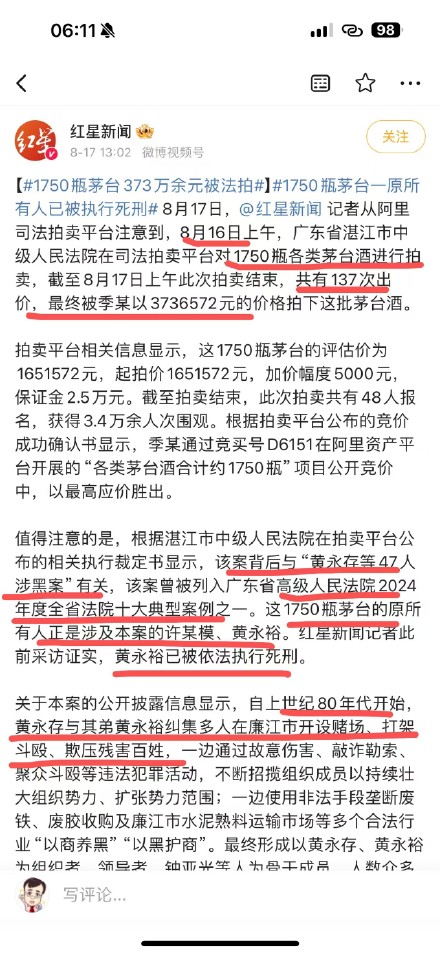
The bottles were seized in 2022 as part of a sweeping investigation into a 47‑person gang led by brothers Huang Yongyu (黄永裕) and Huang Yongcun (黄永存). The two siblings had built a shadowy syndicate in the 1980s that allegedly trafficked counterfeit goods, laundered money and used high‑value luxury items – including Moutai – as a form of “black gold.” When the police finally cracked the case, the authorities confiscated not only cash and property, but also a cellar of the prized spirit that had been hoarded as both a status symbol and a financial safe‑hold.
The Zhanjiang Intermediate People’s Court took charge of disposing of the liquor through a judicial auction hosted on Alibaba’s Ali Judicial Auction platform. The auction opened at 1.65 million yuan (about US$230,000) and closed at 3.73 million yuan (roughly US$520,000), more than doubling the initial bid and underscoring the enduring market appetite for Moutai even under the shadow of criminal provenance.
What makes the sale especially noteworthy is the fate of one of the original owners, Huang Yongyu. In a separate criminal trial, Huang was convicted of leading the gang’s illicit activities and was sentenced to death. The execution, carried out in early 2024, was confirmed by local media outlet Hongxing News, which also interviewed officials and victims to document the case. Huang’s brother, Huang Yongcun, remains in custody pending further sentencing.
Chinese netizens reacted with a mixture of satisfaction and fascination. On Weibo, the platform’s most popular micro‑blogging service, comments coalesced around a few recurring themes. Many users hailed the execution as “justice served,” pointing to the trial as proof that even powerful, well‑connected criminals can be brought down. Others focused on the price of the bottles, noting how a liquor that had once been a covert store of illicit wealth now fetched a public‑market price that surpassed many real‑estate transactions. A smaller, more cautious voice warned that authenticity could be an issue in judicial auctions, where the chain of custody is often murky and counterfeit bottles could slip through.
The episode has resonated far beyond the confines of Zhanjiang. For the luxury‑goods market, it serves as a reminder that even the most prestigious brands can become entangled in illegal schemes. Industry observers note that while Moutai itself is not implicated in wrongdoing, the incident may push manufacturers and distributors to tighten due‑diligence procedures, ensuring that their product does not become a conduit for money laundering or other crimes.
From a societal standpoint, the case reinforces the Chinese government’s narrative of an uncompromising anti‑corruption and anti‑organized‑crime campaign. By publicly seizing and auctioning the gang’s assets, authorities demonstrate that illicit gains can be stripped away and redirected into legal channels, potentially to compensate victims or fund public projects. The visible punishment of a gang leader with the death penalty, coupled with the disciplining of former public‑security officials linked to the case, sends a clear signal that the campaign, launched under President Xi Jinping, remains vigorous.
Politically, the episode illustrates how the state leverages high‑profile prosecutions to bolster legitimacy and social stability. In a nation where the rule of law is often perceived as uneven, the transparent handling of the Moutai auction and the swift execution of a convicted gang boss provide a tangible example of the government’s capacity to enforce order and punish wrongdoing. Analysts suggest that such displays are intended to reassure the public that the party’s “zero‑tolerance” stance on corruption is more than rhetoric.
As the final bidder lifted the winning gavel, the 1,750 bottles of Moutai changed hands from the shadow economy to a legal market, their liquid contents now a symbol of both the intoxicating allure of wealth and the bitter aftertaste of justice. The story of “the original owner of 1,750 bottles of Moutai has been executed” continues to circulate online, a reminder that in China’s relentless pursuit of a cleaner, more orderly society, even a bottle of spirit can become a barometer of the state’s power.