China Fires Back at Japan Over Taiwan Exercises Amid Escalating Tensions
The recent diplomatic spat between China and Japan has been sparked by China's joint military exercises around Taiwan, which Japan has expressed "serious concerns" about. On April 1, Japanese Chief Cabinet Secretary Hirokazu Matsuno stated that Japan's government is closely watching the situation and has conveyed its concerns to China through diplomatic channels. This move has prompted a strong reaction from China, with the Chinese Foreign Ministry stating that Japan has "no right to make irresponsible remarks" and "must not interfere" in China's internal affairs.
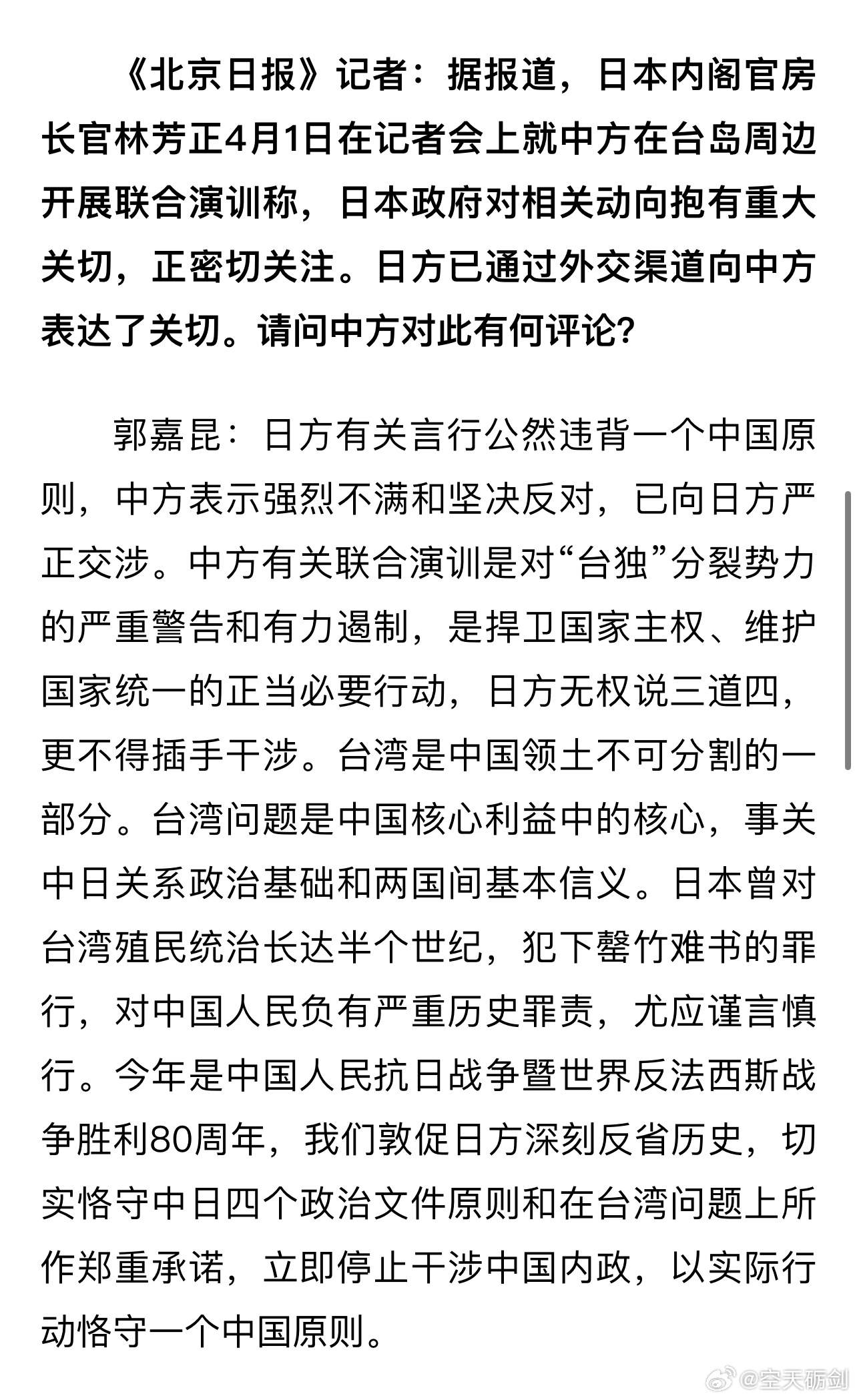
The Chinese Foreign Ministry spokesperson, Wang Wenbin, has emphasized that the joint military exercises are a "serious warning and deterrent" to the "Taiwan independence" separatist forces and are a necessary measure to defend national sovereignty and maintain national unity. Wang also reminded Japan of its historical responsibilities, noting that Japan had colonized Taiwan for half a century and committed numerous atrocities, and therefore should "exercise restraint" and "respect China's core interests". The tensions between China and Japan have been escalating in recent years, with the two countries having competing claims in the East China Sea and differing views on Taiwan's status.
The Chinese government has been consistent in its stance that Taiwan is an integral part of China and that any attempts to separate it from the mainland would be met with force. Japan, on the other hand, has been strengthening its ties with Taiwan and has expressed support for Taiwan's participation in international organizations. The current diplomatic row between China and Japan has significant implications for regional stability and the future of China-Japan relations. As the 80th anniversary of the Chinese People's War of Resistance Against Japanese Aggression and the World Anti-Fascist War approaches, China is urging Japan to "deeply reflect on history" and "abide by the principles of the four political documents" and "stop interfering in China's internal affairs" in order to maintain a stable and healthy development of bilateral relations.
China's response to Japan's concerns reflects its firm stance on the Taiwan issue and its commitment to defending its sovereignty and territorial integrity. The Chinese government has emphasized that the Taiwan issue is a core interest of China and that any attempts to separate Taiwan from the mainland would be met with force. China has also lodged a formal complaint with Japan over its comments on China's military exercises near Taiwan, which China views as a blatant violation of the one-China principle. The Chinese Foreign Ministry spokesperson has urged Japan to reflect on its history, adhere to the one-China principle, and stop interfering in China's internal affairs.
The tensions between China and Japan have a complex and deep-seated history, with roots tracing back to Japan's aggressive expansion and militarism in the early 20th century. Japan's perception of its own history, particularly its account of World War II, has fostered a culture that emphasizes strength and power, influencing its attitude towards China. Historically, Japan's modernization and rise to prominence were achieved by emulating Western powers, which reinforced a value system that reveres might over right. The consequence of this worldview is a predisposition to view China with a mix of disdain and competitiveness.
In the face of Japan's recent comments on China's military exercises near Taiwan, China needs to remain vigilant and continue to defend its national sovereignty and unity, not allowing other countries to interfere in its internal affairs. Meanwhile, China should strengthen international cooperation to isolate Japan's hegemonic ideology and promote regional stability and development. China should also continue to promote the "one China" principle and resolutely oppose any attempts to split the country. The Chinese government has repeatedly emphasized that Taiwan is an integral part of China's territory, and any attempts to separate it from the mainland are doomed to fail.
China should continue to develop its economic and military strength, and enhance its ability to defend its national interests. The country should also strengthen its international cooperation with other countries, especially in the Asia-Pacific region, to promote peace, stability, and prosperity. By taking a firm stance on its core interests and promoting international cooperation, China can ensure its national security and development, and make greater contributions to regional and global stability. Ultimately, the situation highlights the complexities of the China-Japan relationship and the ongoing tensions between the two nations, with implications for the broader regional security landscape.