Chinese Scientists Built the First Nuclear Optical Clock, Putting the Pendulum Inside the Atom
A Chinese team has built and run the world's first nuclear optical clock, using a rare isotope of thorium and a purpose-built ultraviolet laser, and published the result in Nature — a milestone that moves precision timekeeping from the atom's electrons into its nucleus.
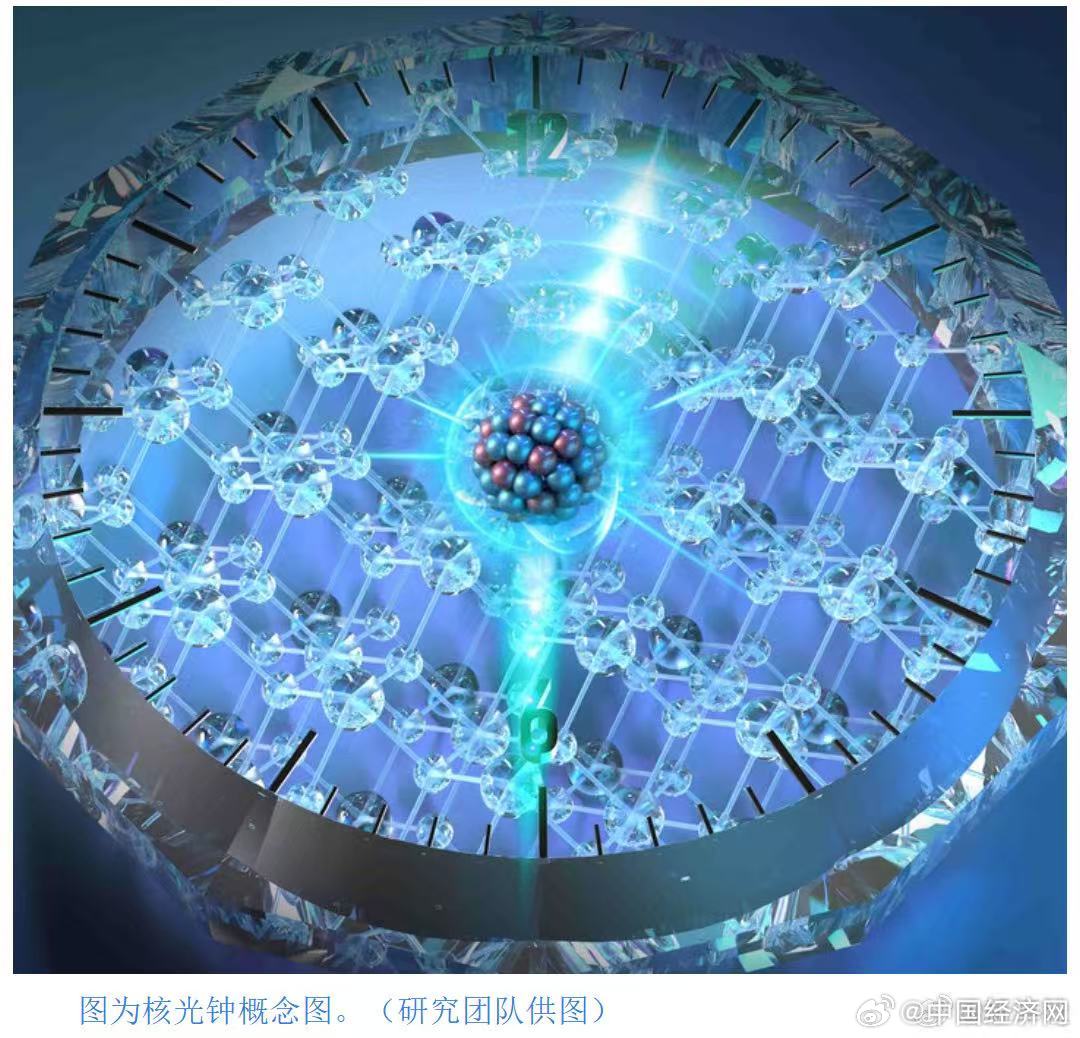
China's scientists have switched on a new kind of clock. A Chinese team announced on October 7 that it had built the world's first nuclear optical clock and run it stably, publishing the result in Nature the same evening — the outcome of a problem researchers worldwide have circled for two decades.
Every precise clock counts something that repeats at a rock-steady frequency, and atomic clocks count the jumps electrons make between energy levels inside an atom. They are the most accurate timekeepers humanity possesses, underpinning GPS, telecom networks and the definition of the second itself. A nuclear optical clock moves the counting one level deeper: into the atomic nucleus. The Chinese team's device drives a transition inside the nucleus of thorium-229, a rare radioactive isotope, using a self-developed continuous-wave vacuum-ultraviolet laser at 148 nanometres, and pairs it with a high-quality calcium fluoride crystal doped with thorium-229. State-media coverage put the distinction in a phrase: an atomic clock "listens to the electrons' beat," while the nuclear clock puts the pendulum inside the nucleus.
Why go to the trouble? Nuclei are far more sheltered from the outside world than electron clouds — stray electric and magnetic fields disturb them much less — so a nuclear clock could keep time even more stably, and could also serve as a probe for physics beyond the reach of ordinary clocks: testing whether the constants of nature drift, and improving deep-space navigation. Zhai Hui, a physicist at Tsinghua University who was not part of the team, called the success an important breakthrough in quantum precision measurement this century, opening a new direction by extending quantum control to the scale of the nucleus.
The engineering behind it was the hard part. The 148-nanometre laser sits in a wavelength band that is brutally difficult to produce as a continuous wave; thorium-229 is scarce and awkward to handle; and the team grew a usable crystal from a tiny quantity of the isotope. Chinese science writers on Weibo dwelt on exactly this — one noted that the achievement had none of the drama of a headline launch, just "patience, details, grinding, and a long stretch of being ignored by everyone."
The story broke out of the science press almost immediately: it charted on Baidu's hot-search board within hours and was carried by CCTV's news service the following morning — rare saturation for a physics result with no product attached.
The clock is a first of the stable-operation kind, and its builders and rivals alike will now race to sharpen its accuracy toward the level atomic clocks have reached. If it gets there, the practical dividends would arrive first in navigation and deep-space missions — and, physicists argue, in a stricter test of what the universe's fine print actually says. The world's most demanding users of time — the laboratories that define the second — now have a new instrument to argue over.