As Pupil Numbers Fall, China Is Moving Primary School Teachers Up to Junior High
School districts across China are transferring surplus primary school teachers to junior high and building convertible 'tidal schools' as the fall in births works its way up the education system. Commenters want to know why the spare teachers can't simply be used to shrink class sizes instead.
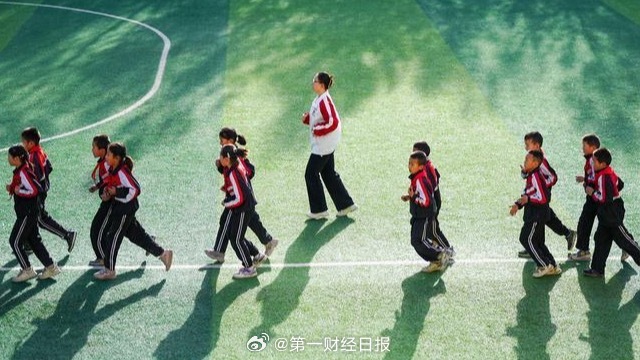
The first domino was the kindergarten; the next ones are moving up the school system. China's Ministry of Education has warned that the country's changing school-age population demands a re-allocation of teachers and classrooms, and local districts are responding. As the news site Yicai tallied this week, school systems in Tianchang in Anhui province, Linquan County, and Longyan in Fujian have all published notices this summer selecting primary school teachers — priority to those who once taught older grades — to move up to junior high. Last year, Changting County, Fengcheng in Jiangxi, and Ezhou in Hubei did the same. The hashtag "primary school teachers in many places transferring to teach junior high" (多地小学老师转教初中) reached Baidu's hot board, alongside a companion phrase: "tidal schools."
The logistics are an arithmetic of demographic waves. The children born in China's last mini-baby-boom are still filling junior high classrooms, but the birth rate's long slide has already emptied the grades below: primary enrolments are falling fast enough that some districts declare a primary teaching corps "surplus" just as junior high reports a shortage. Rather than lay off one set and hire another, districts are re-deploying — a cheap solution if the wave holds its shape, and an awkward one for the transferred teachers, who must relearn a curriculum and a temperament that older pupils demand.
The more ambitious experiment is architectural. In Yiwu, the export-manufacturing city in Zhejiang, two "tidal schools" (潮汐学校) open this autumn: campuses built from the start to convertible specifications, planned to high-school building standards with room held in reserve, so that the same buildings can absorb a junior-high surge now and flip to senior-high use when that wave arrives. The name borrows from the tide table — capacity that rises and falls with the demographic water level — and it answers a question now facing every growing suburb: how to add seats today without building schools that stand empty a decade from now.
The discussion under the Yicai report turned quickly on a different use for all that surplus staffing. "Could class sizes just be reduced instead?" one widely shared post asked, laying out the case that China's real problem is not too many teachers but too many pupils per teacher: average classes of roughly 38 in primary school and 46 in junior high, against OECD norms of 20 to 25, with cost — not pedagogy — as the binding constraint. The post noted that Beijing, Shanghai and Shandong are already piloting smaller classes, that Shandong wants 30-pupil classes to be routine by 2035, and that the current five-year education plan calls for orderly progress toward exactly that. A parent in the replies made it concrete: her first-grader's class has sixty children in it.
The tension the story exposes is fiscal. Small classes spend the demographic dividend on quality; tidal schools and staff transfers bank it. The kindergarten sector already showed what happens when the numbers fall with no plan — buildings closing on their first day of term, as this site covered last month (A Kindergarten Closed on Opening Day) — and young teachers, already declining the least desirable classroom jobs, are watching how their elders get redeployed. Whether the saved money follows the pupils into smaller classrooms, or simply back into the budget, is the question this week's notices did not answer.